How many forms of dissolution of marriage are recognised under Muslim Law ? What is Talaq ? What are its essentials ?
Here we will learn the topic What is Talaq ? What are its essentials of Talaq ? in detail
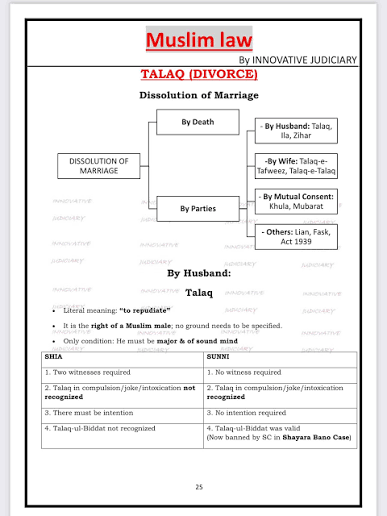
Various Forms of Dissolution of Muslim Marriage
The dissolution of a marriage refers to the legal termination of a Nikah( marriage contract) under Islamic law. Because two willing parties recognize a Muslim marriage as a civil contract, they can terminate it extra-judicially (by themselves) or judicially (by a court decree).
Here we will learn the topic What is Talaq ? What are its essentials of Talaq ? in detail
Dissolution of Marriage
By act of God (Death of husband or wife)
By act of Parties (Divorce)- This type of dissolution is further divided into two types
Here we will learn the topic What is Talaq ? What are its essentials of Talaq ? in detail
(I) Extra-judicial divorce
(ii) Judicial Divorce
(By wife only, under the Dissolution of Muslim Marriage Act, 1939)
(i) Dissolution of marriage under Extra-judicial divorce can be carried out in three ways
(A) By husband
Through (a) Talaq (b) Ila and (c) Zihar
( B) By wife (Delegated Talaq)
(C) By mutual agreement
Through (a) Khula and (b) Mubarat
What is Talaq ?
Talaq is an Arabic word and its literal meaning is ‘to release’ or ‘to set free’. Under Muslim law, Talaq means repudiation of marriage by the husband. As a mode of divorce, Talaq is peculiar because a Muslim husband has an unrestricted right to divorce his wife without giving any reason.
The Muslim concept of divorce is that where it is impossible for the spouses to live together, they must separate peacefully. The law gives the husband an absolute authority to terminate the marriage by pronouncing Talaq because in a society dominated by males, the conjugal happiness primarily depends upon the efforts of the husbands. There is no legal control over the unfettered right of a Muslim husband to dissolve the marriage by uttering a few words. However, an indirect check upon this right is the obligation of a husband to pay the dower upon the dissolution of a marriage.
Essentials of a Valid Talaq
Capacity
Every Muslim husband of sound mind, who has attained the age of puberty, is competent to pronounce Talaq against his wife whenever he likes. It is not necessary for him to give any reason for his pronouncement. This absolute right is given to him by Muslim law itself and does not depend on any condition or cause.
A husband who is minor or is of unsound mind, cannot pronounce Talaq. Talaq by a minor or insane husband is void and ineffective. However, if the husband is lunatic the Talaq pronounced by him during ‘lucid interval’ is valid. The guardian cannot pronounce Talaq on behalf of a minor husband. But according to Tyabji, guardian of a husband of unsound mind, may pronounce Talaq on behalf of such an insane husband if such Talaq is in the interest of the husband. When an insane husband has no guardian, the Kazi or a Judge has the right to dissolve the marriage in the interest of such a husband.
Free Consent
Except under Hanafi law, the consent of the husband in pronouncing Talaq must be a free consent.
Under Hanafi law, a Talaq pronounced under compulsion, coercion, undue influence, fraud or voluntary intoxication etc. is valid and dissolves the marriage.
The Prophet established the basis of this apparently unreasonable Hanafi rule through a tradition in which he said thus: ‘There are three things which whether done in joke or earnest, shall be considered as serious and effectual; the first, marriage, the second, divorce, and the third, taking back.’ Involuntary Intoxication- According to Tyabji, where someone forces a husband to drink some intoxicant (wine) or he takes it as a drug and then pronounces Talaq, the Talaq is not valid even under the Hanafi law. Thus, involuntary or unintentional pronouncement of Talaq is void in all the schools of Muslim law including Hanafi Sunnis. Shia Law – Under the Shia law (and also under other schools of the Sunnis) a Talaq pronounced under compulsion, coercion, undue influence, fraud or voluntary intoxication is void and ineffective.
Formalities Under Sunni Law
(a) According to Sunni law a Talaq may be oral or in writing. Talaq may be simply uttered by the husband or he may write a Talaqnama .
(b) No specific formula or use of any particular word is required to constitute a valid Talaq. Any expression which clearly indicates the husband’s desire to break the marriage is sufficient to dissolve the marriage through. Talaq.
(c) A Talaq whether oral or in writing, need not be made in the presence of the witnesses. Under Sunni law , Talaq without witnesses is valid.
Formalities Under Shia Law
(a) According to Shia laws, the husband must pronounce the Talaq orally, except when he is unable to speak.. If the husband has the capacity to utter the words but gives it in writing, the Talaq is void and ineffective under Shia law.
Shia law requires that the husband pronounce Talaq in the presence of two competent witnesses. Every male Muslim of sound mind, who has attained the age of puberty, can act as a witness. However, in place of one male, two adult female Muslims of sound mind may substitute to act as witnesses. A husband cannot make a Talaq without witnesses or in the presence of incompetent witnesses, as it is void under Shia law.
(c) Shia law requires the use of specific Arabic words in the specific formula in the pronouncement of Talaq.
Express Words
The words of Talaq must clearly indicate the husband’s intention to dissolve the marriage. If Talaq is in express terms, proof regarding the husband’s motive or intention is not necessary. Where the husband clearly uses the word Talaq he cannot say that he did not mean divorce. Gahusi Bivi Vs. Gulam Dastgir, (1968) Mysore L.J. 566.
Presence of Wife
Presence of the wife at the time of pronouncement of Talaq is not necessary. A Talaq pronounced in the absence of the wife is lawful and effective. But where a husband has more than one wife, he must specify and name the wife against whom he is pronouncing Talaq.
Notice of Talaq
The Talaq becomes effective from the moment of its pronouncement and not from the date on which the wife comes to know about it.
Conditional and Contingent Talaq
A Talaq may either be absolute (i.e. unconditional) or subject to a condition or contingency. We call an uncertain future event a contingency, e.g. the child born first is male. Where the Talaq is without any condition it takes effect immediately. A conditional or contingent Talaq becomes effective only upon the fulfilment of the condition or happening of the future event.
Under Sunni law a conditional or contingent Talaq is valid. But the conditions must not be un-Islamic. If a condition is against the principles of Islam., the condition is void and a Talaq cannot take place. For Example-If the condition is that whenever the wife would demand her Prompt Dower there would be Talaq by husband, the condition is void and Talaq does not take place.
Under Shia law, conditional or contingent Talaq is void and ineffective. Even if the condition or contingency is lawful, the Talaq is not valid.