
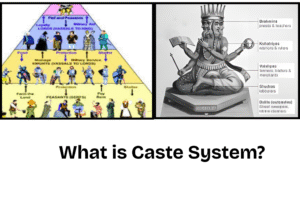
What is Caste System ?Describe in detail the many forms and characteristics of the caste system.
The Caste System’s introduction
The forces of division that plague our country today weaken the ties that bind the Indian people together and have an impact on their progress. Caste has a crucial role in society. The frequent instances of caste confrontation, leading even to occasional outbursts of violence both in urban centers and the countryside force themselves on our attention. The issue of reservation in services and higher educational institutions on a caste basis raises a storm occasionally. When during the election, the political and programmatic appeal does not become the central issue, we witness a rising tide of caste identification and caste animosities.
Here we will learn the topic What is Caste System ? Explain types and features of Caste System in detail
What Caste Means
In India, the caste system is a long-standing social stratification system that divides people into many groups according to their social standing, employment, and place of birth.
In this system, a person’s caste is established at birth and typically doesn’t alter throughout the course of their lifetime. Every caste has its own set of laws, traditions, and social obligations.
Marriage, employment, eating habits, interpersonal interactions, and social standing are all impacted by the caste system.
Scholarly Definitions of Caste
1. Herbert Risley
According to Herbert Risley,
A caste can be described as a group of families that share a name, claim a shared ancestry, work in the same field, and are thought to constitute a single, homogenous society by people who are qualified to make such judgments.
2. Ghuraye, G. S.
According to G. S. Ghuraye,
Caste is a social structure that is marked by hierarchy, prohibitions on marriage and employment, and segmental division of society.
3. M. N. Srinivas
According to M. N. Srinivas,
“Caste is a hereditary, endogamous, and usually localized group having a traditional association with an occupation and a particular position in the hierarchy.”
4. Charles H. Cooley
According to Charles H. Cooley
“When a class is somewhat strictly hereditary, we may call it a caste.”
5. N. K. Dutt
According to N. K. Dutt,
“Caste is a system of social stratification in which membership is determined by birth and fixed for life.”
Here we will learn the topic What is Caste System ? Explain types and features of Caste System in detail
Features (Characteristics) of Caste System
1. Hereditary Membership
2. Social Hierarchy
3. Endogamy
4. Occupational Restriction
5. Social Restrictions
6. Purity and Pollution
7. Segmental Division
Aim of the Caste System
It keep society stable and in order.
They create structured organizations within society.
Caste System control behavior and social interactions.
to continue specializing in one’s line of work.
to maintain religious and cultural customs.
The Caste System’s Goals
to uphold social control and discipline.
to specify each person’s tasks and responsibilities.
to maintain social groups’ purity.
to give status and social identity.
to ensure that traditional occupations continue.
The Caste System’s Functions
1. Social Structure
2. Identity in Society
3. Labor Division
4. Social Security
5. Preservation of Culture
6. Marriage Regulation
The topic of “What is Caste System?” will be covered here. Describe in detail the many forms and characteristics of the caste system.
Types of Caste System
1. Varna System
The traditional four-fold division of society in ancient India.
Brahmins, Kshatriyas, Vaishyas and Shudras
2. Jati System
3. Scheduled Castes (SC)
4. Scheduled Tribes (ST)
5. Other Backward Classes (OBC)
Advantages of the Caste System
1. Division of Labour
2. Social Stability
3. Occupational Specialization
4. Preservation of Culture and Traditions
5. Social Security
6. Regulation of Marriage
Disadvantages of the Caste System
1. Social Inequality
2. Untouchability
3. Restriction on Occupation
4. Lack of Social Mobility
5. Social Division
6. Obstacle to National Unity
Difference Between Caste and Class
| Basis of Difference | Caste | Class |
|---|---|---|
| Meaning | Caste is a closed system of social stratification where status is determined by birth. | Class is an open system of social stratification based on wealth, education, occupation, and achievements. |
| Basis of Membership | Membership is determined by birth and cannot usually be changed. | Membership depends on economic position, education, and social status. |
| Social Mobility | There is no or very limited mobility in caste. A person remains in the same caste throughout life. | High mobility is possible. A person can move from lower class to higher class through education and wealth. |
| Marriage Rules | Endogamy is followed (marriage within the same caste). | There are no strict rules of marriage based on class. |
| Occupation | Occupations were traditionally fixed and hereditary. | Occupations are not fixed and can be chosen according to ability and interest. |
| Social Interaction | There are restrictions on food, social relations, and contact between castes. | There are no strict social restrictions among different classes. |
| Nature | The caste system is rigid and hereditary. | The class system is flexible and open. |
| Example | Brahmin, Kshatriya, Vaishya, Shudra. | Upper class, middle class, lower class. |
9jl is always there for a quick game! Never disappoints when I just wanna unwind. Check it out at 9jl!