
What are the main sources of Mohammedan Law ?
Mohammedan Law is a personal law which is applicable only to Muslims. The law deals with marriage, succession, inheritance and charities among Muslims.
Here we learn the topic What are the main sources of Mohammedan Law ?in detail
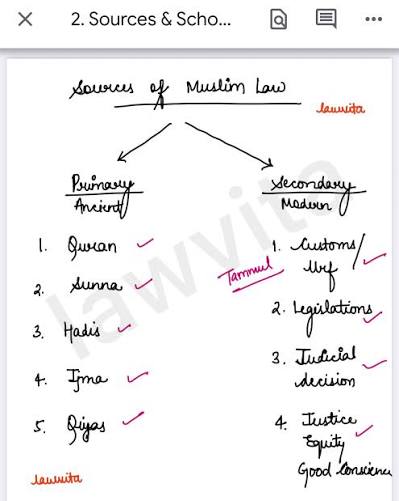
Source of Mohammedan Law
(a) Primary sources
(b) Secondary sources.
Here we learn the topic What are the main sources of Mohammedan Law ?in detail
(a) Primary sources according to Sunni Law –
The primary sources are those which the Prophet himself directed to the sources of Muslim law.
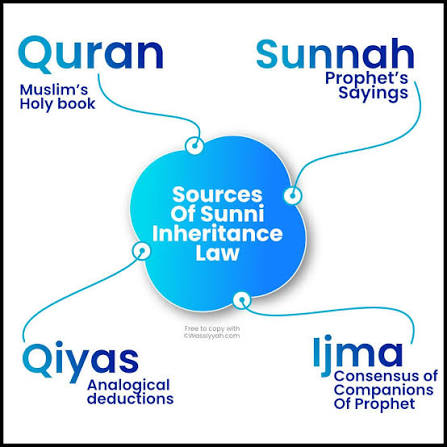
According to Sunni Law, the primary sources are as follows
1. Quran
2. Sunna or Ahadis (Traditions of the Prophet);
3. Ijma (Unanimous decisions of Jurists);
4. Qiyas (Analogical deduction)
Primary Sources According to Shia Law
1. Quran,
2. Traditions (Only those which have come from the Prophet’s family).
3. Ijma
4. Reason (Aql.).
(b) Secondary Sources of Muslim Law
In order to meet the requirements of the society, the local customs, judicial decisions and the Statutes have developed or modified Muslim law. Thus, the Customs, Judicial decisions and Legislations also contain the rules of Muslim law. Scholars call them secondary sources of Muslim law.
Here we learn the topic What are the main sources of Mohammedan Law ?in detail
(a) Primary or main Sources of Muslim Law
1. Quran
The Quran is derived from the Arabic word ‘Qurra’ and ‘the reading’ of ‘that which ought to be read’ is signified properly by it. People believe that the Quran is of divine origin and that God revealed it to Prophet Muhammad for the benefit of mankind. Quran is the first source of Muslim law in point of time as well as in importance. It is the first source in point of time because, before the Quran there was no Islamic society as it exists today. The first revelation (Wahi) came to the Prophet in 609 A.D. Since then the revelations continued to come to the Prophet in fragments during a period of 23 years, till 632 A.D. when the Prophet expired. The revelations were the communications of God and were made by angel Gabriel to the Prophet.
Here we learn the topic What are the main sources of Mohammedan Law ?in detail
Importance or Role of Quran
Quran is such a source of Muslim law which came directly from God. The Prophet received a revelation for the socio-religious reform of the Arabian society of that time, and therefore we may find solutions to almost all the problems of that society. The Quran is in the form of verses. Every verse in Muslim law is called “Ayat”. The Quran contains 6237 verses in 114 chapters. The Quran is a mixture of religion, law and morality.
Here we learn the topic What are the main sources of Mohammedan Law ?in detail
2. Sunna or Ahadis (Traditions of the Prophet) –
All the preachings and the practices of the Prophet (except when direct revelations from God used to come) formed part of Sunna. What the Prophet said, what he did and also his silence in questions put before him, was all taken to be authoritative and become a precedent.
Traditions as a source of Muslim law, consists of :-
(i) Sunnat-ul-Qual (words spoken) which means the utterances or the sayings of Prophet Mohammad;
(ii) Sunnat-ut-Fail (conduct) which includes the doings of the Prophet i.e. his behaviour; and
(iii) Sunnat-ul-Taqrir (silence)
Silence amounted to implied consent or approval of a rule of law.
The preachings and precepts could become an authoritative source of law when some competent and qualified person called Narrator, had narrated it.
Kinds of Traditions
From the point of view of their authority and acceptance in the society, traditions may be classified as under
(i) Ahadis-i-Mutwatir (Universally accepted Traditions) –
They are the traditions which have continuously been narrated by an indefinite number of persons. They are most authoritative because there is no doubt in their genuineness and certainty. These traditions have universal acceptance and are followed by all the sects of Islam.
(ii) Ahadis-i-Mashhoor (Popular Traditions) –
Traditions, which have been narrated by some Companions of the Prophet but subsequently accepted by the majority of the people, are called Ahadis-i-Mashhoor.
(iii) Ahadis-i-Ahad (Isolated Traditions) –
Only a certain section of the society has accepted them as a source of law. Traditions are narrations of law and religion which communicate from one generation to another and hence become the practices in the society.
3. Ijma (Unanimous Decisions of Jurists) –
When Quran and traditions could not supply any rule of law for a new problem, the ‘law-knowing persons’ used to agree unanimously and gave their common opinion over that point.
Persons having knowledge of law were called Mujtahids (Jurists).
Such consensus opinion or unanimous decision of the jurists was termed Ijma, and is the third primary source of Muslim law.
According to Abdur Rahim, the jurists among the followers of the Prophet Mohammad in a particular age may agree on a particular question, defining Ijma. This source of Muslim law has played a very important role in the subsequent development of Muslim law because, through Ijma it was possible to lay down new principles of law in accordance with the changing needs of the Islamic society. Validity of Ijma as a source of Muslim law is based on a tradition of the Prophet. The decision-makers also took public policy, the interest of the community, and equity into account as the basis for a new explanation of law.
Importance or Role of Ijma.
It may be noted that Quran and traditions provided adequate guidance only for the past and not for the future society. Fyzee rightly observes-“Quran and Sunna look to the past; consensus and Qiyas deal with the future of Islamic jurisprudence. In fact a major portion of the positive Muslim law (Fiqh) came through Ijma As a source of law the importance of Ijma is two fold
Firstly, jurists reached consensus opinions that enabled further explanation and clarification of the Quran and traditions, and secondly, they formulated new principles of law, not found in the words of the Quran or the traditions, according to the changing needs of society.
Quran and Traditions being rigid, no change was possible in their words. But Ijma had opened the doors for new interpretations of Islamic legal rules. Ijma has rightly been termed as a ‘movable element in law’.
4. Qiyas (Analogical Deduction) –
In the Arabic language Qiyas means ‘measurement’. In other words, it means measuring or comparing a thing in relation to a standard, or ‘to establish an analogy’. If there was only problem before the society on which the texts (Quran, Sunna and Ijma) were silent then Qiyas was applied to get the law. The researchers used a method of comparing the problem of society with a similar problem for which they provided a solution in the texts. According to Wilson, “Qiyas as an analogical deduction from the reason of a text to a case not actually covered by its language.”
In obtaining a law through Qiyas, the following methods were applied by the jurists-m available in the text.
(b) After establishing the analogy, someone applied the solution of the problem given in the text to the new problem. Thus, scholars directly deduced the required law from the texts of Quran or Sunna or the Ijma. It is significant to note that in this method no one formulated new principles. The researchers simply discovered the law from the spirit or the implied meaning of the text.
It may be noted that the Shia sect does not recognise Qiyas as a source of law.
Here we learn the topic What are the main sources of Mohammedan Law ?in detail
( b) Secondary Sources
Secondary sources are as under
Custom (Urf or Taamul) –
When Islam came into existence, the Prophet found most of the customs to be evil and bad. He totally abolished such bad customs and declared them to be un-Islamic. But there were certain pre-Islamic customs (e.g. dower, talaq etc.) which were good and tolerable. The Prophet did not abolish them, and they continued in the society because the Prophet sanctioned them by his silent approval. In this manner some of the good customs became a
part of the traditions of the Prophet i.e. Sunnat-ul-taqrir.
Importance or Role of Custom
Although custom is not any formal source yet, one cannot underestimate its importance in Muslim law. In the absence of a rule of law in the texts of any of the four primary sources, legal scholars have regarded the customary practices as law.
The four formal sources namely, Quran, Sunna, ljma and Qiyas being fundamental sources, could not include minute details in respect of certain matters.
In such specific cases the customs and usages became a rule in order to complete the law. Therefore, they have used the customary law to supplement the four primary sources of Muslim law. British courts in India had on several occasions recognized the legal force of customs and usages. Those courts have made the maximum use of customary practices in respect of Muslim law and recognized a custom even if it opposed a clear text of a primary source. For Example-In Abdul Hussein V. Sona Dero, (1917) 45 IA 10, the Privy Council observed that if proved, a custom would prevail over a written text of law provided that custom was ancient and invariable.
2. Judicial Decisions
Judgment of a superior court becomes an authority for the courts subordinate to it.
The subordinate courts must follow the law laid down in that decision.
This is called the principle of precedents and the courts in India follow it on the pattern of the British courts.
Thus, a judicial decision of the Supreme Court of India is binding on all the High Courts in so far as the law decided in that case is concerned.
Similarly, the decision of a High Court is binding on the subordinate courts. Muslim law is no exception to this judicial practice and therefore, a point of law decided by the Supreme Court or a High Court of India becomes a ‘source of law’ for the courts subordinate to them. Although there is not much scope for the judicial decisions or Precedents as a source of Muslim law yet, in the absence of any clear text of Muslim law, the courts may interpret a rule of law according to their own concepts of justice. In such cases, the Muslim law becomes what the courts say. For Example-Generally the taking of interest in a loan is prohibited in Islam, but the Privy Council allowed simple interest on the amount of unpaid dower. The realisation of interest on unpaid dower has now become a rule of Muslim law through precedent.
Importance or Role of Judicial Decision –
Judicial decisions have played an important role in laying down rules of Muslim law in accordance with the socio-economic conditions of the Indian Muslims.
In Begum Subanu Vs. Abdul gafoor, A.I.R. 1987, S.C.1103, the Supreme Court held that despite the fact that a Muslim husband has the legal right to contract a second marriage, if the first wife lives separately only because of the husband’s second marriage, he must provide her with maintenance.
S1987 of the Dissolution of Muslim Marriages Act, .
1103 provides eight grounds on the basis of any one of which a wife may seek dissolution of her marriage.
Cl. (ix) of this Act provides, ‘any other ground recognised under Muslim law’. Under this clause, the Indian courts would pass a decree of dissolution on the ground of ‘false charge of adultery by husband against wife’ (Lian) because this ground is not included specifically. But, in Muhammad Usman Vs. Sainba Umma, A.I.R1987, the Kerala High Court held that S. 1103(ix) is a ‘residuary clause’ under which the court may, at its discretion, dissolve the marriage on any ground if it is satisfied that the dissolution is necessary in the case. The law of pre-emption is an important example where judicial decisions have modified the rules of pure Muslim law according to the changing needs of the Indian Muslims.
3. Legislation
In Islam, people generally believe that God alone is the Supreme Legislator and no other agency or body.
earth has authority to make laws. This belief is so deep-rooted that even today, any legislative modification may treat as an encroachment upon.
the
traditional Islamic law.
However, there are following Acts which modify or otherwise lay down principles of Muslim law, and for the modern courts
In India, these enactments serve as the only source of law on the points they cover.
(i) The Mussalman Waqf Validating Act, 1913-This Act re-establishes the validity of Waqf-al-al-aulad (family waqf).
(ii) The Child Marriage Restraint Act, 1929
To some extent this Act modifies the Muslim law regarding the age of marriage. The Act, (as amended by the Act of 1978) provides that the marriage of a boy under the age of
21 years and of a girl under 18 years, is a ‘child marriage’ and is punishable. Under Muslim personal law the age for the marriage is fifteen years. However, a marriage against the provisions of this Act is perfectly valid.
(iii) The Muslim Personal Law (Shariat) Application Act, 1937
This enactment confirms the general principle of Muslim jurisprudence that customs have no place in Muslim law.
(iv) Dissolution of Muslim Marriages Act, 1939
This is the only enactment that can be said to have modified the pure.
Muslim law. Under this Act, a Muslim wife can obtain a judicial divorce on any of the grounds mentioned in
it. Under pure Muslim law a wife had no independent right to seek divorce.
(v) Muslim Women (Protection of Rights on Divorce) Act, 1986-In Shah Bano’s case the Supreme Court held that U/S. 125 Cr. P.C125 her former husband must provide maintenance to a divorced Muslim woman even beyond the period
of Iddat. Under this Act, a divorced Muslim wife can receive maintenance only during the period of Iddat
Here we learn the topic What are the main sources of Mohammedan Law ?in detail

Fellow Filipinos, registering for Plus777 here in the Philippines is easier than ever. Just go to plus777registerphilippines. Legit and hassle-free para sa ating lahat!