
Law’s of Inheritance in Muslim Law
Here we will learn the topic Law’s of Inheritance in Muslim Law in detail.
Law’s of Inheritance in Muslim Law
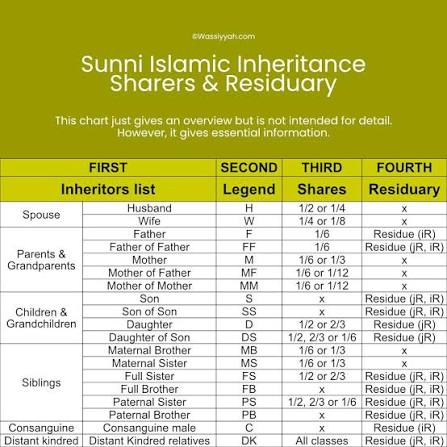
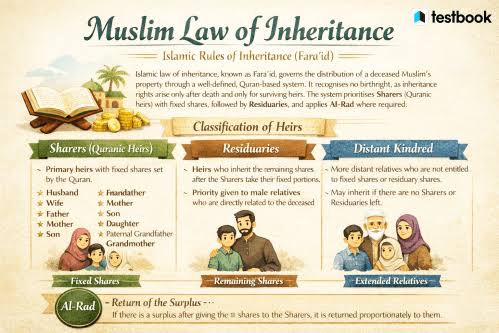
Muslim inheritance law (derived directly from the Qur’an, Hadith, and Fiqh ) dictates fixed, mandatory shares for specific relatives. It strictly prohibits the concept of birthright or ancestral property, applies only upon the deceased’s death, and caps testamentary wills (Wasiyat) to a maximum of one-third of the total estate.
General Principles of the Muslim Law of Inheritance
Under Muslim Law the general principles of inheritance are as under
Here we will learn the topic Law’s of Inheritance in Muslim Law in detail.
Nature of the Heritable Property
After the death of a Muslim, his properties are utilised for the payment of funeral expenses, debts and the legacies ie. wills, if any. After these payments, the remaining property is called heritable property. Under Muslim law, every kind of property may be a heritable property. For the purposes of inheritance, Muslim law does not make any distinction between corpus and usufruct or, between movable and immovable, or, corporal and incorporol property. Thus, any property, which was in the ownership of the deceased at the moment of his death, may be the subject-matter of inheritance.
Shia law
Under Shia law, a childless widow receives her share (1/4) in the inheritance only from the movable property her deceased husband left behind.
Joint or Ancestral Property
Muslims do not know the concept of a joint family or a coparcenary property. When a Muslim dies, his heirs inherit his properties in definite shares, with each heir becoming an absolute owner. Subsequently, when such heirs die, their legal heirs inherit their properties, and this process continues. Thus, unlike Hindu law, Muslim law does not provide for any ancestral or joint-family property. Muslims regard all properties, whether they themselves acquired them or their ancestors inherited them, as individual property, and their legal heirs may inherit them.
Law’s of Inheritance in Muslim Law
No Birth-Right
Unlike Hindu law, the Muslim law of inheritance does not ‘recognise the concept of ‘ right by birth’. Under Muslim law, an heir does not possess any right at all before the death of an ancestor. As a matter of fact, unless a person dies, his relatives are not his legal heirs; they are simply his
heir-apparent and have merely a ‘chance of succession’.
Law’s of Inheritance in Muslim Law
Doctrine of Representation
These systems of laws recognise the doctrine of representation as a well-known principle in Roman, English, and Hindu laws of inheritance. Under the principle of representation, which these systems of laws recognise, the son of a predeceased son represents
his father for purposes of inheritance. But, Muslim law does not recognise the doctrine of representation. Under Muslim law, the nearer excludes the remoter. If there are two heirs who claim inheritance from a common ancestor, the heir who is nearer (in degree) to
the deceased, would exclude the heir who is remoter.
Law’s of Inheritance in Muslim Law
Per-Capita and Per-Strip Distribution
Succession among the heirs of the same class but belonging to different branches, may either be per-capita or per-strips.
In a per-capita distribution, the succession is according to the ‘number of heirs’ (i.e. heads).
The estate divides equally among them; therefore, each heir receives an equal quantity of property from the heritable assets
of the deceased.
On the other hand, in a per strip distribution, the several heirs who belong to different branches, get their share
only from the property which is available to the branch to which they belong.
Under Sunni law, the distribution of the assets is per-capita.
That is to say, an heir does not in any respect represent the branch from which he inherits.
Shia law- Under the Shia law, if there are several heirs of the same class but they descend from different branches, the distribution among them is per strip. That is to say, the quantum of property inherited by each of them depends upon the property available to that particular branch to which they belong.
Law’s of Inheritance in Muslim Law
Female’s Right of Inheritance
Upon the death of a Muslim, if his heirs include also the females then, male and female heirs inherit the properties simultaneously. Males have no preferential right of inheritance over the females, but normally the share of a male is double the share of a female. In other words, although there is no difference between male and female heirs in so far as their respective rights of inheritance is concerned but generally the quantum of property inherited by a female heir is half of the property given to a male of equal status (degree).
A Child in the Womb
A child in the womb of its mother is competent to inherit provided it is born alive.
People regard a child in an embryo as a living person and, as such, the property vests immediately in that child. But, if such a child in the womb is not born alive, the share already vested in it is
divested and, it is presumed as if there was no such heir (in the womb) at all.
Primogeniture
Primogeniture is a principle of inheritance under which the eldest son of the deceased enjoys certain special privileges. Muslim law does not recognise the rule of primogeniture and all sons are treated equally. However, under the Shila law, the eldest son has an exclusive right to inherit his father’s garments, sword, ring and
the copy of Quran, provided that such eldest son is of sound mind and the father has left certain other
properties besides these articles.
Step-Children
The step-children are not entitled to inherit the properties of their step-parents. Similarly, the step-parents too do not inherit from step-children. However, the step-brothers (or sisters) can inherit each other’s properties.
Simultaneous Death of Two Heirs
When two or more heirs die simultaneously and one cannot establish who died first, Muslim law presumes that all the heirs died at one moment. Consequently, such heirs do not exist; the inheritance opens omitting these heirs.
Missing Persons
According to the texts of Hanafi law, a missing person could only become dead after ninety years from the date of his birth; till then the inheritance of his properties did not open. But, now S. 108 of the Indian Evidence Act, 1872 has superseded this rule. Thus, where a Muslim has been missing for at least seven years and if one could not prove that he (or she) was alive then, the law legally presumes that person dead and the inheritance of his (or her) properties opens.
Escheat
Where a deceased Muslim has no legal heir under Muslim law, the Government inherits his properties through the process of escheat. The state regards itself as the ultimate heir of every deceased.
Marriage under the Special Marriage Act, 1954
Where a Muslim contracts his marriage under the Special Marriage Act, 1954, he ceases to be a Muslim for the purposes of inheritance. The inheritance of the properties of such Muslims are governed by the provisions of the Indian Succession Act, 1925.
Difference Between Sunni and Shia Law of Inheritance
| Inheritance Under Sunni Law | Inheritance Under Shia law |
| (i) There are three classes of heirs, namely sharers, residuaries and distant kindred. | (i) There are only two classes of heirs, sharers and residuaries i.e. heirs by consanguinity and heirs by marriage. |
| (ii) The sharers, exclude residuaries, and residuaries exclude the distant kindred. | (ii) Under Shia Law the first excluding the second from inheritance. |
| (iii) The Sunni Law does recognise any right primogeniture. not | (iii) The Shia Law recognises of primogeniture to some extent. Thus, the eldest son is entitled to his deceased father’s sward, wearing apparel and Quran. |
| (iv) The Sunni Law restricts recognition of the doctrine of representation to a few cases. | (iv) In Shia Law it is the cardinal principle of succession. |
| (v) Without exception, homicide is a bar to succession in Sunni Law. | (v) Under Shia Law homicide is a bar only if it is intentional. |
| (vi) Both husband and wife can take by return, i.e., where there is residue. | (vi) Only the husband is entitled to return and not the wife. |
| (vii) The doctrine of increase extends to all sharers alike. | vii) Doctrine of increase applies only to the daughter and sister. |
