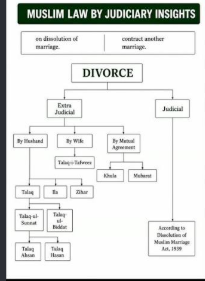
Describe and explain the various grounds on which Muslim wife can obtain a decree of dissolution of marriage from the court of law.
Describe the various grounds of Decree
Prior to the passing of Dissolution of Muslim Marriages Act 1939, the British Courts had denied to Muslim women the rights of dissolution available to them under the Shariat .
The wife could apply for the dissolution of her marriage only on the following grounds –
(a) Impotency of the husband,
(b) Lian and
(c) Option of puberty (Khyar-ul-bulugh).
Finding no other way to get rid of this marital tie, the Muslim wives were compelled to renounce their faith.
Describe the various grounds of Decree
Here we will learn the topic Describe the various grounds of Decree
But now, the Dissolution of the Muslim Marriage Act, 1939 has introduced a revolutionary change in this respect and had restored to her, right of divorce granted to her under Shariat.
Describe the various grounds of Decree
Section 2 of the Dissolution of Muslim Marriage Act, 1939 provides following nine grounds under which a Muslim wife can obtain a decree for the dissolution of her marriage
Describe the various grounds of Decree
Absence of Husband
Describe the various grounds of Decree
If a woman married under Muslim law does not know her husband’s whereabouts for a period of four years, a decree for the dissolution of her marriage shall be obtained by her; however, the decree will not take effect for a period of six months from the date of such decree; and if the husband appears either in person or through an authorized agent within that period and satisfies the court that he is prepared to perform his conjugal duties, the said decree must be set aside by the court.
Describe the various grounds of Decree
Failure to Maintain
If the husband has neglected or has failed to provide for her maintenance for a period of two years, a married Muslim woman can obtain a decree for the divorce.
Describe the various grounds of Decree
In Mrs Nur Bibi Vs. Pir Bux, A.LR. 1950 Sind,
The Sind High court held that where a husband has failed to provide maintenance for his wife for a period of two years immediately preceding the suit, the wife would be entitled to a dissolution of her marriage under S. 2 (ii) of the Act in spite of the fact that on account of her conduct in refusing to live with her husband, she would not have been entitled to enforce any claim for maintenance against the husband in respect of the period during which the husband has failed to maintain her.
Describe the various grounds of Decree
Imprisonment of Husband
If the husband receives a sentence of imprisonment for seven years or more, the wife may petition the court to dissolve her marriage, but the court cannot grant this decree unless the sentence becomes final. (Section. 2 (iii) read with provision (a).
Failure to Perform Marital Obligation
When the husband fails to perform his marital obligations without reasonable cause for a period of three years, the wife can dissolve her marriage by means of a decree.
Impotency of Husband
If the husband was impotent at the time of the marriage and continues to be so, the wife may seek judicial divorce to dissolve her marriage. Before passing a decree on this ground, the court shall, on the application by the husband, make an order requiring the husband to satisfy the court within a period of one year from the date of such order that he has ceased to be impotent, and if he does so satisfy, the court shall not pass a decree on this ground.
Insanity, Leprosy or Venereal Disease
In case the husband has been insane for a period of two years or is suffering from leprosy or a
virulent venereal disease, the wife may claim a judicial divorce under Section.2 (vi) of the above Act. Note that leprosy and virulent diseases need not be two years old; they may be recent.
Repudiation of Marriage by Wife
If her father or guardian arranged her marriage before she turned 15, and she rejected the marriage before turning 18
without consummating it, she can obtain a decree of divorce.
Describe the various grounds of Decree
Cruelty of Husband
Describe the various grounds of Decree
A Muslim wife may also claim judicial divorce if the husband treats her with cruelty, that is to say
(a) Habitually assault her or make her life miserable by cruelty or bad conduct even if such conduct does not
amount
to physical ill-treatment,
(b) Associates with women of ill-repute or leads an infamous life, or
(c) Attempts to force her to lead an immoral life, or
(d) Disposes of her property or prevents her from exercising her legal right over it, or
(e) Obstructs her in the observance of her religious profession or practice, or
(f) If he has more wives than one; does not treat her equitably in accordance with the injunctions of the
Quran.
Describe the various grounds of Decree
(ix) Grounds of Dissolution Recognised under Mohammedan law
Describe the various grounds of Decree
The wife can also obtain a decree for the dissolution of her marriage on any other ground which
Muslim Law
recognises as valid for the dissolution of marriages.
This clause covers the divorces by ila, zihar, khula, mubarat and tafweez. Imputation of unchastity or a false charge of adultery against the wife (Lian) makes a good ground for the dissolution of her marriage. This ground falls in cl. (ix) of S. 2 of the Dissolution of Muslim Marriages Act, 1939.
In Noor Jahan Bibi Vs. Kazim Ali, A.I.R. 1977, Calcutta.,
A suit was filed by Noor Jahan against her husband Kazim Ali, who charged her with bad character and claimed that she was enamoured of one Asghar Ali and had committed adultery with him. The Court held that the doctrine of Lian has not become obsolete under Muslim Law and therefore, a Muslim wife can bring a suit for divorce against her husband on the ground that her husband has falsely charged her with adultery, by virtue of S. 2 (xi) of the Dissolution of Muslim Marriages Act, 1939.