
What marriages are prohibited under Muslim Law? Explain in details.
Answer – Muslim marriage is fundamentally a contractual agreement. In accordance with Muslim Law, a marriage contract can be annulled by a minor upon reaching puberty, analogous to the contractual capacity granted to a ward upon attaining majority. Additionally, parties to a Muslim marriage are allowed to enter into prenuptial or postnuptial agreements, provided these agreements comply with Islamic legal principles. Moreover, the terms of marriage contract may be amended within legal limits to address specific circumstances. Despite the Quran and Hadith setting forth certain prohibitions, provision for breach of contract is available, prevailing standard contractual arrangements.
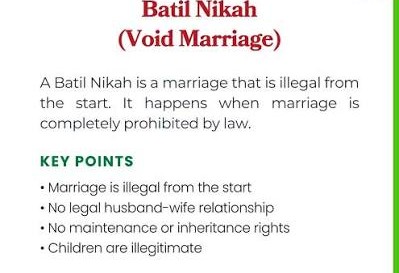
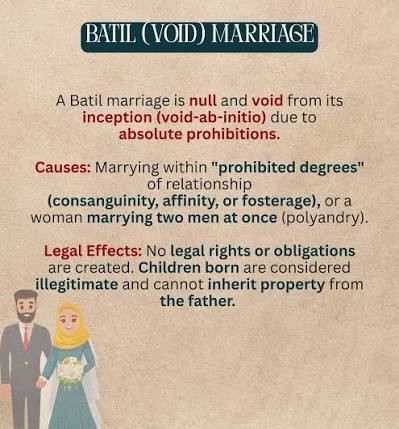
Under Muslim law, any marriage becomes void if it fails to meet the essential requirements of a valid marriage, rendering it legally ineffective and non enforceable. Such marriages are without legal rights or obligations. Under the following conditions of legal disability, marriages under Muslim law are prohibited :-
No Legal Disability -Legal disability means the existence of certain circumstances under which marriage is not permitted.
What marriages are prohibited under Muslim Law? Explain in details.
These prohibitions have been classified into four classes as follows –
1. Absolute Incapacity
2. Relative Incapacity
3. Prohibitive incapacity
4. Directory Incapacity
1. Absolute Incapacity
Absolute incapacity to marry arises from-
(a) Consanguinity,
(b) Affinity, or
(c) Fosterage.
(a) Consanguinity (Qurabat)–
Consanguiniity means blood relationship and bars a man from marrying-
(i) His mother or grandmother how high over,
(ii) His daughter or grand-daughter how lows over,
(iii) His sister whether full, consanguine or uterine,
(iv) His niece or great-niece how lows over,
(v) His aunt (father’s sister, mother’s sister) or great aunt, how highs over, whether paternal or maternal.
A marriage with a woman prohibited by reason of consanguinity is void. Issues from such marriages are illegitimate.
(b) Affinity (Mushaarat) –
A man is prohibited from marrying –
(i) His wife’s mother or grandmother how highs over;
(ii) His wife’s daughter or granddaughter how lows over;
(iii) Wife of his father or paternal grandfather how highs over;
(iv) Wife of his son or son’s son or daughter’s son how lows over.
A marriage with a woman prohibited by reason of affinity is void.
In the case of the above condition
(ii), marriage with the wife’s daughter or grand-daughter is prohibited only if the marriage with the wife was consummated.
(c) Fosterage (Riza) – When a child under the age of two years has been suckled by a woman other than its own mother, the woman becomes the foster-mother of the child. A man may not, for instance, marry his foster-mother or her daughter, or his foster-sister.
Exceptions-Under Sunni Law, there are a few exceptions to the general rule of prohibition on the ground of fosterage and a valid marriage may be contracted with
(i) Sister’s foster-mother, or
(ii) Foster-sister’s mother, or
(iii) Foster-son’s sister, or
(iv) Foster-brother’s sister.
The Shia jurists place fosterage and consanguinity on the same footing and refuse to recognise the exception permitted by the Sunnis.
The above-mentioned prohibition on account of ‘Consanguinity’, ‘affinity’ or ‘fosterage’ are absolute and the marriages contracted in contravention of these rules are void.
2. Relative Incapacity
Relative incapacity springs from cases which create the bar exist. The moment it is removed, the incapacity ends and the marriage becomes valid and binding. Thus, it differs from the case of absolute incapacity where the marriage is void ab initio and can never become valid. The following are the cases of relative incapacity
(i) Unlawful Conjunction – It means contemporaneously marrying two women so related to each other by consanguinity, affinity or fosterage, that they could not have lawfully intermarried with each other if they had been of different sexes. Thus, a Muslim cannot marry two sisters, or an aunt and her niece. The reason behind this prohibition is to avoid confusion of kindred, i.e., dual relationship. A Muslim therefore, cannot contract a valid marriage with his wife’s sister till his first wife is living.
Under the Shia law, a Muslim may marry his wife’s aunt, but he cannot marry his wife’s niece without her permission. Marriage prohibited by reason of unlawful conjunction is void under Shia Law.
(ii) Polygamy or Marrying a Fifth Wife – It means plurality of wives, i.e., marrying a fifth wife. It is unlawful for a Mohammedan to have more wives than four. Marriage with a fifth wife is irregular but this
irregularity may Be removed by divorcing one of them. Under Shia Law, marriage with the fifth wife is not merely irregular, it is void.
(iii) Absence of Proper Witnesses -It is essential amongst the Sunnis that at least two male witnesses or one male and two female witnesses must be present to testify that the contract was properly entered into between the parties. The Hanafi jurists insisted upon the presence of witnesses because in connection with the testimony of marriage, they had in view the authentication of its factum. Absence would affect its contractual completeness. Such marriages have, therefore, been held invalid but not void, as the condition of testimony is not so essential that it cannot be dispensed with. The witnesses must be of sound mind, adult and Muslim.
In Shia Law, a marriage contracted by the spouses themselves or their guardians in private is held valid. The presence of witnesses is not necessary.
(iv) Differences of Religion – A Sunni male can marry a Muslim female (of any sect) or a Kitabia. Marriage with the Kitabia, i.e. a woman who believes in a revealed religion possessing a Divine Book viz Islam, Christianity and Judaism is valid under Sunni Law. But he cannot marry an idolatress or a fire-worshipper. A marriage, however, with an idolatress or a fire worshipper is merely irregular in Sunni Law, but void in Shia Law. A Muslim woman cannot marry any man who is not a Muslim, whether he is Kitabia.
(v) Woman Undergoing Iddat – Iddat is the period during which it is incumbent upon a woman, whose marriage has been dissolved by divorce or death of her husband to remain in seclusion and to abstain from marrying another husband. The most approved definition of Iddat is the term by the completion of which a new marriage is rendered lawful. Iddat is described as a period during which a woman is prohibited from marrying again after the dissolution of her first marriage.
3. Prohibitive Incapacity
It arises in the following cases –
(a) Polyandry – Polyandry means the fact of having more
than one husband. Polyandry is forbidden in the Muslim system and a married woman cannot marry a second time so long as the first marriage subsists. A Muslim woman marrying in contravention of this rule shall be liable to be punished under S. 494, I.P.C., and the issues from such marriage will be illegitimate.
(b) Muslim Woman Marrying a Non-Muslim – A marriage of a Muslim female with a non-Muslim male, whether he be a Christian, or a Jew or an Idolator or a fire-worshipper is irregular under Sunni Law and void under Shia law.
4. Directory Incapacity
This may arise from the following circumstances
(a) Marrying a Woman ‘Enciente’ – It is unlawful to marry a woman who is already pregnant by her former husband. (Ameer Ali).
(b) Prohibition of Divorce -When the marriage is dissolved by the pronouncements of divorce three times, re-union is prohibited except after the lawful marriage of the woman with another man and then its being dissolved after consummation.
(c) Marriage During Pilgrimage – Under Shia Law, marriage during pilgrimage is void. The Shaf is, Malik is and Hanabal is hold marriages within the sacred territory on a pilgrimage to mecca as irregular but the Hanaf is regard such marriage to be legal as expressed in Fatwai Alamgiri, that it is lawful for a muhrim and muhrimah to inter-marry while in state of ihram.
(d) Marriage with a Sickman – Marriage with a sickman suffering from disease which is likely to be fatal is invalid. If however, he recovers and the marriage is consummated, it is valid.
