
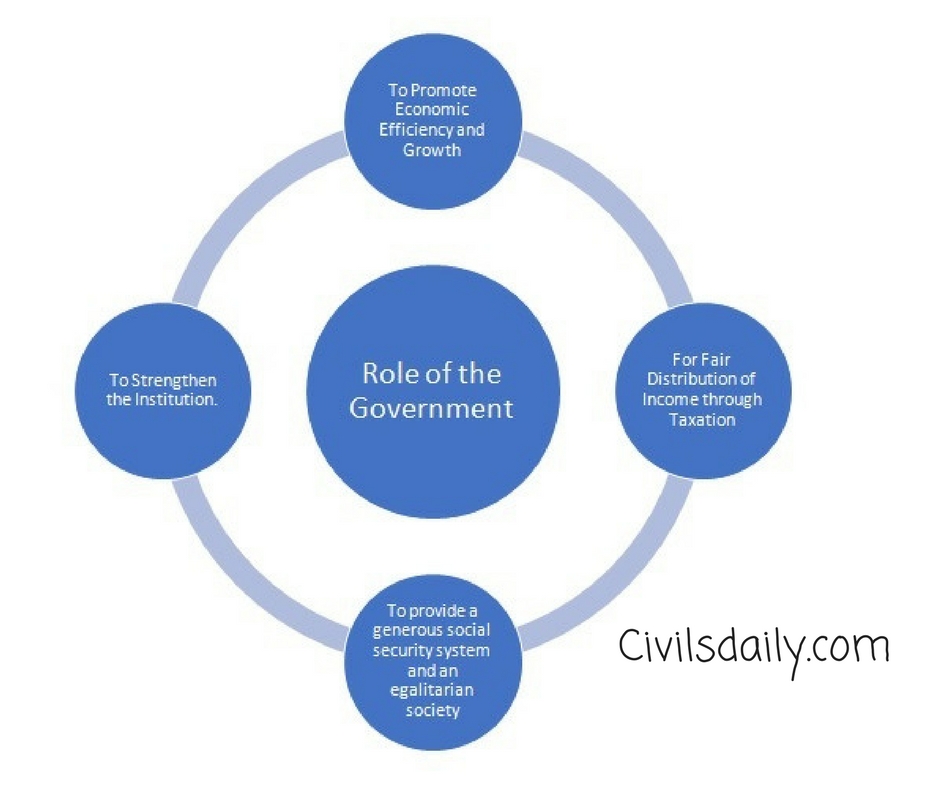

What role does State play in an economy ?
In any economic system, the state plays three important roles
(a) As a producer of goods and services
These include all those goods and services that constitute part of the market, and the market mechanism will distribute them
among the people according to its principal.
(b) As a regulator of the system
The state takes important economic decisions, announces the required economic policies, and takes complete responsibility for implementing them.. The state also ensures control over those who don’t oblige these economic decisions. The role of the state as regulator of the system, laying down the rules of the economy, whether it is
the financial sector or public utilities, will become increasingly important.
(c) As a supplier of ‘public goods’ or ‘social goods’ such :-
These include the goods and services which look essential from the social justice and well being perspective for the people. Education, healthcare, sanitation, drinking water, nutrition, caring for the handicapped and old etc. come under this category. These goods which are either provided free of cost or at the subsidized cost to the beneficiaries. As times change, we will have to redefine the role of states in the new scenario.
How the State Intervenes
There are several ways in which the state can intervene in a mixed economy. Three of the most comprehensive ways in which the government control works in the Indian economy are as follows:
Here we learn in detail What role does State play in an economy ? Examine
(1) Fiscal Policy
Our economy is federal in structure.
This means that the authority of the state is exercised through the Union government as well
as the various state
governments in accordance with
the distribution of powers
between them as determined by the Constitution.
Taxation is an integral part of fiscal policy.
The main purpose of taxation in a developing economy is not only to reduce inequalities of income but also to
change the priorities of the private producers by making some lines of production more or less attractive than others.
Taxation in a developing economy mainly mobilises resources for the investments that the economy needs
for development.
The whole range of direct and indirect taxes can be a very powerful instrument in the hand of the states
for this purpose.
(2) Monetary Policy
The state controls to a great extent over the amount and direction of loans given (or credit created) by monetary institutions by adopting an appropriate monetary policy. Such monetary control is a major instrument for state intervention in the economy.
All monetary controls in the Indian economy rest with the Reserve Bank of India (RBI). As the Central bank of the country, the RBI is at the head of the banking system.
It guides and controls the commercial banks as the custodian of the state’s monetary policy. It also adds to or reduces the currency supply in the hands of the public, and acting as the agent of the government through devices like borrowing from the public. The RBI uses various devices to control the creation of credit by the banking system These devices mainly consist of controlling the amount of cash deposits in banks held by the public or regulating the rate of interest that banks can charge on loans.
(3) Physical Controls in Production and Distribution
The state also tries to control the Indian economy through physical intervention at least in the two spheres of production and distribution.
I. The first area of government action in the field of production was that of industrial licensing. This was first done through the Parliament’s Industrial Policy Resolution of 1948 and the Industries Development and Regulation Act (IDRA) which came into operation in 1951. But, more recently, there have been some changes for the betterment of the industrial sector under the liberalisation of the Indian economy.
II The second area of government’s physical control of the economy has been that of food procurement, food price control and rationing all as part of a large public distribution system for the entire country.
Changing role of the state in Recent Times
The age of liberalisation began in India in 1991 with the introduction of extensive economic reforms.
The year 1991 is known as a watershed year for India which signalled by a systematic shift to a more open economy with greater reliance upon markets, a larger role for the private sector including of foreign investment, and a restructuring of the role of government.
Since mid-1991, the government has introduced new policies aimed at bringing about a qualitative change in the economy by effecting structural adjustments and, thus, stabilising the economy. In a nutshell, the trend of the reforms is seen with the following features
(i) A market-oriented economy, is emerging with increase in competition as a result of doing away with regulations, controls and governmental restrictions that had checked the growth of the private sector in the past. Industries earlier reserved for the public sector have been opened to the private sector. By de-licensing various industries and privatising PSUs, the state has focused on creating an environment that will encourage the private sector.
Liberalisation of the economy largely relieved imports and exports from government imposed restrictions. Reduction in custom duty rates and encouragement to foreign investment in various areas have placed the Indian economy in line with those of other countries. Liberalisation sought to remove unnecessary controls and enable enterprises to work smoothly and contribute in the process of economic and social development.
(ii) State intervention has been restricted as an attempt to reduce the number of industries reserved for public sector and disinvestment of a share of the PSU capital. The role of the state has also been curtailed by lifting the government restrictions that had checked the activities of the private sector. However, the state increased its contribution in the areas where the private sector participation is not preferable.
(iii) The state has shifted its role from regulator to facilitator. The state has assumed the task of facilitating development partners. The state has shifted away from its prioritisation of process orientation and towards outcome orientation , accountability, and citizens participation in its operations.
Here we learn in detail What role does State play in an economy ? Examine
