
What do you mean by law? Explain its nature, various types and sources of law?
Here we describe the Nature of Law in detail
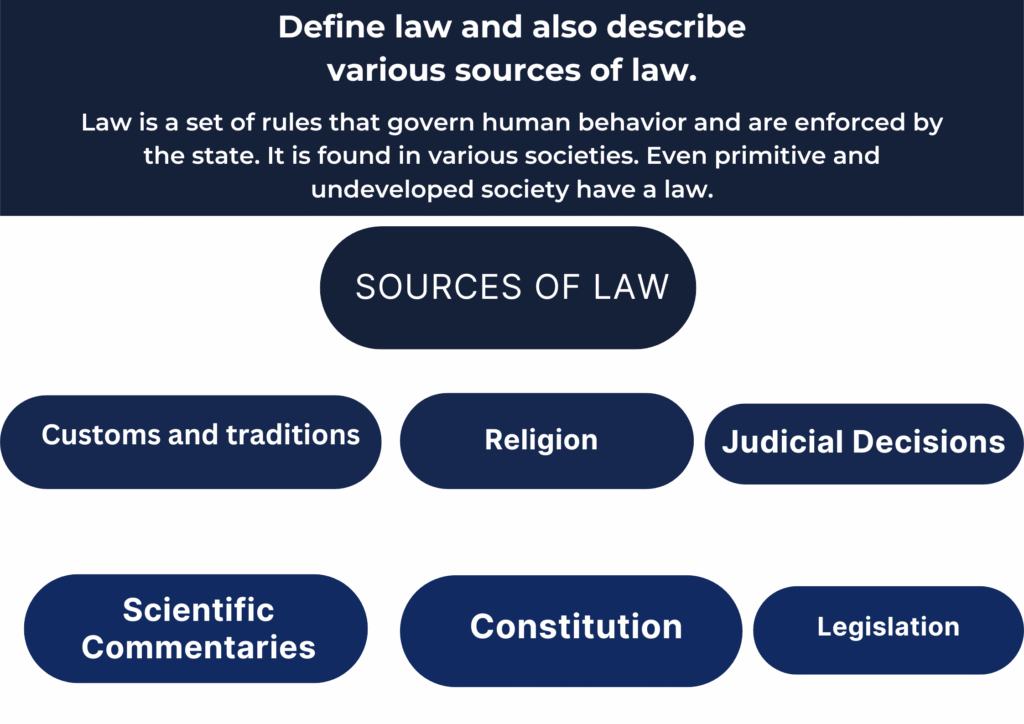
Law is a set of rules that govern human behavior and are enforced by the state. Law is in fact a social inevitability. It is found in various societies. Even primitive and undeveloped society have a law. Through various institutions, the State exercises the control over the society. Normally the true law includes all rules and regulations, directions and orders of established authority. It is not possible to violate them and those who violate them are liable to face consequences.
Maciver and Pages have defined law in the following words-Law is a system of rules and principles created or recognized by a competent authority to regulate human conduct and maintain order in society. It determines what individuals, organizations and governments may do, must do, or must not do.
In simple words, law provides a framework for living together peacefully and fairly. It protects rights, imposes duties, settles disputes and provides consequences when legally established rules are violated.
For example, laws relating to contracts help determine the rights and obligations of parties, while criminal laws identify certain conduct as offences and prescribe legal consequences.
Simple Definition
Law may be understood as a set of legally enforceable rules that regulate behaviour and help maintain justice, order and social stability.
Law is a body of rules that courts of the State recognize, interpret, and apply to particular situations. It derives from various sources, including customs, but it becomes law without the State, which means that courts are prepared to enforce them. Law is a rule binding on the citizens and residents within its jurisdiction. “
Here we describe the Nature of Law in detail
Hobel has defined law as follows
“The law is a social norm that society sanctions infractions of by applying physical force through a party possessing the socially recognized privilege to act.”
Max Weber has defined law as given below-
Law is an order, and the probability that staff will meet deviation with physical or psychic sanction guarantees its validity. Especially empowered to carry out these functions. This staff must have power and power is the probability that in actor an impose, within a social group, his wili even against resistance.”
Max Radien has defined law as quoted below-
“After all law is merely a smart part of the mechanism of the social management, closely connected with the mechanism of political administration. Not justice or good society, but convenience of commercial practice, appeasement of individual quarrels and increase of goodwill among the competitors are the purpose of law.”
Nature of Law
From the definitions given by various social thinkers, we get an idea about the functions and the nature of law. Various social thinkers have analysed the nature of law in various ways and some Important amongst these are as follows
Analytical School
According to this school, we need to analyse the law and classify it based on its implementation. This school does not organize the dynamic nature of law. Important members of this school include Bodin, Hobbes, Rentham, Augustine. According to these thinkers, the definite orders of the State result in law, and Barker connects and frames it by the highest authority or the sovereign body. All other orders that emanate from other sources do not receive recognition as law.
Historical School
According to this school, law is a thoughtful orders of the sovereign but it is the result of the customs and traditions prevalent in the society. This school does not recognize State as the source of law or the former of law but says that its main job is to understand it and implement it.
Philosophical school and the nature of law
Joseph Koheler is the chief exponent of this school of thought. According to Koheler, law is based on the feeling of justice and it has to do with the historical development. According to him, law is the gift of the culture and that is why it has a cultural bias in it. It is responsible for the transmission and diffusion of culture.
Sociological School and the nature of law
According to this school of thought, social forces gift law, so we should interpret and analyse it only in relation to social conditions and social forces. Every society has certain definite need and law develops according to these needs. Therefore, we should consider law as an object for meeting the social needs. The State recognizes the rules and regulations framed to meet the needs of society as law. According to this School, the origin and development of law does not depend upon the State but on social needs and social conditions . Thinkers like Gumplowis, Crabbe, Roscbepound, Holemel etc. are the main exponent of this school.
Here we describe the Nature of Law in detail
Difference Between Law, Morality and Custom
| Basis | Law | Morality | Custom |
|---|---|---|---|
| Meaning | Legally recognized rules governing conduct | Ideas about right and wrong | Established social practices |
| Enforcement | Enforced through legal institutions | Mainly through conscience and social approval/disapproval | May be socially enforced and, in some cases, legally recognized |
| Authority | Derived from recognized legal sources | Often based on ethical or social values | Based on established practice |
| Consequence of violation | Legal consequences may follow | Moral or social consequences may follow | Social consequences; legal consequences only if legally recognized |
| Nature | Generally formally recognized | May vary among individuals and communities | Develops through repeated practice |