Discuss the important features of New Economic Policies .
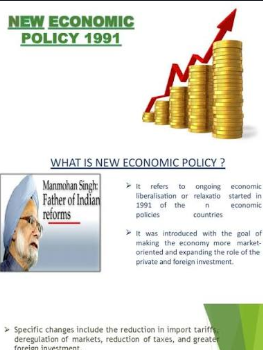
The New Economic Policy 1991 brought a drastic change in the Indian Economy. In the pre-1991 era, the government controlled key industrial sectors namely iron and steel industry, heavy machinery industry, air travel sector, ship building, telecommunication etc. With the new economic policy, the government did many reforms and went ahead with radical policy changes. Following are some of the important features of New Economic policies under economic reforms.
Here we will discuss the important features of New Economic Policies under Economic reforms.
(1)Liberalisation
The policy has made provision for liberalising the economy against unnecessary controls and regulations. It means liberating the economy, trade and industry from unwanted restrictions. It abolished the system of industrial licencing for all industrial undertakings except for a short list of industries. The sectors where industrial licensing still required were the alcohol sector, dangerous chemical sector, defence & aerospace, tobacco products, industrial explosive, drugs and pharmaceuticals etc. There was no restriction on expansion or contraction of business activities and freedom in movement of goods and services.
(2) Privatisation
The word privatisation means introduction of private ownership in public owned units and public managed enterprises and also signifies introduction of private control and management in public sector enterprises. The privatisation programme involves:
(i) reducing the number of reserved industries from 17 to 8.
(ii) raising the share of private sector to total investment of 55 percent at the end of ninth plan.
(iii) Greater participation of private individuals.
(iv) Institutional credit support to private sector enterprises from the national and financial institutions.
(V) Setting up of Board of Industrial and Financial Reconstruction (BIFR). This board set up to revive sick units in public sector enterprises suffering loss.
(3) Globalisation of the Economy
It simply means opening up the economy for the world market by attaining international competitiveness. It involves greater interaction and interdependence among the various nations of the global economy. This policy offers both challenges and opportunities to the developing countries.
Globalization has made following changes:
(i) The new economic policy has prepared a specified list of high technology and high investment priority sectors in which automatic permission will be available for Direct Foreign investment.
(ii) No permission is now required for hiring foreign technicians or for testing indigenously developed technology abroad.
(iii) Rupee has been devalued in IVth phase by nearly 20 percent to increase exports, discourage imports and to raise an influx of foreign capital.
(IV) New Exim policy 1997-2002 was announced which simplified the trade practices further for improving our competitiveness in the Global Market.
(v) In order to bring the Indian economy within the ambit of Global competition, the Government has modified the custom duty to an considerable extent. The government has reduced the peak rate of custom duty from 250 percent to 35 percent.
(4) New Public Sector Policy
The new policy has shifted its emphasis from public to private sector. Four major decision were undertaken:
(i) Disinvestment of shares in PSE (Public Sector Enterprise) to raise resources and encourage wider participation of the general public.
(ii) Policy for sick PSEs was designed at par with that of the private sector.
(iii) Improving performance through the performance contract or Memorandum of Understanding (MOU) system.
(5) Modernisation
The policy has been providing high priority to the introduction of modern techniques in the production system. The policy facilitates the growth of sunrise industries ie., electronics and computers. The government has made special provisions of tax initiatives to facilitate corporate mergers and collaborations to face new challenges ahead. Steps have been taken for the revival and modernisation of sick industrial units established both under private and public sectors.
(6) Financial Reforms
Following financial reforms are undertaken in this sector:
(i) Reduction in liquidity ratio.
(ii) Abolition of direct credit programmes.
(iii) Free determination of interest rates.
iv) Making provision for Non performing assets (NPAs).
(v) Establishment of speedy machinery for recovery of loans by special tribunals.
(vi) Reconstitution of banking system.
(vii) Liberal treatment to foreign banks.
(viii) Giving more freedom to banks and ending dual control of RBI and Finance Ministry.
(ix) Introducing capital market reforms.
Arguments in Favour of Economic Policy
The following are some arguments in favour of such reforms:
(i) The rate of growth has remarkably increased and is now at par with other Asian countries.
(ii) Reforms are helping the country in attaining growing competitiveness in its industrial sector to face Global Competition.
(iii) It aims to reduce the extent of poverty and inequality.
(iv) It has been taking steps to raise the efficiency and profitability of public sector enterprises.
(v) Private investment in important areas has increased.
(vi) The flow of foreign direct investment in the country has increased.
(vii) Govt. has been taking steps to contain fiscal deficits.
(viii) Govt. has undertaken some measures to control in inflationary rise in prices by checking deficit financing and also be better supply management.
(ix) New Economic Policy encouraged adoption of new technology and modern management practices.
(x) The policy helped the service sector to expand rapidly, contributing significantly to GDP.
Arguments against Economic Policy
(i) It has started the policy of liberalisation and globalisation of the economy under the pressure of World Bank and IMF which had led to complete surrender of the economy to these international bodies.
(ii) It has aggravated the problem of unemployment by introducing exit policy without making any adequate provision for alternative scope for employment.
(iii) It has failed to control the rising trend in prices, check fiscal deficit control subsidies & non plan expenditure.
(iv) It has neglected the agricultural sector as compared to industry, trade and service sectors.
(v) This policy is encouraging a dangerous trend of consumerism by encouraging the production of luxuries items for consumption of upper class of society.
(vi) It has increased the dependence of economy on foreign technology and has failed to import technology.
(vii) It has led to loss of economic sovereignty by allowing the sale of equities of Indian Companies to foreign investors. (viii) It has multiplied the volume of external debt.
Here we will discuss the important features of New Economic Policies
1 thought on “Discuss the important features of New Economic Policies”
каркасный дом санкт петербург станет комфортным и энергоэффективным решением для загородной жизни.
Свободное пространство между стойками заполняют теплоизоляционными материалами.
Стены такого дома способны эффективно удерживать тепло.
Внутри помещения отделывают гипсокартоном, вагонкой либо листовыми материалами.
Качественно построенный каркасный дом обеспечивает удобство проживания и экономичность эксплуатации.

каркасный дом санкт петербург станет комфортным и энергоэффективным решением для загородной жизни.
Свободное пространство между стойками заполняют теплоизоляционными материалами.
Стены такого дома способны эффективно удерживать тепло.
Внутри помещения отделывают гипсокартоном, вагонкой либо листовыми материалами.
Качественно построенный каркасный дом обеспечивает удобство проживания и экономичность эксплуатации.