Explain Non-alignment. What are the reasons and objectives
Explain Non-alignment. What are the reasons and objectives
Explain Non-alignment. What are the reasons and objectives
George Schwarzenberger refers to a number of terms that people often take as synonymous with the non-alignment. These are; isolations, noncommitment, neutrality, neutralisation, unilateralism and non-involvement. Each of these has different meanings.
Explain Non-alignment. What are the reasons and objectives
Isolationism
Politics of aloofness.
Explain Non-alignment. What are the reasons and objectives
Non commitment
Explain Non-alignment. What are the reasons and objectives Politics of detachment for other powers in a multicorner relationship.
Explain Non-alignment. What are the reasons and objectives
Neutrality
The political and legal status of a country at war with respect to the belligerents.
Explain Non-alignment. What are the reasons and objectives
Neutralization
It means political status of a particular state which it cannot give up under any circumstances. Switzerland is an example of a neutralized state.
Explain Non-alignment. What are the reasons and objectives
5 .Unilateralism
Policies of calculated risks such as the destruction of own thermonuclear weapons at one’s own instance.
Explain Non-alignment. What are the reasons and objectives
Non-involvement
Keeping away from the struggle between the different superpower ideologies. According to Schwarzenberger non-alignment and th above mentioned six concepts do not mean the same thing, and thy fundamentally differ.
Non-Alignment and Neutralism
The Western scholars like Hans J. Morgenthau, George Liska and Lawrence W. Morton and others have preferred the term “neutralism” to “non-alignment”. As non-alignment is a policy of keeping out of alliances in general and military pacts in particular, it is very close to neutralism. Both seek “non-involvement in cold war” in particular, and in actual war in general. Therefore both have been used interchangeably. However, a non- aligned need not to be neutral under all circumstances. Under exceptional circumstances, it may participate actively in world affairs. As an attribute of foreign policy, non-alignment is subjected to change. If there is a change of government in a non aligned country, the new government has to declare whether it would continue to or abandon non-alignment. During the period of 1977-80, under the Janata party government this happened in India.
Thus while political neutrality means keeping away from a particular issue, non-alignment means the same thing with a difference. it aims at keeping away not only from a particular conflict or issue but also from a continuing international situation such as the cold war. It insists on keeping away from military alliances as they constitute an important feature of cold war.
Reasons for Non-Alignment
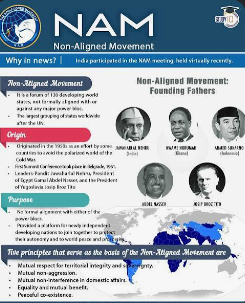
Based on the widespread desire for national independence and non-involvement in the conflicts of others, policies of Non-alignment are such as, every government would follow in a ideal world of sovereign state in which there were no power conflicts or threats to independence that called for special defense arrangement or alliances. Circumstances which influence a country or countries to accept non-nationalism, anti-alignment as the basis of their foreign policy are: Post-war nationalism, anti-colonialism and the pressing problems of economic underdevelopment. Following factors/bases are responsible for the adoption and development of non-alignment.
Sentiment of Nationalism
It was the most important feature of the freedom movements in Asian and African countries. It was a movement to obtain freedom after a long and persistent struggle. In order to preserve their freedom after, the nations were determined to follow a course whereby they may not become tools in the hands of big powers. Hence they preferred to follow the policy of non-alignment.
Anti-Colonial Feeling
Even after they attained freedom, anticolonial feeling persisted in the countries of Asia and Africa. These powers were afraid that they may be again subjugated by the colonial powers. They were determined to keep them off from these colonial powers by avoiding membership of both the blocs and adopting an independent course of action, keeping out of all sort of alliances.
Economic Aid for Development
The countries of Asia and Africa who gained independence were generally poor and underdeveloped. They were very keen to improve the standard of living of their people and promote systematic development of their country, to achieve their objectives at a fast rate. They needed capital and financial assistance from both the blocs. Hence, they thought it was proper to keep off from political alliances and pursue a policy of non-alignment.
Mutual Sympathy and Cooperation
Since long the colonial powers had fed the afro-Asian nations with the idea that were racially as well as culturally backward. This feeling evoked mutual sympathy among the people of the newly emerged states of Asia and Africa. Being common victims of economic exploitation and political domination by the European nations they had a sense of affinity which led them to cooperate with each other.
Need of Peace
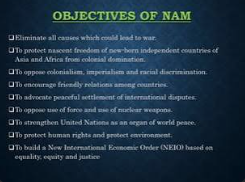
Explain Non-alignment. What are the reasons and objectives. As the newly independent states wanted to live in peace, therefore, they concentrated on their development. They decided to keep off from the military alliance and the two power blocs. From the above discussion it is clear that there is no antithesis of alignment. Objectives of Non-Alignment
To Pursue Independent Policy
After throwing off the slavery, colonies were keen to secure their hard won independence. Economically, politically and militarily they could not compete favourably with the older and stronger nations. By keeping themselves out of power blocs, they were able to pursue an independent foreign policy.
Explain Non-alignment. What are the reasons and objectives
To Avoid Involvement in General War
Explain Non-alignment. What are the reasons and objectives
Newly freed nations wanted to avoid entangling themselves in the wars so that they may be able to concentrate on the economic and material development of their people. They did not form an alliance with either of the two power blocs because they did not want to be unwillingly drawn into a war.
Explain Non-alignment. What are the reasons and objectives
Preservation World peace
Explain Non-alignment. What are the reasons and objectives
Newly freed nations felt that the course of alignment is best designed to prevent war. They felt that alliance and arms race have eventually resulted in war. It would able to mediate between the power blocks through non- alignment as they did in Korea, Indo-china and Congo. They could supply impartial policemen and observers. They could provide manpower for U.N. Emergency Force. Thus they play an important role in avoiding war and preserving World peace.
Explain Non-alignment. What are the reasons and objectives
To Achieve Economic Development
Explain Non-alignment. What are the reasons and objectives
They could not divert their limited resource to armaments and defence at the cost of neglect to the economic development of the country. By and large and non-aligned states preferred to concentrate on the policy of economic development so that conditions of their people may be better.
To Achieve Moral Superiority
Non-alignment is a moral doctrine. While the system of alliances and counter-alliances are manifestations of “power politics.” Non- aligned nations regard themselves as morally superior even though they are weaker and lack material wealth. They consider it their proud duty to influence the international scene with moral force rather than by taking recourse to power.
To Help U.N. to Function Successfully
The non-aligned nations wish to ensure that U.N. functions successfully in fulfilling its objectives of preservation of world peace and economic development. This could be possible only if UNO were freed from the game of power politics constituting the third force. The non-aligned states could play a useful role in international politics by judging each issue on its merits and finding a viable solution.
To Secure Economic and Technical Assistance
By remaining friendly to all the big powers, the non-aligned nations could secure economic and technical assistance from both blocs. By the classical tradition of politics, general and international politics in particular state must protect its interests by all sorts of methods. Thus despite some glaring defeats and imperfections non-alignment has a strong positive aspect and offers a model to the world. It has acceptance by nations of almost all continents, races and colours in the East as well as the West, due to its dynamism and desirability.
Explain Non-alignment. What are the reasons and objectives