Discuss the meaning of ‘Non-alignment’. Evaluate Non-alignment through its demerits and merits.
The term non-alignment denotes different meanings to different people. The western scholars like Hans J. Morgenthau, George Liska and Lawrence W. Marton and others have preferred them ‘neutralism’ to ‘non-alignment’. George Schwarzenberger refers to a number of terms like isolationism, non-commitment, neutrality, neutralisation, unilateralism and non-involvement, which are often taken as synonymous with the non-alignment. But each term has a different meaning. Isolationism stands for policies of aloofness. Non-commitment refers to politics of detachment of other powers in a multi corner relationship. Neutrality describes the political and legal status a country at war with respect to the belligerents.
Discuss the meaning of ‘Non-alignment’. Evaluate Non-alignment through its demerits and merits.
Neutralization means political status of a particular state which
it cannot give up under any circumstances (Switzerland in an example of a neutralized state).
Discuss the meaning of ‘Non-alignment’. Evaluate Non-alignment through its demerits and merits.
Unilateralism is identified with policies of calculated
risks such as the destruction of own t
hermonuclear weapons at one’s instance Non-involvement means keeping away from the struggle between the different upper power ideologies.
Schwarzenberger says that non-alignment and the above mentioned six concepts do not mean the same thing, and they fundamentally differ.
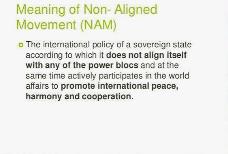
‘Non-alignment is a policy of keeping out of alliances in general and military pact in particular’.
The term is very close to neutralism, since the basic object of the two is ‘non-involvement in cold war’ in particular and non-involvemen in actual war in general.
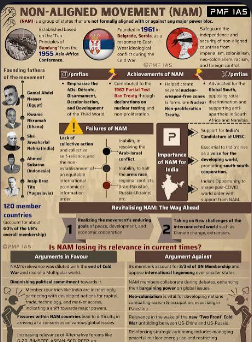
Some scholars have used the two interchangeably, but non-alignment has broader meanings. It means that a nation following such a policy need not be neutral under all circumstances. It can participate actively in world affairs under exceptional circumstances. Non-alignment being an attribute of foreign policy is subject to change. That is why a change of government in a non-aligned country often results in the change of the attitude. The new government has to make a specific declaration to the effect of whether it would continue or abandon non-alignment, as happened in the case of India during the period 1977-80 under the Janta Party. Non-alignment taken in this context is not equivalent to neutralism or neutrality, which on the other hand is adopted as a result of international agreement.The commitment to neutrality remains permanent and is not affected by a change in government unless international agreement is abrogated.
In short, it can be said that political neutrality means keeping away from a particular issue while non-alignment means the same thing with difference. Non-alignment also aims at keeping away from a particular conflict or issue but from a continuing international situation-the cold war. Since military alliances constitute an important feature of cold war, non alignment naturally insists on keeping away from these alliances.
The non-alignment is based on the widespread desire for national independence and non-involvement in the conflict of others. The policies of non-alignment are the policies every government would follow in an ideal world of the sovereign state in which there were no power conflicts or threats to independence that called for special defence arrangement of alliances. There are widespread circumstances which influence the country or countries to accept non-alignment as the basis of their policy. Post war nationalism and anti-colonialism and the pressing problem of economic under development are the background circumstances in which non-alignment has flourished.’
Evaluation of Non-Alignment
Demerits
Vague Politics
James Burton has rightly pointed out that there has been no full treatment of the concept, no analysis and precise description, no exposition through which others might estimate the significance and future prospects of policies of non-alignment.”
Abuse of Analytical Precision
There is no popular understanding of the concept among the majority of the people. Though the term Non-alignment is in common use, no effort has been made by the propounders of the concept to properly analyse it.
No Model of International Behaviour
The advocates of non-alignment claim that it is of great significance as a model of international behaviour which all countries should follow in the interests of peaceful relations: It is a solution for the grave problems of nuclear age. However, the nations, wrongly imagine non-alignment as they deduce that it is a “shifting policy of unrealism expediency of blackmail and of irresponsibility like not to be permanent and to be even a danger to the world peace.”
Policy of National Self-interest
Some Western scholars have pointed out that non-alignment is a policy designed to fulfil the selfish interest characteristic of all foreign policies, but the general expression has not been admitted by the western scholars that non-aligned countries expediency and self interest like all other concept-laissez faire, balance are not self seekers. However, its concept too has developed out of power, parliamentary government etc.
Confusion with Other Terms
Thus the advocates and proponents of the doctrine are themselves not very clear about its meaning. Often the concept of non-alignment is confused with neutralism. As in U.N., Burma, an advocate of non-alignment once said in a speech, “This policy (non-alignment) has called neutralism in the cold war. Perhaps that is the right name for it.” Merits
Preservation of World peace
International politics is a struggle for power. It gives rise to alliance and counter alliance, armaments race and militarism, etc. As the non-alignment nations try to keep out of this power struggle, the concept is ultimately conducive to world peace.
Preservation of Freedom
Once under the political subjection of the great powers, Non-alignment nations had to wage a hard and long struggle to win their political independence. As they do not want to lose their hard won independence they keep out of world power struggle lest their independence may be jeopardize again.
Increase in Economic Aid for development
Non-alignment nations could win the favour of both blocs and receive economic assistance from both for their development. For example, as a non-alignment country India received the aid from the Soviet Union as well as U.S.A. she secured more aid only from both the sources in comparison to pakistan which received aid from the Western bloc countries alone.
Check on the Ambitions of Big Powers
The superpowers, U.S.S.R., U.S.A. and China have embarked upon ambitious policies of economic dominance of the world. Non-aligned nations have thwarted the imperialistic ambitions of the superpowers by keeping aloof. They have rejected power politics in the field of international relations. To quote Schwarzenberger, “It signifies a type of relations and states in which certain patterns of behaviour are predominant, hegemony, imperialism, alliances, balance of power and war.”
Discuss the meaning of ‘Non-alignment’. Evaluate Non-alignment through its demerits and merits.
Check on the Cold War
Discuss the meaning of ‘Non-alignment’. Evaluate Non-alignment through its demerits and merits.
Group war between superpowers has somewhat subsided since the emergence of non-alignment. The Afro-Asian countries decided to take an independent course and keep away from the involvement of any kind of military pacts with either of the big powers which made the continuation of cold war difficult, it not impossible.
Discuss the meaning of ‘Non-alignment’. Evaluate Non-alignment through its demerits and merits.
Support of U.N. Policies
Discuss the meaning of ‘Non-alignment’. Evaluate Non-alignment through its demerits and merits.
Non-aligned nations have exercised great influence on the decisions of the U.N. General Assembly, due to their numerical strength. Even though they could not do anything against the use of veto in the Security Council, no majority decision could be taken without their support. As they are peace-loving, there can be no cases where the obligations of the United Nations may conflict with the obligations of impartiality. Thus, they have helped U.N.O. to carry on its peace-keeping function effectively.
Discuss the meaning of ‘Non-alignment’. Evaluate Non-alignment through its demerits and merits.
Freedom of Judgement
Discuss the meaning of ‘Non-alignment’. Evaluate Non-alignment through its demerits and merits.
Non-alignment envisages freedom of judgement. It judges various events and problems on merits rather than on preconceived ideological nations and other affinities.
Discuss the meaning of ‘Non-alignment’. Evaluate Non-alignment through its demerits and merits.
Disarmament
Discuss the meaning of ‘Non-alignment’. Evaluate Non-alignment through its demerits and merits.
Non-alignment supports all activities aiming at the relaxation of international tension. It encourages all institutions to work for peaceful resolution of conflicts. Non-alignment policies support disarmament and faith in the U.N.O. as they support independence of foreign policy.
Discuss the meaning of ‘Non-alignment’. Evaluate Non-alignment through its demerits and merits.
Importance of Non-Alignment – According to J.W. Burton there are four reasons for the importance of the non-alignment.
Discuss the meaning of ‘Non-alignment’. Evaluate Non-alignment through its demerits and merits.
( i) Non-alignment is a special feature of the current world system.
Discuss the meaning of ‘Non-alignment’. Evaluate Non-alignment through its demerits and merits.
(ii) Non-alignment reflects some of the features of a developing world community;
Discuss the meaning of ‘Non-alignment’. Evaluate Non-alignment through its demerits and merits.
(iii) Non-alignment has inherent within it certain features which are developing amongst aligned states;
Discuss the meaning of ‘Non-alignment’. Evaluate Non-alignment through its demerits and merits.
(iv) Non-alignment offers an alternative game and set of rules which is likely to be important once nuclear deterrence is no longer credible.
Discuss the meaning of ‘Non-alignment’. Evaluate Non-alignment through its demerits and merits.
Thus despite some glaring defeats and imperfections non-alignment has a strong positive aspect and offers a model to the world. It is expected to lead to an ideal world society. It has acceptance by nations of almost all continents, races and colours in the East as well as the West, due to its dynamism and desirability.
Discuss the meaning of ‘Non-alignment’. Evaluate Non-alignment through its demerits and merits.
Discuss the meaning of ‘Non-alignment’. Evaluate Non-alignment through its demerits and merits.