Describe the important Reforms introduced by William Bentick.
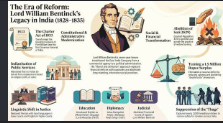
Lord William Bentick’s tenure was known for its remarkable reforms in the judicial system. Lord William Bentinck reorganized
India’s judicial system between 1828 and
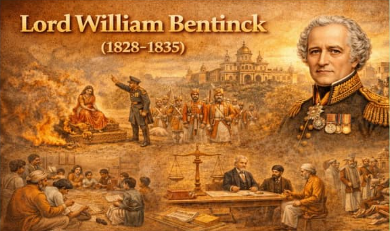
1835 to reduce huge case backlogs, cut administrative costs, and make justice faster and more accessible. Between 1828 and 1835, Lord William Bentick served as the first official Governer- general of British India. He was known as a man in peace, discipline, and economy. He was a remarkable reformer and
earned regard as the first governor to sympathise
with the Indians because he instituted a number of significant reforms in the judicial system.
Important Judicial reforms introduced by Lord Willam Bentick
( A) Abolition of circuit courts – He observed that the current system of
circuit courts increased the number of
cases having long delays in determining
judicial decisions as it had extremely broad territorial authority and hence abolished the circuit court system.
(B) The power of Judges increased:-
In 1831, they extended the power of Indian judges. The authorities increased the claim amount or pecuniary jurisdiction of the Munsif to Rs 300. The Sadar Amins also received
authorization to decide on any suit referred by the Zila or City judge up to the value of Rs 1000. The Principal Sadar Amins could decide on original suits up to the value of Rs. 5,000.
(C) Civil and Revenue Jurisdiction to Collector:
Tax collectors gained exclusive jurisdiction over rent-related suits and the authority to make summary decisions.
(D) Jury System – Regulation VI of 1832 gave the governor general in council , the ability to invest in any European civil judge in a Civil suit original with the power to enlist the help of the Indians in one of three methods.
Describe the important Reforms introduced by William Bentick.
(E) Authorities made Sati an offence as they deemed it inhumane
Sati was a kind of heinous act and inhuman rite in which a Hindu widow compelled herself to burn in her husband’s burning pyre. Society then designated it culpable homicide and a penal offense, punishing any form of assistance for the crime as well.
Describe the important Reforms introduced by William Bentick.
(F) Indian appointed Judicial officers-
There is no religious discrimination in becoming an Ameen. The appointment of Indians as judicial officers saved costs because English judges were well compensated whereas Indian judges were available for a low salary.
Describe the important Reforms introduced by William Bentick.
(G) District and Sessions Judges: Lord William Bentick appointed separate District and Sessions Judges to handle criminal trials and reduce the heavy workloads of revenue commissioners.
Describe the important Reforms introduced by William Bentick.
(H ) New Sadar Courts: He established a second Sadar Diwani Adalat (civil) and Sadar Nizamat Adalat (criminal) at Allahabad to spare litigants in the Upper Provinces a long trip to Calcutta.
Describe the important Reforms introduced by William Bentick.
(I) Language Changes: Lord William Bentick replaced Persian with local vernacular languages in lower courts and English in higher courts to help common people understand proceedings.
Describe the important Reforms introduced by William Bentick.
(J) Laying Foundations for Codification by setting up Law Commission: Lord William Bentick set up the first Indian Law Commission under Lord Macaulay to begin standardizing and codifying the diverse legal rules of British India. This work eventually led to the creation of the Indian Penal Code (IPC).
Describe the important Reforms introduced by William Bentick.
(K) The charter Act of 1833:- Scholars considered it to be one of the most important charters. According to the charter, for the next twenty years, the British Crown gave the East India Company territorial possession, and they established an All India legislature with wide legislative powers.
Describe the important Reforms introduced by William Bentick.