What are the reasons for Formations of Regional Organisations.
Reasons for Formations of Regional Organisations.
Reasons for Formations of Regional Organisations.
Generally the states form regional organisations for three reasons viz. security, economic assistance and political co-operation. The states have formed a number of regional organisations like North Atlantic Treaty Organisation (NATO), Central Treaty Organisation (CENTO), and Warsaw Treaty Organisation (Warsaw Pact) for security reasons. These organisations determine how member states deploy their armed forces and require them to act in specific ways under certain circumstances. The regional organisations formed for security purposes deprive the member states of independence of action in defence matters by integrating their armed forces.
Reasons for Formations of Regional Organisations.
Secondly, regional organisations such as the European Communities (EC), the Council for Mutual Economic Assistance (CEMA), and the Latin American Free Trade Association (LAFTA) established themselves to promote economic interests through mutual assistance, economic cooperation, and the exchange of technological knowledge. This type of regional organisations also restrain the freedom of the member states with a view to avoid duplication and waste and ensure fullest utilization of the total pooled resources,
Reasons for Formations of Regional Organisations.
Thirdly, some states have established regional organisations, such as the Organisation of American States (OAS), the Organisation of African Unity (OAU), the Arab League, and the British Commonwealth of Nations, to serve multiple purposes.These organisations try to promote political, economic, cultural as well as military co-operation.
Reasons for Formations of Regional Organisations.
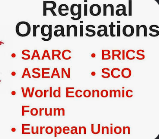
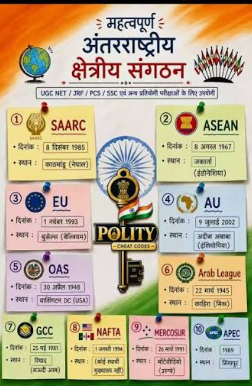
Regional Organisations
Reasons for Formations of Regional Organisations.
At present there are such a large number of regional organisations that it is not possible to deal with all such organisations here. However, for a proper understanding of regionalism, we shall deal with some of the prominent regional organisations in brief .
Reasons for Formations of Regional Organisations.
Organisation of American States (OAS)
Reasons for Formations of Regional Organisations.
This is the oldest regional organisation which was created by the states of the American Hemisphere in 1948 with a view to promote mutual co-operation.
Reasons for Formations of Regional Organisations.
The OAS Charter came into force on 13 December, 1951 and was reformed in 1967. The membership of the organisation is open to all the American states, including Canada. Any member can withdraw from the organisation by giving two years notice.
Reasons for Formations of Regional Organisations.
It consists of the following organs
Reasons for Formations of Regional Organisations.
The Inter-American Conference
Reasons for Formations of Regional Organisations.
Before 1970 it was the supreme organ of the OAS. It consists of representatives of all the member states. They meets once in five years at different places by rotation. It determines the policy, structure and functions of other organs. The Conference takes all the decisions by majority. As a matter of practice, however, the membership tries to arrive at unanimous decisions.
Reasons for Formations of Regional Organisations.
Foreign Minister Meeting
Reasons for Formations of Regional Organisations.
This body meets on the request of the majority of the members and deals with pressing security and related problems of common interest to the American states. This body acts as the enforcement agency of the OAS and can order the member states to take collective measures or impose sanctions in a particular case.
Reasons for Formations of Regional Organisations.
Permanent Council
Reasons for Formations of Regional Organisations.
This organ of OAS contains delegates of all the member states. The Council elects a Chairman and a Vice-Chairman from amongst its members every year. The Council is responsible for the smooth working of the OAS and is responsible for convening the conferences and meeting of the members. It prepares the agenda for these conferences in consultation with the concerned Governments.
Reasons for Formations of Regional Organisations.
The Pan American Union,- It works as the Secretariat of the OAS. It coordinates the social and economic activities and promotes the welfare of members.
Reasons for Formations of Regional Organisations.
The Specialised Organisation
Reasons for Formations of Regional Organisations.
The organisation carries on co-operative programmes in the fields of health, child welfare, education, Agriculture, CIC.
Reasons for Formations of Regional Organisations.
The Specialised Conference
Reasons for Formations of Regional Organisations.
The conferences are called to encourage joint efforts to solve technical problems.
Reasons for Formations of Regional Organisations.
In addition to the above organisation, OAS has certain specialised and subsidiary organisations. The specialised organisations include Inter-American Institute of Agricultural Sciences, Inter-American Children’s Institute, Inter-American Commission of women, Inter-American Commission of Human Rights, Inter-American Indian Institute, Pan-American Health Organisation and Pan-American Institute of Geography and History. These agencies look after their allotted specialised functions. The Specialised Institutions of OAS include three Councils viz. Inter-American Economic and Social Council. The Inter-American Cultural Council and Inter-American Council of Jurists.
Reasons for Formations of Regional Organisations.
The members of the OAS hold faith in setting their disputes through peaceful methods. Before referring their disputes to the Security Council they submit these disputes to the regional organisation.Generally, these disputes resolve through conciliation of investigation. The members of OAS pledge to assist each other in case of armed attack against any American States and correlatively deal with the aggression. An Attack against any state is taken as an attack against all American states.
The members pledge to resolve amicably the political juridical and economic problems arising among them and cooperate in the economic social and cultural development.
The Organisation of American States has played an effective role in checking the threat of Communism in the hemisphere. The organisation played an effective role in the Dominican Republic in 1995. It also checked the guerrilla warfare in several states. In the Organisation of American States, the United States has played a dominant role, specially in matters relating to security. Similarly in the field of economic development also, the USA has played a dominant role and provided necessary finances.
The ASEAN ( Association of South-East Asian Nations )
Indonesia, Malaysia, the Philippines, Singapore, and Thailand created the ASEAN in 1967 through the Bangkok Declaration. The leaders of these countries felt the need of the organisation because the situation in Vietnam as result of US imperialist action and political crisis in Cambodia. Indonesia, Laos, and Burma convinced them that they could best serve the difference between Indonesia and Malaysia and the strong anti-Chinese stance of interest only by uniting. The end of confrontation with the Military regime to Indonesia also facilitated the creation of this organisation. However, Burma and Cambodia did not join the organisation on account of its anti-Chinese stance.
The main objectives of ASEAN are:
(i) to accelerate the economic growth, social progress and cultural development in the region,
(ii) promotes regional peace and stability
(iii) to promote active collaboration and mutual assistance on matters of common interest in the economic, social, cultural, technical, scientific and administrative fields,
(iv) to provide assistance to each other in the form of training and research facilities in the educational, technical and administrative sphere;
(v) to promote South-East Asian Studies and
(vi) to collaborate for the greater utilisation of their agriculture and industries and expansion of trade etc.
(vii) to maintain close and beneficial co-operation with existing international and regional organisations with similar aim and purposes.
The organisation of the ASEAN consists of the Ministerial Conference, Standing Committee, the Secretariat and a number of Permanent and Ad hoc committees.
The Foreign Ministers of the member states compose the Minister’s Conference.
The Conference holds periodical consultations with regard to military and other matters relating to the area. Generally, each country hosts its meetings annually by rotation.
The Standing Committee meets when necessary between Ministerial meetings for consultation.
The five countries hold the meetings by rotation.
The Committee consists of the Foreign Minister of the host country and Ambassadors of the other four countries.
The ASEAN also has a permanent Secretariat with its headquarters in Jakarta (Indonesia).
In addition to these organs, the ASEAN has one permanent committee headquartered in Singapore and ten special committees, viz., Navigation, Trade and Tourism, Industrial Mineral and Energy, Food, Agriculture and Forestry, Transportation and Communication, Finance and Banking, Science and Technology, Social Development Culture and Information and Budget.
For auditing, eight ad hoc committees exist. During the first few years of its existence, the ASEAN made little progress towards any substantial regional co-operation beyond laying down the framework for consultation. However, after 1975, ASEAN underwent transformation and began to move significantly. It not only enlarged its administrative machinery but also made serious proposals regarding economic co-operation and took a unified stand on extra regional affairs. The strength of the Association rose to nine in 1997. These nine members include Brunei, Indonesia, Laos, Malaysia, Myanmar, the Philippines, Singapore, Thailand, and Vietnam.
The significance of ASEAN in international affairs lies in the fact that it represents an effort to develop an Asian solution to the Asian problem in a co-operative arrangement consisting wholly of the nation in the region. Although it is mainly concerned with the economic and social problems, it has also tried to reduce the foreign influence in the region and assert that all foreign bases in the region are temporary. The Association has also undertaken projects with a view to improve tourism, shipping fishing, trade, etc.
Towards the close of 1997, a serious financial crisis confronted ASEAN countries. They made a big declaration to resolve the crisis at a summit held at Kuala Lumpur in December 1997. At this summit, the ASEAN leaders called for greater national, regional, and international efforts, including action from the major economies and international financial institutions to overcome the financial turmoil. They appealed to the IMF to expedite measures for the stabilisation of the currencies. In March 1998, the Finance Ministers of ASEAN countries met at Singapore and made a bid to arrive at an agreement regarding the implementation of regional currency payments for intra-regional trade. However, they could not achieve much success in this regard.
In September 1999, the economic ministers of ASEAN held a meeting at Singapore and agreed to develop ‘an action plan’ force consisting of experts from public and private sectors, to develop a broad-based and comprehensive action plan which would cover the ‘physical legal logistical, social and economic infrastructure aspects of an ASEAN e-space.’ The Economic Ministers agreed to create three ASEAN investment promotion missions which were to interact with Japan, the USA and Europe and to ensure foreign capital flows to South-East Asia. In 1999, the leaders of ASEAN also held meetings with representatives of China, Japan and South Korea and agreed to increase mutual understanding and trust in the sensitive political-security sphere through a process of sustained dialogue. They also agreed to cooperate in tackling transnational issues of common concern like drug trafficking, piracy, and terrorist activities.
In November 2000, Singapore hosted the fourth informal summit of ASEAN plus 3, which included China, Japan, and South Korea. At this summit, the leaders announced the launch of the Initiative for ASEAN Integration (IAI) to “provide a framework for regional cooperation through which the more developed ASEAN members could help those member countries that most need it.” IAI would mainly concentrate on three key factors: education, skill development, and worker training. The leaders also discussed the issue of formalising the ASEAN plus 3 but could not arrive at any final decision. However, in November 2000, the ASEAN heads of state signed a “c-ASEAN framework agreement” with the objective of promoting cooperation to develop, strengthen, and enhance the competitiveness of the information-communication technology sector in ASEAN. The agreement also aimed to reduce the digital divide within ASEAN member states and promote the liberalisation of IT products, services, and investments.
The European Union
Belgium, France, Germany, Italy, Luxembourg,
and the Netherlands formed the European Coal and Steel Community (ECSC) in 1951 under the Treaty of Paris.
These countries created
two new bodies in 1957, namely the
European Economic Community (EEC) and the European Atomic Energy Community (EURATOM), with a view to integrating the
economies of these countries and achieving political unity. All three bodies collectively became known as the European Community.
The Single European Act of Luxembourg in 1985 and the
Maastricht Summit of 1991 carried out amendments to the earlier treaties. On 1 November 1993, the European Community was renamed the European Union.
The membership of the Union which stood at 6 at
the time of its formation increased to 9 in 1973 with the
admission of UK, Denmark and Ireland as full members.
In 1981, Greece joined the Council.
This was followed by admission of Portugal and Spain in 1986 and Austria, Finland and Sweden in 1995.
Thus at present the European Union has 15 members, and is regarded as the world’s biggest and richest supranational bloc.
The chief objectives of the European Community include
(ⅰ) consolidation of the tariff schedules
of the members into a single system applicable to imports from Third World countries and (ii) progressive reduction and
removal of all fiscal and physical restrictions on the free movement of goods capital and labour, between member states.
With a view to eliminate completion, the members
concentrate on the production of
commodities for the entire community
and as such each member concentrates on the production of a limited number of items and produces them in bulk.
The organisation of the European Union consists
of the European Council, the Council of Ministers, the European Parliament, the European Commission and the Court of Justice.
The European Council comprises the heads of states of government of all the members states.
The Council of Ministers meets at least twice a year.
It elects a President who holds office for a term of six months. The Council takes all decisions on the basis of unanimity rather than the majority.
The Council of Ministers consists of the foreign ministers of the 15 members of the states.
These members represent the interests of their respective countries rather than that of the European Union. The Council meets at least once a month and takes all major decisions. The Council works in complete
cooperation with the Commission
and the members of the Commissions also take active part in the deliberations of the Council.
The European Parliament or Assembly is a large body consisting of representatives of all the members states. The legislatures of the respective states elect these members from amongst themselves. The various member states have been accorded representation in the Parliament on the basis of their population and economic potentials. These members do not work according to the instructions of their government but take independent decisions. The Parliament exercises general supervision over the working of the Commission and the Council through debates and annual reports. The Parliament can make
formal recommendations to the council on its own, although these recommendations are not binding on the Council. With the coming into force of the Treaty of Amsterdam on
1 May, 1999, the powers of the European Parliament were considerably enlarged.
It was
given the power to monitor the European Union’s budget and to accept or reject the recommendations of the European Commission.
Reasons for Formations of Regional Organisations.
The European Commission comprised 20 members appointed for a term of five years. These members are appointed with the unanimous consent of the member government. Each Commission is responsible for a specific area of work. The Commission takes all decisions by majority vote and is collectively responsible to the European Parliament. It operates through 23 Director General and is assisted by a large number of bureaucrats. The Commission ensures the Implementation of the policy and initiates new policy. The commission is expected to uphold the European ideal.
Reasons for Formations of Regional Organisations.
The Economic and Social Committee consists of representatives drawn from the economic and social life of various countries. These members are appointed by the Council for a term of four years by unanimous vote. Usually one-third of these members represents the trade union, one-third represents the employers and the rest represent the general interest. The recommendations of the Economic and Social Committee are treated with due deference by the Commission, even though they lack binding character.
Reasons for Formations of Regional Organisations.
Then there is a Court of Justice, its members are appointed for a term of six years. The court ensures the observance of the rule of law in the countries of the community and interprets the treaties and law of the European Union. The decisions of the Court are binding on all the parties, including the government and there cannot be any appeal against them.
Reasons for Formations of Regional Organisations.
The necessary finance to meet the expenses of the Community are contributed by the member states in agreed proportions.
Reasons for Formations of Regional Organisations.
The European Economic Community has proved quite effective as a regional organisation. It has not only been able to solve the problem of tariff adjustment among the members and ensure greater co-operation among them, but also exercise influence over other regions of the world in the sphere of economic development. To a large extent the idea of evolving regional organisations for greater economic co-operation in different regions of the world drew inspiration from the success of the European Union.
Reasons for Formations of Regional Organisations.
Single European Community (EC) Market.
Reasons for Formations of Regional Organisations. Effort to achieve greater unification among members of EC were stepped up in December 1992 when the Edinburgh Summit evolved a formula for the creation of a single market within the barrier and amending various rules and laws across the countries of the community. The creation of a new border-free single market within the Community has resulted in tearing down the barriers to trade in goods and services among all EC countries. Even the travellers can move freely over the new single market and the bankers are free to open new branches anywhere. The workers and professionals can also move about freely from one country to another. It is hoped that this market would ultimately lead to the emergence of ‘unified Europe, even though the task is not likely to be all smooth.
Reasons for Formations of Regional Organisations.
Borderless European Union
Reasons for Formations of Regional Organisations. A further step in the direction of European unity was taken in March 1995 when Schengen agreements were signed to enable some 370 million citizens to move freely within the union. Initially seven countries, viz. Germany, France, Spain, Portugal Belgium, Luxembourg, and Netherlands decided to abolish their border controls. Subsequently eight other member states also signed the agreement. As a result, now the European citizens can travel anywhere within European Union countries without a passport.
Reasons for Formations of Regional Organisations.
Economic and Monetary Union.
Reasons for Formations of Regional Organisations.
In March, 1998, eleven out of the 15 members of the European Union, announced their decision to create the Monetary Union and merge their currencies at the beginning of 1999.
Reasons for Formations of Regional Organisations.
These eleven countries include Germany France, Belgium, the Netherlands, Luxembourg, Ireland, Italy, Finland, Spain, Portugal and Austria. This was a significant development.
Reasons for Formations of Regional Organisations.
On 1 January 1999, they launched the Euro and fixed the exchange rates of participating currencies irrevocably. They decided to use Euro as book money. During the next phase commencing from 1 January 2002, they shall automatically convert all contracts, and they introduced Euro notes as well as coins. On an agreed date, not later than 1 July, 2002 all national currencies shall cease to be legal tender.
Reasons for Formations of Regional Organisations.
The Euro zone grouping Germany, France, Austria, Belgium Finland Ireland, Italy, Luxembourg, the Netherlands, Portugal and Spain accounts for nearly a fifth of the world’s economic output and trade. The Euro shall be the second largest economy in the world after the United States.
Reasons for Formations of Regional Organisations.
In January 1999 the finance ministers of EU states met at Brussels and tried to work out a strategy to combat unemployment. They considered prospects of creating jobs in the 15 EU countries.
Reasons for Formations of Regional Organisations.
Meanwhile, in December 1998 France and Britain entered into a new joint defence pact which sought to give the EU a voice in the military corner like US dominance within the NATO.