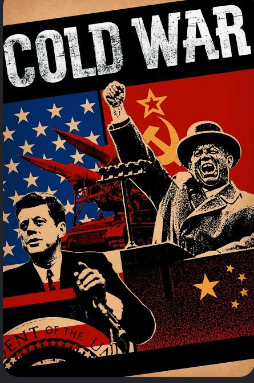
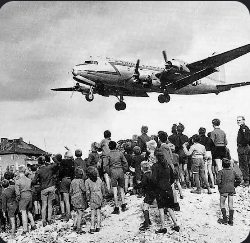
Define Cold War. Explain the basis and causes of Cold War. Write about the phases through which Cold War passed. What are the impacts of Cold War ?
Write a short notes on Cold War.
Definition of Cold War
Write a short notes on Cold War.
The term ‘cold war’ was first used by an American statesman Bernard Baruch.
Write a short notes on Cold War.
Walter Lippmann popularised the term in
1947 with his little book entitled Cold War
wherein he described the situation that had arisen between the Western powers and the Soviet Union.
Write a short notes on Cold War.
The Western powers and the Soviet Union had come
Write a short notes on Cold War.
together to fight against the Axis aggression during the Second World War. However, their relations were suffering from an undercurrent of mutual distrust and jealousy.
Write a short notes on Cold War.
Florence Eliott and Michael Summerskill defined the
cold war as “a state of tension between
countries in which each side adopts policies designed to strengthen itself and weaken the other line falling short of actual hot war.”
Soon after World War II, the cold war engulfed the world—an era of neither peace nor war. But mutual distrust and jealousy guided their relations. This distrust assumed the shape of a rivalry after World War II over the questions of Germany and Japan.
Write a short notes on Cold War.
The Basis of Cold War
Write a short notes on Cold War.
The cold war was based on a number of assumptions. First, they assumed that the military strength of the Soviet Union posed the real threat to world peace. This assumption gave rise to
Write a short notes on Cold War.
the policy of strength, which developed the
Write a short notes on Cold War.
military theory of cold war based on the atom bomb, hydrogen bomb, and clear warfare.
Write a short notes on Cold War.
Secondly, it assumed the ineviability of conflict
between the socialist and capitalist
States, which prompted the states of both the
blocs to keep themselves in condition of constant preparedness for a final show down. It assumed that no co-operation was possible between states with different social system. It was on account of this feeling, the Western powers equated all socialist movements which sub-versive movements. For example, the American interventions from Greece and Turkey in 1947 to Vitenam. It assumed that the struggle between West and East was a struggle between freedom and tyranny.
Write a short notes on Cold War.
Causes of Cold War
Write a short notes on Cold War.
The main factors which contributed to the rise of cold war were as follows-
(1) Firstly, Soviet Union tried to increase its influence in Eastern Europe in violation of the terms of Yalta Agreement.
Thus, the Soviet Union established the Lublin Government in Poland, violating its commitment to include the Polish government-in-exile in London and ensuring that the Soviet-influenced Lublin Government would have proper representation in Poland’s future government.
(2) In the Balkans also, Soviet Union tried to establish communist government despite an understanding with Britain regarding their sphere of influence in the Balkans.
All this aroused the suspicion of the Western powers and they decided to check further expansion of Soviet influence.
Secondly, Soviet Union refused to withdraw its forces from Iran and instigated a rebellion in Northern Ireland. Soviet Union also compelled Iran to sign a treaty on 4 April, 1946 which recognised Soviet interest over oil resources of North Ireland for 25 years. This was in complete contrast to the policy adopted by Britain and USA which withdrew their forces from Iran as per terms of agreement of 1942. The question of presence of Soviet forces in Iran was raised in the UN and ultimately Soviet Union was made to withdraw its forces from Iran. This policy of Soviet Union greatly contributed to sharpening of tension with Western powers.
(3) Thirdly, Russia extended support to the Communist to pull down legally constituted government in Greece which soon engulfed the country in a civil war. This was greatly resented by Britain and USA and they extended every possible assistance to save the democratic government of Greece.
(4) Fourthly, Soviet Union brought undue pressure on Turkey to modify the Straits Convention and demanded certain territories. As Turkey refused to oblige, Soviet Union began to foment trouble in Turkey. Thereupon USA came for the rescue of Turkey against the growing communist threat in Greece and Turkey led to the enunciation of Truman doctrine by USA which pledged support to people who were resisting attempted subjugation by armed minorities or by outside pressures.
(5) Fifthly, the attitude adopted by Soviet Union towards Germany also greatly contributed to cold war. Soviet Union, unmindful of its commitments in the Potsdam Agreement and London Protocol, tried to put unnecessary burden and pressure on the German region under its occupation. It also deprived the people of Germany under Soviet zone of their fundamental political freedom. All this was greatly resented by America and other Western powers.
(6) Sixthly, refusal of United States and other Western powers to accord recognition to the governments of Bulgaria and Rumania also generated tension between the two blocs. The plea of the Western powers that they had refused to extend recognition to these countries on the ground that they lacked popular representation, could not satisfy the Russians.
(7) Seventhly, frequent use of veto powers by Soviet Union during the initial years of the working of United Nations, was also responsible for generating tension between Soviet Union and America. It flouting all their plans. On the other hand, the Soviet Union complained that since United States had manipulated majority in the Security Council, it had no other choice but to make frequent use of its veto power. This sense of distrust towards each other greatly contributed to cold war.
(8) Eighthly, the unnecessary obstacles put by Soviet Union in the way of conclusion of peace treaties also raised a good deal of suspicion in the minds of the American people about the ultimate intentions of Soviet Union.
(9) Ninthly, bitter criticism of the capitalist system and vociferous propaganda against United States also contributed to the tension between the two countries. Soviet Union stepped up its activities in United States and even tried to smuggle out some of the confidential and secret documents. This compelled United States to adopt stiff attitude towards Soviet Union.
(10) Tenthly, the unnecessary delay by the Western powers in opening the second front during the Second World War, and the consequential losses suffered by Soviet Union, made her suspicious about the true designs of the Western powers. The inadequate aid given by the western powers to the Soviet Union during the war, also raised doubts in the minds of Russian leaders about true intentions of their Western allies. This suspicion was further heightened due to the attempt on the part of America and England, to keep their programme of atom bomb secret for Soviet Union and other East European countries.
(11) Finally, the abrupt suspension of the land-lease aid by United States to Soviet Union, soon after the surrender of Germany, convinced the Soviet leaders that the Western powers were jealous of their progress.
All the above factors contributed to the growth of cold war.
Write a short notes on Cold War.
Phases of Cold War
Write a short notes on Cold War.
The cold wars passed through a number of phases. The first phase lasted from 1946 to 1949. During this period, observers held that if they could organize strong pressure, the Ked regime in the Soviet Union would collapse like a house of cards. This feeling arose because America had a monopoly on the Atom Bomb and Russia was in a very weak condition. Therefore, analysts held that U.S.A., due to its superiority in military power, could determine the history of the world and influence the internal affairs of the Soviet Union. America’s allies could not implement the policy of containing the Soviet Union because they lacked adequate military preparedness for such a war. Moreover, memories of the Second World War remained fresh in their minds, which discouraged them from resorting to military action.
During this phase, America resorted to direct military intervention through Truman Doctrine of March, 1947 and economic integration of the West European Powers by Marshall Plan of June, 1947. U.S.A. during this period followed the policy of intervention and defender of status quo. This phase was also marked by anti-communist feeling, which U.S.A. tried to implant throughout the world. This phase of cold war ended with the conclusion of North Atlantic Treaty on April 4, 1949. This treaty was a sort of new Anti-Comintern Pact and was openly directed against the Soviet Union. These activities of U.S.A. naturally provoked Soviet Union to take necessary measures for self-defence.
The second Phase lasted from 1949 to 1953. During this period U.S.A. continued her policy of military and economic assistance against Soviet Union. During this period U.S.A. concluded security treaty with Australia and New Zealand (ANZUS) and Peace Treaty with Japan (1951). This period also witnessed the Korean War which was a major confrontation between U.S.A. and U.S.S.R. The United States intensified her anti-communist propaganda and spent millions of dollars for the purpose. USA also invested huge amounts to carry out subversive activities in the socialist countries. This provoked natural reaction from Soviet Union which exploded the atom bomb and broke-down the American monopoly.
The Third phase of world war listed from 1953 to 1957. During this phase U.S.A. continued her policy of military and economic offensive. USA organised the South East Asia Treaty Organization (S E A T O) and the Middle East Defence Organization (M.E.D.O.). These two treaties became new defence links with N.A.T.O. America also made a serious effort to perpetuate American domination in the Middle East by extending the Truman Doctrine to this area. U.S.A. also established a number of military bases around Soviet territory and concluded defence treaties with 43 states. It was also during this period that U.S.A. involved herself in Vietnam, which turned out to be a grim climax of the Cold war.
During this phase Soviet Union also increased her influence.
Soviet Union sponsored WARSAW Treaty with
East European powers as a states and foiled the American attempt to promote counter-revolution in Hungary. This period also witnessed the permanency of the Potsdam partition of Germany.
The subsequent establishment of two
German States allied to the two bloc was also the outcome of cold war during this period. The phase also saw simultaneous explosion of hydrogen bombs by U.S.A. and Soviet Union.
The fourth phase lasted from 1957 to 1962. It saw two extreme trends. On the one hand, the
principles of peaceful co-existence were asserted and on the other hand, it saw the most dangerous strain prevailed. The two countries exchanged cultural and political delegates. The heads of governments of two countries paid visits to each other. The agreement for Paris Summit clearly demonstrated that the cold war attitude had ended.
But this spirit was sabotaged by the U-2 incident
when an American Lockheed U-2 spy plane was shot down by Soviet Union on May 1,1960.
The damage done by the U-2 incident was partly
repaired by the General Assembly Summit of 1960 and the Vietnam mecting of Khrushedev and President Kennedy in 1961.
But the Cuban crisis literally brought the two countries to the verge of war. However, the situation
was finally saved by an agreement between
Khrushedev and Kennedy by which
Soviet Union agreed to withdrawal the missile base in exchange for the American guarantee never to invade Cuba.
The fifth phase started from 1962 and is marked by a deep appreciation of the futility of nuclear war strategy. This phase saw the conclusion of “Partial Test Ban Treaty” of 1963. By the Geneva Hot-Line Agreement of 1963 the two countries were closely linked. The Non-Proliferation Treaty of 1968 could also be concluded due to the understanding of the two powers.
Another important step in the direction of
casing the cold war was the
Three Power Partial Nuclear Test Ban Treaty formally signed on 5 August, 1963. This treaty provided for a limited ban on all nuclear tests in the atmosphere including territorial waters or high seas. On the recommendations of the General Assembly United States. Soviet Union and Great Britain adopted the Nuclear Non-Proliferation Treaty. Under this treaty the nuclear powers agreed not to transfer their nuclear weapons or control over them to any non-nuclear power or the provide assistance in producing those weapons.
The cold war assumed new dimension in the wake of Sion-Soviet rift in early sixties.
This cold war between Soviet Union and China brought about a thaw in the traditional cold war between Soviet Union and United States.
In the wake of American bombing on North Vietnam, the Arab-Israel conflict of 1967 and the Soviet military intervention in Czechoslovakia in 1968, assumed more serious shape to the cold war.
Write a short notes on Cold War.
During the Berlin crisis of 1969 there was a possibility of direct confrontation between the two super-powers.
Write a short notes on Cold War.
However by 1970, the tension somewhat subsided and the two super powers agreed not to use force against each other. Soviet Union concluded a treaty with West Germany under which it agreed to have diplomatic relations with West Germany and not to use force against it. This helped in reducing tension in Europe. In August, 1971 as a result of agreement over Berlin between U.S.A., Britain, USSR and France, the tension further subsided. The agreements between North Korea and South Korea and East Germany, signed on 4 July 1972 and 8 November 1972 respectively, also contributed to the reduction of tension between the two superpowers.
Write a short notes on Cold War.
In the field of arms limitations, significant progress also occurred during this period.
Write a short notes on Cold War.
In 1973, Brezhnev, the Chief of the Communist Party of the USSR, paid a return visit to Washington, and they held Summit talks.
Write a short notes on Cold War.
These talks the two parties agreed to work for lasting world peace and to end the nuclear arms race. This summit talk resulted in the conclusion of four agreements between the two countries. These agreements related to co-operation in the field of research in agriculture, transportation, and expansion of cultural and scientific exchanges between the two countries. The two countries also committed themselves to negotiate a treaty for mutual reduction of nuclear weapons, and co-operation in nuclear power research. The two countries also undertook to avoid nuclear war not only between then but also with the third state. The leaders of the two countries asserted that a lasting peace in Europe was the paramount goal of their policy and pledged to work for the success of the Conference on European Security scheduled to be held at Helsinki in July, 1973.
Write a short notes on Cold War.
Despite, the he Change in leadership in USA, the above agreements did not mark any change. Further, leaders of these countries attended the Summit Conference on Security and Cooperation in Europe held at Helsinki in July, 1975 and an atmosphere of complete detente between the two supers powers prevailed. In July, 1975 the two super powers participated in the joint Apollo-Soyuz space mission, which was an important indication of the cordial relations. But despite the detente, there were many points of conflict between the two powers and they tried to check each other’s influence.
Write a short notes on Cold War.
The cold war which somewhat subsided during the early seventies got once again reactivated following. Soviet intervention in Afghanistan in 1979. The western powers were so bitter about it that they decided to boycott Olympic Games held at Moscow in July, 1980. In the subsequents years also the two super powers adopted critical attitude towards their opponents. People described this new phase of the Cold War as the “New Cold War” or the “Second Cold War.” It differed from the earlier Cold War in several respects.
Write a short notes on Cold War.
First, unlike the earlier Cold War, this phase mainly involved the two superpowers.
Write a short notes on Cold War.
Second, both superpowers engaged in a nuclear arms race, making this phase more threatening than the earlier Cold War. Thirdly, the element of ideology which was a dominant feature of the earlier cold war, was conspiciously absent this time.
Write a short notes on Cold War.
Impact of Cold War
Write a short notes on Cold War. The Cold War gave rise to permanent military alliances, which countries formed well in advance of any war. The major alliances, including NATO, SEATO, CENTO, and the Warsaw Pact, emerged during the Cold War. This system of alliances covered most countries of the world. Thus, the Cold War encouraged countries to form alliances even during peacetime, and they continuously worked to strengthen these alliances. However, the newly independent states of Asia and Africa tried to avoid alignment with either of the two groups.
Write a short notes on Cold War.
Cold war stood in the way of achieving the objective of one world. The mutual rivalry reduced the U.N.O. to the states of a simple forum of world opinion. The cold war prevented some of the states from becoming members of the world body. The denial of representation to people’s China in the Security Council for a long time was mainly due to this Cold war.
Write a short notes on Cold War.
Cold war resulted in made race for armaments. States of both the blocs spent huge amounts to equip themselves with latest weapons.
Write a short notes on Cold War.
Cold war adversely affected the economic development of the country by diverting human labour an resources to the manufacture of destruction weapons.
Write a short notes on Cold War.
The cold war and the consequent competition among Great Powers resulted in more freedom of action for the small and middle powers. Each group tried to win them over. The influence which the afro-Asian countries were able to exert in the U.N. cold war.