Describe briefly the contents of the Nuclear Ban Treaty
Describe briefly the contents of the Nuclear Ban Treaty or Non-Proliferation Nuclear Treaty.
Briefly the contents of the Nuclear Ban Treaty
Non-proliferation Nuclear Treaty
Describe briefly the contents of the Nuclear Ban Treaty
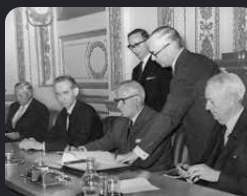
This treaty was signed at Moscow, the capital
of Soviet Russia, on August 5, 1963 but it came into force on October 10, 1963. So far a hundred countries of the world have signed this treaty. The government of the United States of America, the United Kingdom of Great
Britain and Northern Ireland, and the Union of Soviet Socialist Republic were “Original parties”. They proclaimed that their
principal aim is the speediest possible achievement of an agreement
on general and complete disarmament under strict international control in accordance with United Nations. The objectives of the United Nations is
to put an end to the armament race, eliminate
the incentive to the production and testing of all kinds of weapons, including nuclear weapons.
Describe briefly the contents of the Nuclear Ban Treaty
Seeking to achieve the
discontinuance of all test explosions of nuclear weapons for all time these nations determined to continue negotiations to this end. Resolutions for Non-proliferation Nuclear Treaty are as follows:-
Describe briefly the contents of the Nuclear Ban Treaty
Each of the Parties to this
Treaty undertakes further more to refrain from causing, encouraging, or in any way participating in, the carrying out of any nuclear weapon test explosion, or any other nuclear explosion, anywhere which could take place in any of the environments described, or have the effect referred to, in paragraph of this article.
Describe briefly the contents of the Nuclear Ban Treaty
Each of the parties of this
Treaty undertakes to prohibit, to prevent, and not
to carry out any nuclear weapons test explosion, or any other nuclear explosion, at any place under its jurisdiction or control.
(a) In the atmosphere beyond its limits, including outer space; or under water, including territorial waters or high seas; or
(b) The parties understand that if an explosion in any other environment releases radioactive debris beyond the territorial limits of the state that conducts or controls it, this provision will not prevent them from concluding a treaty that permanently bans all nuclear test explosions, including underground tests, as stated in the Preamble to this Treaty.
Any party may propose amendments to this Treaty. The text of any proposed amendment shall be submitted to the Depositary Governments which shall circulate it to all Parties to this Treaty. Therefore, it requested to do so by one-third or more of the Parties, the Depositary Governments shall convince a conference to which shall invite all the Parties, to consider such amendment.
Any amendment to this Treaty must be
approved by a majority of the votes of all the Parties to this
Treaty, including the votes of all of the Original Parties.
The amendment shall enter into force for all Parties
upon the deposit of instruments of ratification by a
majority of all parties including the instruments of ratification of all of the Original parties.
Describe briefly the contents of the Nuclear Ban Treaty
Provision for Membership
This treaty shall be open to all states for signature.
This treaty shall be subject to ratification by signatory states. The Original Parties—the United States of
America, the United Kingdom of Great Britain and Northern Ireland, and the Union of Soviet Socialist Republics—shall deposit their instruments of ratification and accession with their respective Governments, which shall serve as the Depositary Governments.
For states that deposit their
instruments of ratification or accession after this Treaty enters into force, the
Treaty shall enter into force on the date they deposit those instruments.
The treaty shall enter into force
after its ratification by all the Original Parties
and the deposit of their instruments of ratification.
The Depositary Governments
shall promptly inform all signatory and acceeding states of the
date of each signature, the date of deposit of each instrument of ratification of accession to this Treaty, the date of its entry into force, and the date of any requests for conferences or other notices.
This treaty shall be registered by the Deposits,
related to the subject matter of this Treaty, have jeopardized the supreme interests of its country. It shall give notice of such withdrawal to all other Parties to the Treaty three months in advance. Peaceful Uses
(i) All parties to the
treaty affirmed the principle
that the-benefits of peaceful applications of nuclear
technology, including any technological by-products
which may derived by nuclear-weapon states from
the development of nuclear explosive devices,
should be available for peaceful purposes to all parties to the treaty, whether nuclear weapon or non-nuclear weapon states.
Describe briefly the contents of the Nuclear Ban Treaty
Convinced that in furtherance
of this principle, this treaty entitles all parties to participate
in the fullest possible exchanges of scientific
information to contribute alone or in
co-operation with other states to the further development of the applications of atomic energy for peaceful purposes.
Describe briefly the contents of the Nuclear Ban Treaty
(iii) Declaring their intention
that potential benefits from any peaceful applications
of nuclear explosions should be available
through appropriate international procedures
to non-nuclear-weapons state party to this treaty
on a non-discriminatory basis
and that the charge to such parties
for the explosive devices used should be as low as possible and excluded any charge for research and development.
Describe briefly the contents of the Nuclear Ban Treaty
(iv) Declaring their intention
to achieve at the carliest possible date the
cessation of the nuclear arms race,
urging the co-operation of all states in the attainment of this objective.
Describe briefly the contents of the Nuclear Ban Treaty
(v) Desiring to further the casing of international tension and the strengthening of trust between states in order to facilitate the cessation of the manufacture of nuclear weapons the liquidation of all their existing stockpiles and the elimination from delivery pursuant to a treaty on general and complete disarmament under strict and effective international control.
Describe briefly the contents of the Nuclear Ban Treaty
All parties to the treaty have agreed as follows-
Each nuclear weapons state party to this treaty undertake not to transfer to any recipient whatsoever nuclear weapons or other nuclear explosive devices or control over such weapons or explosive devices directly or indirectly, and not in any way to assist, encourage or induce any non-nuclear weapon state, to manufacture or otherwise acquire nuclear weapons or other nuclear explosive devices or control over such weapons or explosive devices.
Each non-nuclear weapons state party to this treaty undertakes not to receive the transfer from any power whatsoever of nuclear weapons of other nuclear explosive devices or of control over such weapons explosive devices, directly, or indirectly, not manufacture or otherwise acquire nuclear weapons or other nuclear explosive devices; and not to seck or receive any assistance in the manufacture of nuclear weapons of other nuclear explosive devices. International Control
Nothing in this treaty shall interpret as affecting the inalienable right of all the parties to the treaty to develop research, production and use of nuclear energy for peaceful purposes without discrimination as well as the right of the parties to participate in the fullest possible exchange of information for, and to contribute alone or in co-operation with other states to the further development of the application of nuclear energy for peaceful purposes.
(a) Any party to this treaty may propose amendment to this treaty. The Depositary Governments shall submit the text of any proposed amendment, circulate it to all parties to the Treaty, and convene a conference to consider the amendment, inviting all parties to attend.
(b) All parties to the Treaty must approve any amendment by a majority vote, including the votes of all nuclear-weapon states that are parties to the Treaty and all other parties that, on the date the amendment is circulated, are members of the Board of Governors of the International Atomic Energy Agency.
Five years after this Treaty enters into force, the parties shall hold a conference in Geneva, Switzerland, to review its implementation and ensure that the Treaty achieves its purposes and fulfills its provisions.
(a) This treaty shall be open to all states for signature. Any state which does not sign the treaty before its entry into force in accordance with Paragraph C of this article any accede to it any time.
(b) All parties to the Treaty must approve any amendment by a majority vote, including all nuclear-weapon states that are parties to the Treaty and all other parties that are members of the Board of Governors of the International Atomic Energy Agency on the date of the amendment’s circulation.
(a) This treaty shall enter into force after its ratification by all other states nuclear-weapon states signatory to this treaty, and signatory to this treaty, and the deposit of their instrument of ratification, for the purpose of this treaty; a nuclear weapons state is one which has manufactured and exploded a nuclear weapons or other nuclear explosive device prior to January 1, 1967.
The states that deposit their instruments of ratification of accession after the entry into force of this treaty shall have it enter into force on the date of the deposit of those instruments.
(c) The depositary governments shall promptly inform all signatory and acceding states of the date of cach signature, the date of deposit of each instrument of ratification or accession, the date of the entry into force of this treaty, and date of receipt of any request for convening a conference or other notices.
Describe briefly the contents of the Nuclear Ban Treaty
(d) This treaty shall be registered by the depositary governments pursuant to Article 102 of the Charter of the United Nations.
This treaty shall be of unlimited duration.
Describe briefly the contents of the Nuclear Ban Treaty
Each party shall, in exercising its national sovereignty, have the right to the subject-matter of this treaty, have jeopardized the supreme interests of its country. It shall give notice of such withdrawal to all other parties to treaty and to United Nations Security Council there months in advance. Such notice shall include a statement of the extraordinary events it regards as having jeopardized its supreme interests.
Describe briefly the contents of the Nuclear Ban Treaty
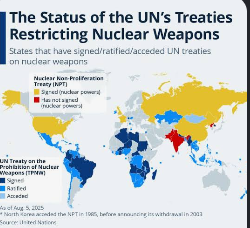
This treaty, the English, Russian, French, Spanish and Chinese texts of which are equally authentic, shall deposited in the archives of the depositary governments. Duly certified copies of this treaty shall be transmitted by the depositary governments to the governments of the signatory and acceding states. The Prospect of Nuclear Proliferation Nuclear weapons pose a particularly destructive threat. Prevention of the proliferation and use of nuclear weapons is urgently important to public health. The likelihood is that additional states will acquire nuclear weapons, writes Prof. Osgood, and the probable consequences of their doing so present problems of analysis for beyond technological prediction of strictly military considerations. Thus it is clear that the next political incentive or disincentives for a state to build nuclear weapons has been as important in determining the number of nuclear powers as the technological and economic capacity of states, since several nuclear states Canada, West Germany, Japan, Italy, India and Sweden-have at least as great a capability to acquire nuclear weapons as China.
Describe briefly the contents of the Nuclear Ban Treaty
In the next ten to fifteen years, says Prof. Osgood the spread of plutonium production for civilian energy will probable enable at least 2 dozen more states to build nuclear weapons with limited delivery capabilities if they should decide to make the effort, if all these states should rush into nuclear production as fast.In order to pose a nuclear threat, nations or other entities not only need these weapons but also need missiles or other methods for delivering them.
Describe briefly the contents of the Nuclear Ban Treaty
‘Instinctively, the United States and the Soviet Union oppose the spread of nuclear weapons, not only because they do not want competition, but also because they have become very sensitive to the dangers of nuclear and do not want the problem of keeping these dangers under control complicated by the addition of other fingers on nuclear triggers.
Describe briefly the contents of the Nuclear Ban Treaty
Controlling proliferation of nuclear weapons is one of the major challenges we face as a global society. Given that public health is “what we, as a society, do collectively to ensure the conditions in which people can be healthy,” controlling the proliferation of nuclear weapons and ultimately abolishing them must be a major global health priority. Securing genuine guarantees to non-nuclear states through the United Nations would be of no use because the Security Council cannot be expected to apply conventional force against a major aggressor. ‘Among the major international competitors there are no common interests, requiring the use of force that can be relied upon to take precedence over special national interests. Following the first Chinese atomic explosion, he announced in a national address on October 18, 1964, “The nations that do not seek national nuclear weapons, can be sure that if they have strong support against some threat of nuclear black-mail then they will have it.”
Describe briefly the contents of the Nuclear Ban Treaty