What are the various kinds of Dower ? What are the presumptions regarding prompt and deferred dower?
What are the various kinds of Dower ?
Here we will learn the topic What are the various kinds of Dower ? in detail.
What are the various kinds of Dower ?
Dower is a sum of money or other property which the wife is entitled to receive from the husband in consideration of marriage. The various kinds of dower are as follows
What are the various kinds of Dower ?
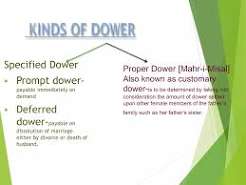
Specified Dower ( Mahr-i- Musamma)
Unspecified Dower ( Mahr-i-Misl) or
Proper Dower or
Customary Dower
Here we will learn the topic What are the various kinds of Dower ? in detail.
Specified Dower
What are the various kinds of Dower ?
Usually the Mahr is fixed at the time of marriage and Kazi performing the marriage enters the amount in the
register or in a regular contract called Kabin-nama, with numerous conditions. The amount of Mahr may be fixed either at the time of marriage or later, and the father’s contract on behalf of a minor son is binding on the minor. A minor, on attaining the age of puberty cannot take the plea that he was not a party to the contract of marriage.
The husband may settle any amount of Mahr for his wife, though it may leave nothing to his heirs after payment of the amount. But in any case he cannot settle the dower less than ten dhirams according to Hanafi law and three dhirams according to Maliki law. Shia law does not fix any minimum amount for the dower.
What are the various kinds of Dower ?
Specified Dower (Mahr) is further divided into two kinds
(i) Prompt Dower (muajjal mahr)
(ii) Deferred Dower (muwajjal mahr).
What are the various kinds of Dower ?
(i) Prompt Dower
What are the various kinds of Dower ?
Prompt Dower is payable immediately after marriage on demand. According to Ameer Ali, a wife can refuse to enter into the conjugal domicile of the husband until the payment of the prompt dower. The following points are notable regarding prompt dower
The husband must pay the Prompt Dower immediately upon the marriage taking place, and he must pay it on demand, unless he stipulates for or agrees to delay. The wife may realize it at any time before or after the marriage. The wife may refuse herself to her husband until he pays the Prompt Dower. If the wife is minor, her guardian may refuse to allow the husband to send her to his house till he pays the Prompt Dower.
(b) Prompt dower does not become deferred after consummation of marriage, and a wife has absolute right to sue for recovery of prompt dower even after consummation. After consummation, she cannot resist the conjugal rights that the husband exercises if he has not paid the prompt dower.
(c) The husband becomes entitled to enforce the conjugal rights only after he pays the prompt dower unless the marriage is already consummated. The dower payment triggers the right of restitution.
(d) As the prompt dower is payable on demand, limitation begins to run on demand and refusal. The period of limitation for this purpose is three years. If during the continuance of marriage, the wife does not make any demand, the limitation begins to run only from the date of the dissolution of marriage by death or divorce.
Although Muslim Law requires a husband to pay prompt dower immediately on demand, yet in a large majority of cases
husbands rarely demand it and rarely pay it; in practice a Muslim husband generally gives little thought to paying dower
to his wife save when domestic disagreement arises, or when the wife presses him for payment upon his embarking upon
a course of extravagance and indebtedness without making any provision for her.
What are the various kinds of Dower ?
(ii) Deferred Dower
What are the various kinds of Dower ?
Deferred dower is payable on dissolution of marriage either by death or divorce. According to Ameer Ali, generally in India deferred dower is a penal sum with the object to compel the husband
to fulfil the marriage contract in its entirety. Following points are notable regarding the deferred dower :-
(a) Deferred dower is payable on dissolution of marriage by death or divorce. But if there is any agreement as to the payment of the deferred dower earlier than the dissolution of marriage such an agreement would be valid and binding.
(b) The wife cannot demand payment of deferred dower (unless otherwise stipulated), but the husband can treat it as prompt and pay or transfer the property in lieu of it. The husband will not render such a transfer void as a fraudulent preference unless actual insolvency is involved.
(c) The widow may relinquish her dower at the time of her husband’s funeral by the recital of a formula. Such a relinquishment must be a voluntary act of the widow.
(d) The interest of the wife in the deferred dower is a vested one and not a contingent one. It is not liable to be displaced by the happening of any event, not *even on her own death and as such her heirs can claim the money if she dies.
Presumption Regarding Prompt and Deferred Dower
The parties divide the amount of dower into two parts:
(i) One is called ‘prompt’ which the husband pays on demand, and
(ii) People call the other ‘deferred’ which the husband must pay on dissolution of marriage by death or divorce. The wife may realise the prompt portions of the dower at any time before or after consummation. The husband may not pay dower at once, and for that reason one may describe it as deferred dower, but if he postpones it until the wife demands it, the law considers it prompt dower. But the deferred dower does not become prompt merely because the wife demands it.
What are the various kinds of Dower ?
If the Kabin-nama fixes the amount of dower but fails to show what portion of it will be prompt and what deferred dower, the Allahabad and Bombay High Courts should fix the proportion between the two on the basis of
(i) position of wife, (ii) custom of locality, (iii) total amount of dower, (iv) status of husband.
What are the various kinds of Dower ?
Shia Law
What are the various kinds of Dower ?
Under Ithna Ashari Shia law, if the Kabin-nama fixes the total amount of dower but does not specify what portion of it will be prompt and what deferred, the law regards the whole of the dower as prompt. In the Madras Presidency, unless otherwise stipulated the entire dower is prompt no matter if the parties are Shia or Sunni.
What are the various kinds of Dower ?
Sunni Law
What are the various kinds of Dower ?
According to Sunni Law, in the absence of any family usage and statement in Kabin-nama, the law regards half of the total amount as prompt and half as deferred.
What are the various kinds of Dower ?
(2) Unspecified or Proper (Customary) Dower
If the marriage contract does not fix the amount of dower or if the parties contract the marriage on the condition that the wife should not claim any dower, the wife can claim Proper dower. The wife or the court determines the proper dower by considering the amount of dower settled upon other female members of the father’s family such as her father’s sisters.
Here we will learn the topic What are the various kinds of Dower ? in detail.
Determination of Proper Dower
What are the various kinds of Dower ?
The following factors regulate the proper dower (Mahr-i-misl) :-
(a) Personal qualifications of wife; her age, beauty, fortune, understanding and virtue.
(b) Social position of her father’s family.
(c) Dower given to her female paternal relations.
(d) Economic condition of her husband.
(e) Circumstances of time.
There is no limit to the maximum amount of proper dower under the Sunni law. But under the Shia law the proper dower should not exceed the 500 Dirhams. They fixed 500 Dirhams as the dower in the marriage of Fatima, the Prophet’s daughter.
What are the various kinds of Dower ?
Here we will learn the topic What are the various kinds of Dower ? in detail.