What are the various aspects of Muslim marriage ? Also explain nature and objectives of Muslim Marriage.
Here we will learn the topic What are the various aspects of Muslim marriage ? Also explain nature and objectives of Muslim Marriage. in detail
The Arabic word Nikah (Muslim Marriage) literally means the union of the sexes. Under Muslim law marriage is a civil contract for legalisation of the intercourse and for legitimation of the children. Marriage in Islam paves way to the fulfilment of the rights and duties of both husband and wife. It is also a shield from committing sins and immoral activities. Marriage provides a favourable environment to build a strong and healthy family and a prosperous community.
Nature and Concept of Muslim Marriage
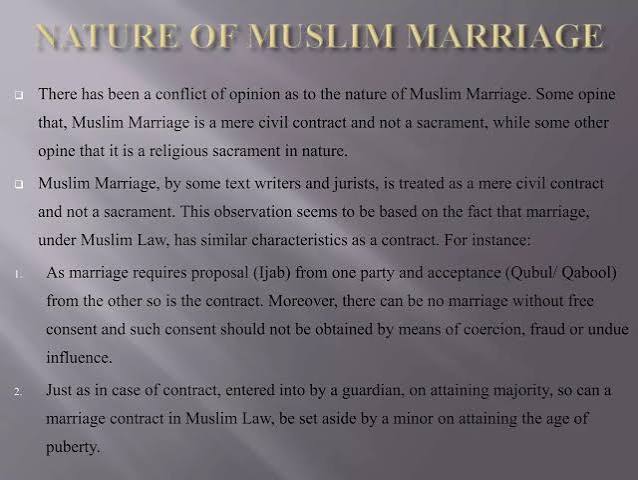
Legally speaking, Muslim-marriage is a contract. Therefore, its legal nature is contractual. Although a Hindu marriage also contains the elements of contract. However, the nature of a Hindu marriage is sacramental because it involves certain religious ceremonies. Muslim marriage is against this sacramental nature of a Hindu marriage, that J. Mahmood defined Muslim-marriage as a civil contract. But this is only the legal aspect. Besides being a civil contract, the marriage in Islam is also a social and religious institution. A court of law may not take into account its social or religious aspects, but one cannot understand the true nature of Muslim marriage without studying all its aspects. Infact a Muslim marriage has the following three aspects
Legal Aspect
Legally, Muslims consider a Muslim marriage as a civil contract. The following facts may explain the contractual nature of a Muslim marriage.
(i) The parties to the marriage must be competent,
(ii) There must be offer and acceptance,
(iii) There must be a free consent of the parties or of their guardians,
(iv) Like a civil contract, the tems of marriage-contract, within legal limits, may be settled by the parties themselves.
(v) Just like a civil contract, there is also a provision for the breach of marriage in the form of various kinds of divorce.
Thus, the composition of Muslim marriage is similar to that of a civil contract. But only on the basis of the above-mentioned contractual elements, it is not correct to define it as purely a civil contract. In its form or appearance a Muslim marriage may look like a contract but it is not so in its essence as is evident from its social aspect.
Social Aspect
It may be noted that Nikah is a social institution on the basis of the following arguments
(i) In civil contracts general rule is that there is no liability to pay consideration if it has not been specified in the contract. But, in a Muslim marriage, even if the amount of dower has not been specified, the law requires the husband to pay something (proper dower) to the wife as a mark of respect towards her.
(ii) There is limited polygamy under Muslim law and a person is not allowed to marry with more than four wives at a time. In civil contracts, one may enter into as many contracts at a time as he likes.
(iii) There is prohibition in the marriage between certain close relatives. Has marriage been purely a civil contract, the relationship of the parties to the marriage would not have been a relevant factor.
(iv) Moreover, there are certain circumstances in which the Muslim law disapproves the contract of marriage. For Example-A Shia Muslim is not allowed to marry during a religious journey (Haj). More truly, it is an effective social institution for the uplift and betterment of the women.
Religious Aspect
It may be noted that Quran, directs every Muslim to marry a suitable woman of his liking. It is, therefore, a religious, duty of every Muslim to contract a marriage according to the rules of Islam. A person who remain bachelor without any reasonable excuse, disobeys the words of God. It is believed in Islam that marriage is an act of such a nature that if a person does it, he gets religious benefits; if he abstains from doing it, then he commits a sin. The Holy Prophet, the best role model for the Ummah is an ideal for the Muslim community. His attitude, behaviour, kindness and generosity with his wives is an important component of Islamic law.
Thus, marrying a suitable girl is not only social activity but also a religious duty of every Muslim. In Anis Begam Vs. Mohd. Istafa, 1933, (All.), Sulaiman, C. J. has pointed out that apart from being a contract, a Muslim marriage is also a religious sacrament.
Conclusion
Taking into account all the three aspects, we may conclude that as far as the nature of a Muslim marriage is concerned, in form or appearance it is contractual but in essence its nature is undoubtedly socio-religious. Hence , a Muslim marriage, (i) Creates the rights and obligations of the husband and wife; (ii) Confers a definite social status on them, and. (iii) it is also their religious duty.
Objectives of Marriage
The objects of Muslim marriage are
Legalising sexual intercourse;
Procreation of legitimate children;
Ordering of a domestic and social life,
Upbringing of virtuous children,
Keeping discipline of the family and respectability of the wife and children.
Here we will learn the topic What are the various aspects of Muslim marriage ? Also explain nature and objectives of Muslim Marriage. in detail