
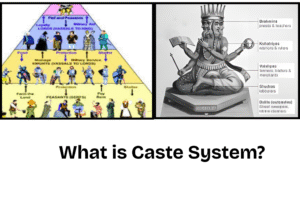
What is Caste System ? Explain types and features of Caste System in detail
Introduction of Caste System
Today among the divisive forces that afflict our national life, disrupt the bonds of unity among the Indian people and affect its development. Caste is in the major use of the society. The frequent instances of caste confrontation, leading even to occasional outbursts of violence both in urban centers and the countryside force themselves on our attention. The issue of reservation in services and higher educational institutions on a caste basis raises a storm occasionally. When during the election, the political and programmatic appeal does not become the central issue, we witness a rising tide of caste identification and caste animosities.
Here we will learn the topic What is Caste System ? Explain types and features of Caste System in detail
Meaning of Caste
The caste system is a traditional social stratification system in India where society is divided into different groups based on birth, occupation, and social status.
In this system, a person’s caste is determined by birth and usually remains unchanged throughout life. Each caste has its own rules, customs, traditions, and social responsibilities.
The caste system influences marriage, occupation, food habits, social relationships, and social status.
Definitions of Caste by Scholars
1. Herbert Risley
According to Herbert Risley,
“A caste may be defined as a collection of families bearing a common name, claiming a common descent, following the same occupation and regarded by those who are competent to give an opinion as forming a single homogeneous community.”
2. G. S. Ghuraye
G. S. Ghuraye defined caste as a social system characterized by segmental division of society, hierarchy, and restrictions on marriage and occupation.
3. M. N. Srinivas
According to M. N. Srinivas,
“Caste is a hereditary, endogamous, and usually localized group having a traditional association with an occupation and a particular position in the hierarchy.”
4. Charles H. Cooley
According to Charles H. Cooley
“When a class is somewhat strictly hereditary, we may call it a caste.”
5. N. K. Dutt
According to N. K. Dutt,
“Caste is a system of social stratification in which membership is determined by birth and fixed for life.”
Here we will learn the topic What is Caste System ? Explain types and features of Caste System in detail
Features (Characteristics) of Caste System
1. Hereditary Membership
2. Social Hierarchy
3. Endogamy
4. Occupational Restriction
5. Social Restrictions
6. Purity and Pollution
7. Segmental Division
Aim of the Caste System
-
To maintain social order and stability in society.
-
To organize society into structured groups.
-
To regulate social relationships and behavior.
-
To maintain occupational specialization.
-
To preserve cultural and religious traditions.
Objectives of the Caste System
-
To maintain social discipline and control.
-
To define the roles and responsibilities of individuals.
-
To preserve the purity of social groups.
-
To provide social identity and status.
-
To maintain continuity of traditional occupations.
Functions of the Caste System
1. Social Organization
2. Social Identity
3. Division of Labour
4. Social Security
5. Cultural Preservation
6. Regulation of Marriage
Here we will learn the topic What is Caste System ? Explain types and features of Caste System in detail
Types of Caste System
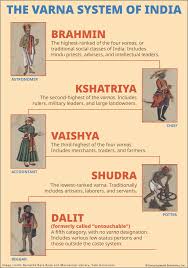
1. Varna System
The traditional four-fold division of society in ancient India.
-
Brahmins – Priests and scholars
-
Kshatriyas – Warriors and rulers
-
Vaishyas – Traders and merchants
-
Shudras – Laborers and service providers
2. Jati System
3. Scheduled Castes (SC)
4. Scheduled Tribes (ST)
5. Other Backward Classes (OBC)
Caste Class Equations
In addition to the ritual hierarchical order of the caste system, several scholars have categorized castes as upper and lower, equivalent to class divisions. The studies of K.N. Raj, Andre Betielle, MN. Srinivas and Kathleen Gouch confirm the fact that there is a correspondence between caste and class that the rich landlords and peasants generally come from the higher castes such as Brahmins, Bhumihars, Rajput, and Thakurs. At the same time, the Harijans, Adivasis, and tribals contribute the bulk of agricultural labor. However, caste and class cut across each other at the intermediary level. Most members of the middle castes, such as Jats, Gujjars Yadavs, and Kurmis, are small and medium peasants and tenants, though there has been an upward movement. This is especially true of northern regions of Rajasthan, UP, and Gujarat; but is also becoming visible in the South as in Tamil Nadu and Karnataka. By and large, the tiny land holding poor peasants come from the lower castes and also work as agricultural laborers
In this context, Muncher writes, “Looked at from the bottom up, the system has two striking features. Second, one of the system’s functions has been to prevent the formation of classes with any commonality of interest or unity of purposes. Caste stratification has been a deterrent to the development of “class conflict” or “proletarian consciousness”. This is because “caste derives its validity from its partial making of extreme socio-economic differences. “Those who have emphasized a study of the Hindu value system to analyse caste have illustrated that ‘untouchables and other lower sections of Hindu society’ and attempting to achieve a substitute for heredity as a basis of rank.
K.L. Sama points out that most of the consideration is that classes are not found as a system of stratification in the same way as castes are entrenched in Indian society and that most of the “problems created by the caste system are still of class nature, related to economic domination and subjugation, privileges and deprivations, and “conspicuous waste” and bare survival. These problems are essentially those of the “Haves” and the ‘Have-nots’, and one can group them strictly in a Marxian sense, as class antagonism, class consciousness, and class unity are absent.
First, Caste or Jati is a localized social group with common socio-cultural bonds. Despite several efforts, no all-India caste organization has so far existed. Second, caste does not just form a social group.. Production and distribution systems have remained caste-based for centuries, not with standing intra and inter-caste mobility and regional variations in the social hierarchy. With the introduction of the capitalist system, the consequent penetration of capital, and the competitive political system, certain changes have taken place in the features characterizing the caste system. Production is no longer based on caste, weakening the system’s rigid hierarchy.
Nonetheless, social bond perpetuates caste соnsciousness and division among the subordinate classes. It is not, however, a major stumbling block in the unity of the upper-caste – class in the economic sphere. Such a situation works to the advantage of upper caste/class entrepreneurs who seek support and mobilize their poor caste brethren who can desire in their intra-class faction, flight. Whenever needed such support also legitimizes the dominance of the haves and have-nots. The reality of caste in a democratic system was considered a stumbling block and an important means of political consciousness.
Caste System in India during Colonial Period
Caste has always been a potential and actual weapon in keeping the people divided and weak in the face of any challenge. More than a hundred and fifty years back Marx remarked, “How came it that English supremacy was established in India? Such a country and society, were they not the predestined prey of conquest?” Nevertheless, during the colonial period effectively in politics itself, the existential realities of the caste system began to be different from its typical ideal form.
On the other hand, the traditional aspects of the caste were getting changed and on the other hand caste was acquiring new dimensions and functions – political. For administrative purposes, the British government had brought a good deal of improvement in communication. The immediate affect of this, write Srinivas, was that it increased caste consciousness and inter – caste competition. This happened because now it was possible for the caste relation to outgrow its regional and developcaste association so as to bargain for some concessions from the British government on the plea of backwardness in order the catch upwith the advanced castes. At the same time the caste associations worked for elevation of social status. This backwardness was claimed in the secular context and a high status in a ritual context. This was a new dimension and function of caste, unknown before
Thus, we find that the caste system began to acquire new functions and dimensions in the changing social, economic and political ambience of the pre- independence period. I undermined the vocational basis of caste, its economic rationality, its interactional restriction and as spatial and political isolation. However, changes in the caste system notwithstanding, the grip of this institution on the social matrix didn’t loosen to any appreciable extent. ‘Caste continued to persist, albeit in a different form from its feudal embodiment.’
Caste System in India after Independence
A democratic polity based on the principle of the adult franchise was perhaps the most crucial factorthat reinforced caste with a lot of vigor. According to Moin Shakir, there is a dual role of caste in the post-independence era: democratizing the system and hampering the rise of evolutionary class organizations. The type of mass politics operating after independence is radically afferent from that of British India. The compulsions of the democratic system, to mobilize the illiterate people, who cannot understand politics in terms of class interests make it imperative to appeal to the caste sentiment because it pays dividends. Its activises are primordial institutions. Thus caste, religion, etc become relevant inputs in the main politics in India.
As regards the mobilisation of the people on the basis of castes, Rudolph and Rudolph say that there are three types of mobilisations. They are as follows: –
-
Vertical mobilization,
-
Horizontal mobilization
-
Differential mobilization
-
Vertical mobilization: – It is the marshalling of the political support by traditional notables in local societies that are organized and integrated by rank, mutual dependence and the legitimacy of traditional authority.
-
Horizontal mobilization: – It involves the marshalling of political support by class or community leaders and their specialized organization.
-
Different Mobilization: – It involves marshalling of direct or indirect political support by political support by political parties (and other integrative structures) from viable but internally differentiated communities through parallel appeals to ideology, sentiment and interest. Political implication of this development is recruitment of leaders, provision for political personnel, legitimisation of the traditional authority pattern and creation of group consciousness and divisions along narrow sectarian lines.
The primary function from of caste politics, suggests Moin Shakir had been to transfer authority from higher to the middle castes. Those who were the lowest of the low untouchables, landless peasant’s rural poor – were not benefited by this new political arrangement. The class interests of the emerging rural elite could best be protected through an alliance with the urban bourgeoisie. Thus, adult franchise democratic decentralisation, Panchayati Raj institutions have, in practice, helped the ruling classes in consolidating their rule by using caste in Politics. The new rural and urban elites have developed vested interests in the perpetuation of “caste in politics”. Irawati Karve perpetuating rightly points out that politicians who enjoy privileged position aimed at perpetuating the operation of caste to seek sanction for their power in social system which possess a great inequality in status, wordly goods and opportunities. In the rural context “caste in politics” has been the instrument of mobilisation, a channel of communication, representation and leadership which links the electorate to the new democratic process. This inters relationship frees the lower castes from exploitation and victimisation by other castes.
To what extend caste has become a means to level the old order, inequality is, of course, highly debatable issue. But there cannot be gain saying the fact that caste has provided ‘substance of politics. It will be proper to recall here that even the communists in India used caste idioms for mobilising the class of agricultural labourers in Andhra Pradesh election in 1950’s. And later, on Congress used the same caste idiom to arrest influence from the hands of the Communists. The point that is to be noted is that caste one finds an extremely well-articulated and flexible basis for organisation- something that is also available for political manipulation and one that has a basis in consciousness .The style of functioning of the various political parties proves the validity of the caste factor in the selection of the candidates at intelligible to the overwhelming majority of the electorate. They are realistic to accept that the stress on caste should be more at the Gram Panchayat level and less on the state and negligible at the national level.
Many authors suggests that these developments are not simply to be deplored as the deterioration of party or politics, but if anything, to be hailed as the adaptation of caste to the modern beginning democracy. According to them, the caste associations, representing the adaptive response of caste to modern social and political changes combine the traditional and modern. As various caste communities have sought social uplift and economic advancement, they have organised themselves to secure and more effective political access.
The meaning of caste itself has changed in the encounter between tradition and modernity. But creating conditions in which a caste’s significance and power is beginning to depend on its numbers rather than on its ritual and social status, and by encouraging egalitarian aspirations among its members, the caste association is exerting a liberating influence. Writing about Kerala, even the Marxist leader, E.M.S. Namboodiri pad argues that the caste association was “the first form in which the peasant masses rose in struggle against feudalism.” “As he rightly suggests, however, such associations consolidate community separatism and must be transcended if the peasantry is to be organised as a class. For quite often the caste dilutes the programmatic and ideological aspect of the parties . More importantly it does reduce the strength and impede the activities of the business, kisan, workers and other types of interest groups.
In this context an important development is that lower castes have become significant in elections. Leaders of all the major parties and formation agree that the crucial Dalit vote can make or break their fortunes. In fact, a new phase of Dalit assertion had begun in states such as UP, Punjab and Madhya Pradesh. The Dalit Shoshit Samaj Sangharsh Samiti was set up by Kanshi Ram in 1982. In 1984, Bahu Jan Samaj Party (BSP) was formed by him. Since then, BSP has emerged a significant force. The RPI, formed in 1956 by BR Ambedkar was larger experience and a richer intellectual tradition to draw from. It has witnessed radical militancy under the Dalit Panthers in the 1970’s producing an inspiration and vigorous Dalit literature.
It is also important to understand that it is the persistence of feudal relations and very retarded growth of capitalism that is responsible for close caste- class relation is being obtained still in India rather than any ritual or numerical status. Working within the framework of direct, personal subservience, often the villagers vote as a near unity irrespective of higher/ lower caste divisions . This is where the caste affiliation of the rich and the medium land owners become important, though numerically they form only a small percentage of the total rural population or even among the agricultural population. The concentration of specific regions helps them to carry more weight with the lower castes in the villages. Equally the coming together of various middle and lower castes based on the common interest of the peasantry class has helped these groups to consolidate themselves further.
Here we will learn the topic What is Caste System ? Explain types and features of Caste System in detail
Caste System in India During Elections Since Pre and post-independence
Given the above the caste has started playing a very significant role in electoral politics for two reasons. One back in the 1950’s, India’s newly franchised were not aware of the power of their numbers, although they made up majority. That is changing and ever more rapidly. Now the underclass knowns that vote is the most potent weapon of all in its hands. Over the past few years, India’s low placed have made their influence felt in organised politics as never before. In fact, there has emerged a cognitive revolution in the minds of the untouchables and the lower castes.
Caste system in India with its Trends
From the above discussion it becomes clear the caste important factor in Indian polities. Within the new context of political democracy caste remains a central element of Indian society while adopting itself to the values and methods of democratic politics. Thus, while the form of our politics is secular, the style is essentially casteist.