What do you mean by Regionalism and discuss the factors which are responsible for Regionalism ?
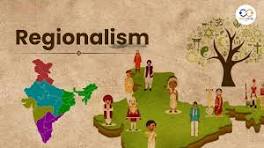
Regionalism has always been present in India in one or the other form. When there are so many states in the country it was not harmful to have regionalism in them but when we consider the entire country as one nation, regionalism poses a serious threat to national unity and integrity. Regionalism describes the idea that people living in a particular region share a common identity based on their distinct characteristics, such as language, culture, history, and food habits. This shared identity creates a sense of togetherness among people inhabiting a region.
It is important to note that local patriotism and loyalty to one’s locality, region, or state and its language and culture do not necessarily constitute regionalism. However, regionalism can become problematic when the interests of one region or state are asserted against the country as a whole or against another region or state in a hostile manner. In the context of India, regionalism has been one of the biggest challenges for the consolidation of the country as a nation since its independence.
Regionalism in India had its beginning with the British policy of political conquests. The British policy towards Princely states was the beginning of Federalism, and the Princely states were the nuclei of regionalism in India. The policies of Lord Wellesley’s ‘Subsidiary Alliance’ to Dalhousie’s ‘Doctrine of Lapse’ sought to bring India under the control of the company. Due to this, these states converted into separate political units which helped them to re-assertion of their respective local identities.
Regionalism is the sense of affection and attachments for the people belonging to one’s own religion and hatred for those belong to some other religion. As a result of this, people of one region in India started looking at people from some other part of the country as threat for their development and local identities. They want that only people of their own religion should run the government in their region and avail all the opportunities available in that region.
They do not want to make any place for people who have migrated from some other region of the country irrespective of the period for which they are living there.
India, is a union of states and citizens of India can move anywhere in India and avail opportunity.
If all the people are going to lay their faith in their own respective regions and will not accord any
consideration to the interest of the nation then it will become difficult for the union government to continue functioning.
Causes of Regionalism
There are many causes at the root of this regionalism in the country, whereas the major causes are as follows:
Geographical causes
The main cause of regionalisms is geographical. There is some essential difference between the food habits, language, life, etc. of every region and the people who live
there. By virtue of these differences, they come to regard people of other region as foreigners and they acquire an attitude of fear and hatred for each other.
Historical causes
Regionalism in India had its beginning with the British policy of political conquests. The British policy towards Princely states was the beginning of Federalism, and the Princely states were the nuclei of regionalism
in India. The policies of Lord Wellesley’s ‘Subsidiary Alliance’ to Dalhousie’s ‘Doctrine of Lapse’ sought to bring India under the control of
the company. Due to this, these states converted into separate political units. There has been some difference also between the people of the north India and south India ever since the
time of
the Aryans and it has continued. Many of the king of the north India won over the south India and in the same way there were
few kingdoms in the south which had extended to the northern part of India .This indicates that historical causes are also at the root of regionalism.
Political causes
If we observe the present situation carefully and minutely, we will see that the main cause at the root of regionalism present in the country is of a political nature. In different regions, some people demanded the formation of regional governments and were inspired by regional interests and by the aim of gaining power. In this direction, revolutionary groups like the Naga party guided by Phizo, the Akali party of Punjab, the D.M.K. party of the south, and other political parties have played a major part. The truth is that the leaders of these political parties are responsible for having propagated regionalism in there respective areas. Not only this, but even some representatives of different areas who are members of political parties prioritize the interests of their own regions even in the face of national interests, which they disregard.
Psychological causes
Finally, the psychological causes have contributed no less to the development and stability of regionalism. It is the wish of most of the persons that their areas progress the most. This in itself in neither bad nor detestable but when they disregard the national interest and those of other regions
for the attainment of this, then this feeling takes on the form of regionalism. Besides this, there are many individuals encouraging regionalism who express the hatred, jealousy, fear, anger, and other feelings contained in
them in this manner. Especially, the regions where there are immense opportunities, people of these regions don’t want that people of other regions avail
the benefit of the opportunities.
Other Factors
There are some other factors apart from the factors mentioned above that promote regionalism. For example, it is rarely noticeable that in married couples, one belongs to Bengal and the other to Punjab or
to Rajasthan or to Tamil Nadu . As a general rule, people belonging to different regions do not marry and hence the occasion for close contact between
the people of two dialect do not arise. In addition to these there are some economic causes of regional tension. In the country there are some regions that are backward in comparison with some other regions. As a result there are large gap in opportunities and developments in one region and another region. For example, if we see the successful businessmen are from Marwar, Gujarat, Punjab regions and many industrial growth is also
concentrated in some parts of India. Due to this, people of developed region has sometimes hatred towards people who try to turn them out from their
own regions.
In this way, regionalism has become a serious problem for the interests of one nation. The unity of the nation can be maintained so long only the people regard the entire country as one nation