Discuss the role of United Nations in Disarmament.
Here we will learn the topic Discuss the role of United Nations in Disarmament. in detail
Disarmament and the United Nations
Here we will learn the topic Discuss the role of United Nations in Disarmament. in detail
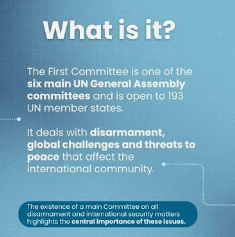
The UN Charter also provides for disarmament. In the optimistic mood of the post-War era, great powers agreed on the basic principles of disarmament. The First General Assembly adopted the first resolution on January 24, 1946, which devoted itself to disarmament. The First General Assembly also created the United Nations Atomic Energy Commission comprising permanent members of the Security Council plus Canada. At the first meeting of the Commission, the US put forth the Baruch Plan (1946) to create an International Atomic Development Authority. On the other hand, the U.S.S.R. submitted a Draft Convention on Prohibition of Atomic Energy for the purpose of mass destruction. But each of these proposals rejected the other party. The Soviet Union objected to the provision for inspection, for international ownership and management of atomic energy. The Soviet Plan favored the International Control Commission but subjected it to veto in the Security Council. Then the Soviet proposal for one-third reduction in conventional arms emerged. In 1947, the Security Council set up a Commission for Conventional Disarmament. The Sixth Assembly created the UN Disarmament Commission to regulate, limit, and balance the reduction of all armed forces and to manage International Control of Atomic Energy for peaceful purposes. Thus, this Commission replaced the two previous Commissions in 1952. No success occurred between 1948 and 1952, as disarmament became a hostage of the Cold War, which reached its coldest phase during this period.
Here we will learn the topic Discuss the role of United Nations in Disarmament. in detail
But with the relaxation in Cold War following the death of Stalin in 1953, President Dwight D. Eisenhower introduced his famous peace proposal, known as Atoms for Peace , in an address to the United Nations General Assembly on December 8, 1953.In the Ninth Assembly (1954) the Soviet Union agreed to consider the plan of disarmament. She agreed that reduction in conventional arms needs more precede the inspection machinery. . In the Eleventh Assembly (1956), the question of Nuclear Bomb Test dominated. The U.S. barred test suspension with International Inspection. In 1957, the Soviet Union proposed the enlargement of the Disarmament Commission by the addition to Egypt, India Poland and a Latin American country, and also proposed test suspension for two or three years. Again in the the same years it demanded a Disarmament Conference of all the 82 members. In 1959, Khrushchev introduced his surprise and sensational proposal for a General and Complete Disarmament within four years and a Non-aggression Pact between the Warsaw Pact powers and the NATO countries. In the same years after the Camp David meet, the two leaders, Khrushchev and Eisenhower declared to solve the question of disarmament. Accordingly, they convened a Ten-Power Conference in 1960 to resume negotiations. It consisted of five Western powers and five members of the Soviet bloc. They also proposed holding a summit in Paris in 1960, but the summit could not take place because the U-2 plane affair once again poisoned the entire atmosphere. In 1961, they expanded the Ten-Power Disarmament Conference to include the Non-aligned countries – Brazil, Burma, Ethiopia, India, Mexico, Nigeria, Sweden and the U.A.R. Subsequently, they raised its strength to 38. Again in June, 1996, they raised its strength to 61. Most of the subsequent disarmament proposals are based on Drafts prepared by this body.
Here we will learn the topic Discuss the role of United Nations in Disarmament. in detail
It is worth noting that by the late 1960s, the UN had reached a state of “stable stalemate” over the issue of armament. The Great Powers discarded the goal of general disarmament and started arms control negotiations without the United Nations.
Here we will learn the topic Discuss the role of United Nations in Disarmament. in detail
The following are some of the notable agreements regarding arms control and disarmament since 1960 onwards:
Discuss the role of United Nations in Disarmament.
(1) Antarctic Treaty (1961). This Treaty has freezed all territorial claims in the Antarctic region. It has also declared it to be a nuclear free zone. This Treaty has been acceded to by about 40 countries, including India.
Discuss the role of United Nations in Disarmament.
Nuclear Test Ban Treaty (1963): When the Berlin Crisis and the Cuban crisis defused (1961-62), the stage set itself for redressal in the Cold War. Under the impact of the Cuban crisis, both superpowers realized that any showdown could lead to mutual destruction. Both sides recognized the state of mutual destruction. This awareness led both to believe in the inevitability of peaceful co-existence. This spirit of accommodation reflected in the conclusion of Moscow, Britain, and the Soviet Union. But non-signatories could access it by means of accession.
Discuss the role of United Nations in Disarmament.
The Treaty has five articles. The Preamble acknowledge the fact that the nuclear test contaminates man’s environment by radio activity. Articles 1 prohibits every members to launch any nuclear test under its jurisdiction and control-atmosphere, outer space and under water or high seas. Under ground tests however are not prohibited as their detection is difficult. This Treaty is of unlimited duration, but under extraordinary events one can withdraw under article IV of the Treaty. Though earlier it was a limited and partial test ban treaty, its significance lies in the fact that it was the first major step towards arms control and a break through in the disarmament stalemate. It reduced the dangers of radio active fallout by restricting the test of underground. The Treaty was the first global agreement to protect the environment and was partly intended to crode the growing opposition to nuclear weapon tests. But it provides no machinery to ensure successful accomplishment of its Initially Nuclear Test Ban treaty was considered as Limited Nuclear Test Ban treaty but due to continuous global support and response, later in 1996 it has been transformed as Comprehensive Nuclear Test Ban Treaty (CTBT). Initially the number of signatories countries was 126 which has reached to 188 now.
Discuss the role of United Nations in Disarmament.
(3) Outer Space Treaty (1967): The Outer Space Treaty of 1967 is the basic legal framework for international space law that regulates how countries explore and use outer space.The Treaty prohibits the stationing of nuclear arms in outer space.
(4) Tlatelolco Treaty (1967): The Treaty of Tlatelolco, officially known as the Treaty for the Prohibition of Nuclear Weapons in Latin America and the Caribbean, is an international agreement that bans nuclear weapons in those regions.Key Details. But the US is yet to sign it.
By the end of 1969, a new era began, which may be described as a period of detente. The process of detente continued in the 1970s, resulting in a number of arms control agreements, with the Non-Proliferation Treaty taking the lead. The Treaty (NPT) aims to prevent the multiplication of nuclear powers and completed the process of ratification. The Treaty on the Non-Proliferation of Nuclear Weapons (NPT) is a landmark international agreement that aims to stop the spread of nuclear weapons, promote peaceful uses of nuclear energy, and advance total disarmament. The term of the Treaty was for 25 years with a 5-yearly review. The last review conference took place in New York in April-May 1995. Representatives from 175 countries attended the Conference and decided on its indefinite and unconditional extension. Now, 191 nations have signed it. India, Pakistan, and Israel, who have nuclear capability, (Undeclared nuclear powers) are yet to accede to it.
The Treaty has 10 articles. It is full of flaws as it has no verification provision,
and there is no way of forcing the nuclear powers to observe their commitments. Further, it is the most ill-designed Treaty. It allows vertical, horizontal and spatial proliferation. No doubt, this Treaty is biased in favour of the nuclear weapons powers. It is an “undisguised nuclear colonialism” or a “system or nuclear aparthied”. It is patently discriminatory and propouncedly unequal. India, as such, gives only conditional support to this unequal treaty. India’s objection is that there is no provision for
nuclear powers’ guarantee against
nuclear attack on non-nuclear states and no commitment for reduction or destruction of existing nuclear weapons within a prescribed period.
Further, it has now
legitimised the possession of nuclear
weapons in th hands of five countries in perpetuity.
At the time of its indefinite extension (May, 1995),
the nuclear powers did not offer further ban on Article VI of the NPT for any binding time-bound pledge in disarmament.
Thus, their commitment to a systematic
and progressive reduction of nuclear
weapons globally which appears as a statement of principles, appended to NPT, is a weak substitute.
Here we will learn the topic Discuss the role of United Nations in Disarmament. in detail