Describe the composition & power of the Security Council.
Here we learn the topic Describe the composition & power of the Security Council in detail.
The Security Council
Describe the composition, powers and functions of the Security Council
The United Nations Security Council is one of the six principal organs of the United Nations, having primary responsibility for the maintenance of international peace and security. The Dumbarton Oaks Proposals in the year 1944, emphasised the need for an executive organ of international membership to be entrusted with “primary responsibility for the maintenance of international peace and security.” Indeed, the increased degree of centralization of the procedures for maintaining international peace and security, made the Security Council even more essential than the Council of League. It has to function continuously and take decisions quickly and effectively so as the enforcement machinery of Chapter VII of the U.N. Charter to bring into operation wherever international peace and security is threatened. It is the Guardian-in-Chief for the maintenance of international peace and security.
Describe the composition, powers and functions of the Security Council
Composition of Security Council
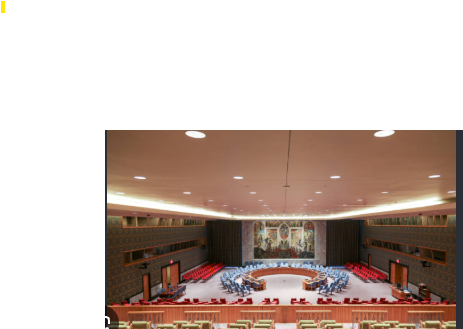
According to Article 23 of the UN Charter, the Security Council shall consist of fifteen members of the United Nations, out of which five are “permanent members”, namely, China, France, U.S.S.R., U.K. and U.S.A. The permanent members enjoy exceptional status not only by virtue of their permanency but also by reason of special voting rights. The power of “Veto” is the most important right. As Jessup puts it, “the justification for granting this exceptional status to five members lies in an inescapable fact of power differentials.” The provision of the Charter has placed the great Powers above law, for a permanent member can even veto enforcement action against itself.
Describe the composition, powers and functions of the Security Council
The General Assembly had to elect 10 other members of the United Nations to be
non-permanent members of the Security Council.
These members of the United Nations are responsible
to maintain international peace and security and for the other purposes of the
Organization, and also to achieve equitable geographical distribution.
The non-permanent members of the Security Council were to be elected for a term of two years. A retiring member shall not be eligible for immediate re-election. According to Art. 23, each members of the Security Council shall have one representative.
Describe the composition, powers and functions of the Security Council
Double Standards
Describe the composition, powers and functions of the Security Council
In spite of its profession of universal brotherhood and “sovereign equality” of all nations,
UNO applies a double standard to the conduct of international relation-a rigid subjection to the
rule of the law for the small powers and freedom from law for the Great Powers.
As late Mr. Nehru pointed out the Assembly contained no real
representation for half of the population of the world that lives in Asia.
In fact the assumption made in 1945 that these five named states were the “Great Powers”,
was of course, a political judgement.
It introduced a static element into the Charter, for which we cannot assume that
these five nations will necessarily remain five “Great Powers” for ever.
The retaining of old China on the list of 1945 presents a peculiar scene of this principal organ. In contrast to the status of permanent members, the General Assembly elects the non-permanent members for two years. They are not immediately eligible for re-election.
Here we learn the topic Describe the composition, powers and functions of the Security Council in detail.
Voting Procedure
Describe the composition, powers and functions of the Security Council
The Charter states the voting procedure of the Security Council in Article 27 as follows:
Describe the composition, powers and functions of the Security Council
( a ) Each member of the Security Council shall have one vote.
( b )The affirmative vote of nine members shall make decisions of the Security Council on procedural matters.
The nine members of the Security Council shall make decisions on all
other matters by an affirmative vote (including the concurring votes of the permanent members); provided that in
decisions under Charter VI, and under paragraph 3 of Article 52, a party to the dispute shall abstain from voting.
The Security Council shall organize itself to be able to function continuously. Each member of the Security Council shall for this purpose represent themselves at all times
at the seat of the Organization.
Describe the composition, powers and functions of the Security Council
The Security Council shall hold periodic meetings at which each of its members may, if it so desires, represent itself by a member of the Government or by some other specially designated representative.
The Security Council may hold meetings at such places other than the seat of the Organization as in its judgment will best facilitate its work”.
Here we learn the topic Describe the composition, powers and functions of the Security Council in detail.
Right of Veto
Describe the composition, powers and functions of the Security Council
Article 27 (3) states that the members of the Security Council shall make decisions on all other matters
by an affirmative vote of seven members, including the concurring votes of the permanent members of the Council.
This power of Veto has destroyed much of the efficacy of the Security Council.
Researchers have said that the decline of the Security Council due to Veto provisions as the U.N. principal peace making organ and the emergence of the General Assembly is unquestionably the most significant constitutional development.
Sometimes the permanent members abstain themselves from voting rather than cast a negative vote which prevents the Council from taking a decision.
Legal scholars have generally accepted this practice of abstention as a constitutionally valid interpretation of the vote of ‘concurrence.’ For example, the decisions of June 25 and 27, 1950, determined a breach of peace in Korea and recommended that member states take up arms to assist South Korea, in the absence of the U.S.S.R. Thus, when the permanent member abstains from using a Veto, one may say there is an implied “concurrence.” But this cannot be said when the member is not present. Article 27 (3) lays down conditions under which abstention is compulsory, for example a party to a dispute shall abstain from voting.
Here we learn the topic Describe the composition & power of the Security Council in detail.