What do you mean by new International Economic order?
What do you mean by new International Economic order. Write a short note on India and New International Economic Order.
What do you mean by new International Economic order?
There has been a yawning gap between the developed and developing countries. Out of the estimated 4,000 million people inhabiting the world, 1,200 million live in countries where per capital GNP is less the $ 2000 a year. At the other end a minority of around 600 million live in countries where per capital GNP range between $ 2000 to 5600. Remaining 12,000 million live in countries where per capital GNP levels range between $200 to 2,000. There is a huge gap in the economy of developed countries and less developed countries. As per estimation, in South Asia alone half of the population lives below a poverty line. The less Developed Countries (LDCs) have been making persistent demands for introducing fundamental reforms in the economic, commercial and financial relationship between themselves and the developed countries.
What do you mean by new International Economic order?
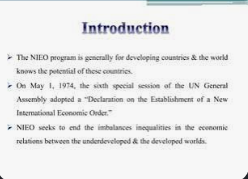
The developing countries raised the questions of establishing New International Economic Order (NIEO) and demanded restricting of international economic relations on just, democratic principles on the basis of full equality. They asserted their determination to dispose their own national resources freely. In view of the persistent demand from the developing countries for restricting the economic system, in 1973 the UN General Assembly adopted Resolution No. 3171 which acknowledged the right of the states to nationalise foreign property and the determine the form and size of compensation. In 1974. the General Assembly reaffirmed the right of each state to regulate and control the activitics of the Transnational Corporations in its territory and adopted the Charter of Economic Rights and duties of the States.
What do you mean by new International Economic order?
On 1 May, 1974, the General Assembly in the face of opposition from the United States and other Western powers, adopted the Declaration on the Establishment of a new International Economic Order by an overwhelming majority. The Declaration stipulated the principles on which the international economic relations should be based. The main principles emphasised by the declaration were – i.sovereign equality of states, ii. territorial integrity of states, iii. non-interference in the internal affairs, iv. equal participation of all the states in the solution of the world economic problems, v. the right to adopt an economic system of their own choice, vi. unalienable and permanent sovereignty of each state over their natural resources and all economic activities, and vii. the right of states, peoples and territories under foreign dominance to reimbursement and full compensation for the exploitation, depletion and damage caused to their natural and other resources etc.
What do you mean by new International Economic order?
The Declaration laid down a solid international legal basis for the establishment of truly equal international economic relations, meeting the interests of all states and people. The Assembly also adopted a Programme of Action which outlined specific steps for the implementation of the Declaration.
What do you mean by new International Economic order?
In 1975, the General Assembly at its 7th Special Session in the course of discussion on ‘Development and International Economic Cooperation’ reiterated the demand for the acceleration of the implementation of the decision of the General Assembly taken at the earlier session.
What do you mean by new International Economic order?
The call for New International Economic
Order is based on the assumption that the
prevalent international order perpetuate and
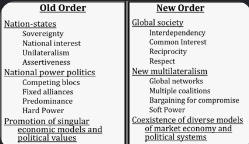
aggravate international inequalities and that new relationship of interdependence should replace the older pattern of dependence and unequal exchange.
Advocates of the New International Economic
Order argue that rich, developed
countries have a moral obligation to increase and facilitate the flow of resources to less developed countries.
They also argue that developed countries should promote economic growth and development in poorer nations to expand their markets.
India and New International Economic Order (NIEO)
Since its independence, India has pleaded for
the democratisation of International political order and restructuring of the economic system evolved in the post world war II period.
Indian policy makers considered this vital for the economic and social upliftment of the Indian people.
To attain these objectives, India tried to forge
new links and also tried to revamp the old links by gradually changing its economic relations.
India sought to promote international economic
co-operation on the basis of equality and
mutual benefit and also initiated steps to usher in the New International Economic Order.
India pleaded for ending the exploitative features
of the present economic system, which the rich and
developed countries dominated, and tried to evolve a system conducive to the socio-economic development needs of the developing countries.
In fact, ever since sixty, India
has been strongly pleading for the creation of
a new international economic order at various forums
like the United Nations, NAM, Third World Conference, Afro-Asian solidarity Conference, etc.
A brief review of the efforts
made by India to further the cause of the New International Economic Order is as under –
(a) It is noteworthy that at the meeting of Trade and
development board, the Indian representatives played
a vital role in getting the General Agreement on
Trade and Tariff (GATT) rules amended and
secured permission for the developing countries to bypass import restrictions with a view to improve their export potential.
(b) In the UN also, India consistently
continued to support the demand for increasing the role and share of the developing countries in the international economic order.
At the Sixth Special Session of the General Assembly in 1974, India’s Foreign Minister (Sardar Swaran Singh) suggested :-
i. Comprehensive policy for the re-polarisation of prices of raw materials.
ii. Provision of additional liquidity for specially affected countries.
iii. Equitable pattern of voting rights in IMF and other international of developing countries;
iv. Provision of external capital for the development of developing countries; and
v. Financial and technical assistance to developing countries.
Most of these suggestions were incorporated in
the ‘Declaration on the Establishment of New International Economic Order’ adopted by the United Nations on 1 May, 1974.
(c) At the Seventh Special Session of the UN General
Assembly held in 1975 also, India’s Foreign Minister (Mr. Y. B. Chavan) put forth the following suggestions for the establishment of NIEO :-
i. Only through voluntary transfer, developing countries can acquire a sort of buffer between rising bills and falling export earnings.
Due to the sharp rise in their imports, particularly fuel,
fertilizers and manufactures, the import bill of
most developing countries have
increased to such an extent that even
though a 100 per cent increase
in export earning, there is no assurance that balance will be corrected or even half way met.
ii. For the creation of trade of developing countries,
a more managed approach to the problem of trade is
required in manufactures which would deal not only
with the removal of trade barriers both tariff and non-tariff,
but also with the question of supply of production, marketing and distribution.
iii. The developing countries have a greater say in the management of the monetary system. The IMF should provide greater liquidity to the developing countries to cope with the problem of external debts.
iv. The conduct of transnational corporations should be
subject to greater regulations because they have acted
irrationally also in many instances detrimental to the sovereignty and the freedom of developing countries in the management of the resources for development.
India also strove for realising the ideals of NIEO in the various sessions of UNCTAD. During the session of UNCTAD held at Nairobi in May, 1976, India played a vital role in getting the programme of global action adopted to improve the market structure in international trade in commodities of interest to the developing countries. On 11 June, 1978 India’s Prime Minister (Morarji Desai) said “The road to NIEO May be rough, torturous and long, but it must not be allowed to become a mirage. It was here that countries like USA have crucial role to play by giving the lead in the implementation of various decisions aimed at eradicating the poverty and want from the Earth.”
In 1982, India took initiative to organise South-South meet in New Delhi to secure increased economic and trade co-operation among the developing countries and to coordinate the policies of developing countries with the approach of the developed countries. This meet was attended by representatives of 44 developing countries. Addressing the meet, the then Indian Prime Minister (Mrs. Indira Gandhi) expressed concern over the deterioration in the global economy since the Cancan Summit. The Indian Prime Minister specially criticised the protectionism in the industrialised countries which virtually tantamounted to victimisation of the developing world, and urged the developing countries to close their ranks to withstand pressure from the affluent nations.
In 1985, India organised a ministerial level meeting of the developing countries to consider the Global System of Trade Preference (GSTP) to Promote South-South Co-operation. In his inaugural speech, the then Prime Minister Rajiv Gandhi called upon the developing countries to work for collective self-reliance through boosting of their trade. Realising that there was very little scope of an airily North-South agreement over the New International Economic Order. It was felt desirable to promote South-South cooperation among the developing countries as a step towards evolution of new economic order.
India also played an active role in promoting the idea of the creation of NIEO at the various meeting of Group of 15 (G-15) and played a vital role in its deliberations and decision making.
At the second summit meeting of G-15 held at Caraces (Venezuela), India urged the developing nations “to seize the historic opportunity provided by the end of super power rivalry to poor their combined energies and to seek to resolve their problems through South-South cooperation.”
The Indian Prime Minister asserted that it was wrong on the part of some developed countries to prescribe in somewhat arbitrary terms what making should do and where it should go after the casing of East-West relations.
At the third summit meeting of G-15 held at Dakar (Senegal) in November 1992 also India expressed concern over “diminishing opportunities and contracting freedom in the wake of end of East-West confrontation and pleaded that the developing countries should go in for South-South cooperation in a big way.
Again, as Chairman of the Fourth Summit of G-15 held at New Delhi in 1994, India played a significant role in emphasising the needs of South-South Cooperation and holding North-South dialogue so that the interests of the developing countries could be adequately protected in the implementation of the Uruguay Round. In the next two G-15 summits held in Argentina and Zimbabwe also India played an active role in promising the idea of greater South-South cooperation.
It is evident from the proceeding account that India has consistently pressed the need of New International Economic Order at various international forums and has projected itself as staunch supporter of NIEO with a view “to end the dominance of the International economic system by the rich and to secure an equitable distribution of world income and resources.”