Describe the administrative and judicial reforms made by Governor Warren Hastings and Lord Cornwallis in India.
Describe the administrative and judicial reforms made by Governor Warren Hastings and Lord Cornwallis in India.
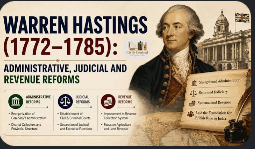
Administrative and judicial Reforms brought by Warren Hastings
Warren Hastings was an imperial administrator who worked for the East India company in India from 1772 to 1775. As Governor of Bengal, he instituted many substantial changes entirely in administration as well as an entirely new and streamlined model of the Legal system.Warren Hastings laid the foundation of the British administrative and judicial framework in India by abolishing the corrupt Dual Government and introducing a structured district court system.
During the period, the previous Chief Administrator of Justice, the Nawab, used to misuse his position. The Zamindars who served as lower-level-judges in their respective areas were extremely corrupt and judgemental. Overall, mass corruption plagued the judicial system.
Warren Hastings made numerous administrative reforms, which are as follows.
(I) Abolition of Dual Government
Just after taking charge in 1772, Hastings ended the system where the East India Company held revenue rights (Diwani) and the Nawab held administrative control, bringing the same under the direct British supervision.
(II) Centralized system for revenue collection
He created a Board of Revenue in Calcutta and appointed English Collectors to manage districts and streamline tax collection.
(III) Shift of Capital
The authorities moved Bengal’s capital from Murshidabad to Calcutta to improve governance and strengthen control.
(IV) Trade Regulations
He abolished abusive free trade passes (dastaks), restricted private trade by Company employees, and set a uniform 2.5 % tariff.
Warren Hastings executed numerous judicial reforms during his reign, which are as follows.
I) Civil Courts (Diwani Adalat)
The English collectors presided over a civil court in each district and applied Hindu law to Hindus and Muslim law to Muslims with the assistance of local scholars, such as pandits and qazis.
(II) Criminal Courts (Faujdari Adalat)
He set up district criminal courts in each district presided over by Indian judicial officers and Muslim law officers (qazis and muftis) under the British supervision.
(III) Appellate Courts
He established two supreme appellate courts in Calcutta. The Sadar Diwani Adalat deals with civil cases and the Sadar Nizamat Adalat deals with criminal cases.
The Governor and two judges whom he selected from his council oversaw the Sadar Diwani Adalat, while the Governor-in-Council appointed an Indian judge to preside over the Sadar Nizamat Adalat.
(IV) Supreme Court at Calcutta
The Regulating Act of 1773 created the Supreme Court at Calcutta in 1774 to handle cases for British subjects.
Administrative and judicial Reforms brought by Lord Cornwallis.
Lord Cornwallis served as the Governor-General of Bengal from 1786 to 1793 and laid the foundation of a modern, efficient, and structured British administration and judiciary in India. Lord Cornwallis Succeeded Warren Hastings as the Governor General of India. His aims as Governor General were to
(I) Uproot corruption from the present Judiciary and Administrative System.
(II) Tackle the problem of land revenue.
(III) Develop a proper system of administration of Justice.
Load Cornwallis was Governor General from the year 1786 to 1793 and his most noted work was in the field of criminal judicature .
Judicial Plan of 1787 by Lord Cornwallis
Reorganisation of districts
The number of districts in Calcutta were reduced from 36 to 23.
Describe the administrative and judicial reforms made by Governor Warren Hastings and Lord Cornwallis in India.
Appointment of collector
Describe the administrative and judicial reforms made by Governor Warren Hastings and Lord Cornwallis in India.
Each district appointed a collector. The collector was an Englishman who received the task of revenue collection and related matters. He also presided over the Mofussil Diwani Adalat (district level civil court) as a judge. The collector also presided over the Magistrate court as a Magistrate, where he empowered to try and punish cases of petty crimes and offences up to Rs 200.
Describe the administrative and judicial reforms made by Governor Warren Hastings and Lord Cornwallis in India.
Establishment of Mal Adalats
Mal Adalas were revenue courts in each district which exclusively dealt with revenue matters.
Describe the administrative and judicial reforms made by Governor Warren Hastings and Lord Cornwallis in India.
Establishment of Registrar Courts
Describe the administrative and judicial reforms made by Governor Warren Hastings and Lord Cornwallis in India.
The collector appointed an assistant officer known as the Registrar. He presided over the Registrar’s court and decided civil cases up to the value of Rs 200/_
Describe the administrative and judicial reforms made by Governor Warren Hastings and Lord Cornwallis in India.
Judicial plan of 1790 by Lord Cornwallis.
Describe the administrative and judicial reforms made by Governor Warren Hastings and Lord Cornwallis in India.
Reorganized districts into division
The districts were further devided into four divisions: Murshidabad, Calcutta, Dacca and Patna
Describe the administrative and judicial reforms made by Governor Warren Hastings and Lord Cornwallis in India.
Mofussil fauzdari Courts were abolished and replaced with Court of Circuits at all the four divisons to try criminal cases. It was presided over by two company servants and assisted by Muslim law officers: Qazı and muftis. It was a moving court which used to move from district to district in their respective division to try criminal cases.
The Salaries of all the judges of all the courts were fixed and increased to control corruption.
Describe the administrative and judicial reforms made by Governor Warren Hastings and Lord Cornwallis in India.
Civil Services
Describe the administrative and judicial reforms made by Governor Warren Hastings and Lord Cornwallis in India.
Earned the title “Father of the Indian Civil Service” by organizing a professional, well-paid, and disciplined bureaucratic framework.The post of Nawab, who did not carry out criminal justice properly, was abolished and now the Governor General in Council presides over Sadar Nizamat Adalat instead. The court introduced fees to reduce the burden on courts.
He made government officials and collectors legally accountable to civil courts for official misconduct. Judicial Plan of 1793 by Lord Cornwallis
1) Separation of Services
Describe the administrative and judicial reforms made by Governor Warren Hastings and Lord Cornwallis in India.
He divided the civil service into three distinct branches: revenue, judicial, and commercial.
2) Separation of Executive and the judiciary
Describe the administrative and judicial reforms made by Governor Warren Hastings and Lord Cornwallis in India. Earlier, the powers vested in the collectro were admistantive and judicial. Now the collector was only responsible for administrative work and collection of revenue. Someone handed over the judicial control to the Governor General and his Council.
Describe the administrative and judicial reforms made by Governor Warren Hastings and Lord Cornwallis in India.
3) Authorities established provincial courts of appeal at each division i.e. Patna, Calcutta, Murshidabad and Dacca to try the appeals from the Mofussil Diwani Adalat which were to be heard within three months of filing them.
Describe the administrative and judicial reforms made by Governor Warren Hastings and Lord Cornwallis in India.
4) The provincial court of appeal merged with the Court of circuits. The judges of the Diwani Adalats took away the powers of the collector as magistrate and vested them instead.
Describe the administrative and judicial reforms made by Governor Warren Hastings and Lord Cornwallis in India.
5) The Sadar Nizamat Adalat had to apply Muslim personal law when trying and punishing criminal cases.
Describe the administrative and judicial reforms made by Governor Warren Hastings and Lord Cornwallis in India.
6) The authorities recognized the legal profession in India for the first time.
7) Permanent Settlement (1793)
Introduced the Permanent Land Revenue Settlement in Bengal, fixing land taxes permanently and making zamindars landowners.
Describe the administrative and judicial reforms made by Governor Warren Hastings and Lord Cornwallis in India.