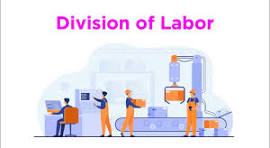
What is division of labour ? What are the different forms of division of labour exist in modern society? What are the principal basis of division of labour in primitive society ?
What is division of labour ? Different forms of division of labour exist in modern society? What are the principal basis of division of labour in primitive society ?
Concept and meaning
What is division of labour?
With the development of civilization and as a result of complications in the social set up, man has ceases to remain self-dependent.
He is now dependent on others and this situation has resulted into specialisation. The concept is the gift of 19th century but as an institution it is as old as the society or
the civilization. It is the separation of a work process into multiple tasks, with each task carried out by a different person or group of people. It takes place mostly in systems of mass production, since it limits unnecessary movements and reduces the handling of various tools and parts. The primary reason for division of labor is specialization. When a complex work process breaks down into simpler, manageable tasks, it generates efficiency, as workers develop competency in the specific tasks to which their supervisors assign them. The division of tasks reduces individual workloads, which allows workers to handle jobs more easily. The division of tasks reduces individual workloads, which results in jobs that workers can handle more easily.
What is division of labour?
Definition
Fredrick E. Lumeley
What is division of labour?
The division of labour may analyse itself under two heads.
On one hand there is a simple form, under which a workman carries out the whole work himself in various stages in production. The tailor, cobbler, the carpenter etc. falls under this head. On the other hand there is a more complexed head, under which there is a splitting of work into several operations in carried out by various groups or persons to achieve production.”
What is division of labour?
Sir Sydney Chapman
“Specialization of work is the division of labour.”
Watson has analysed division of labor on Professional basis
Division of labour is in fact based on division of profession.
Each one is carrying on one aspect or job of production. It leads to specialization of job.
According to Watson
“Production by division of labor consists in splitting up the production process into its component parts concentrating specialized factors on each sub-division and combining their output into the particular forms of consumption output required. “
Different forms
Division of Labour’s expresses itself in various forms. Given below are a different forms of division of labour’s in present society-
(1) Occupational Division of Labour, (2) Territorial Division of Labour, (3) Division of Labour into complete process; and (4) Division of Labour into incomplete process.
Let us discuss these forms in details
(1) Occupational
This is the simplest and oldest form in which a individual or a group of individual does a particular job and the other one, does another job. In Indian society, there is division of the society on the basis of work such as cobblers, washerman, sweepers etc. This is nothing but occupational division of Labours. As a result, society divides into various groups, and people know these groups as castes or some other name. These groups have further sub-division, based on requirements of the occupation.
(2) Territorial
This type of division is based on geographical conditions. Geographical conditions of a particular place favour and create a congenial environment for a particular profession, so people of that region or area specialize in that job. Because of geographical conditions. people of various geographical regions take to various job. For example, people of Lanchshire are specialist in weaving of textiles. Similarly, people of different geographical regions of India are good at different jobs. This type is known as Territorial. It is also known as geographical. For example, Assam specializes in tea production, West Bengal specializes in jute production, whereas the textile industry is located in Mumbai, Surat, and Ahmedabad.
(3) Division of Labour’s into complete process
As a result of the development of society, need was felt to have production of various things on a mass scale. The whole process of production, in the interest of efficiency or quickness, was divided into various groups. This was all done when complicated machines like that of today had not come into operation. For example, in the production of textile goods, certain persons were entrusted with weaving while others were given the responsibility to prepare the thread and so on. Everybody completed only the one part of the entire process.
(4) Division of Labour into incomplete process
This is the gift of the scientific inventions. As the mass scale production gained momentum, one unit of work was divided into various units. This was in order to bring about greater perfection. Since one unit of production or one work was divided into several jobs or sub units, it came to be known as incomplete process of the division of labour. In the modern society, it is a common feature of the production.
Basis of division of labour in primitive society
It is not the gift of modern society alone. It existed even in the primitive society. In fact it goes with every structure of economy. Without this division of labour no economy can go on. As a result of Division of Labour, every person is interested with a particular job. This division may be based on sex, age, family relations, castes class etc.
In primitive society, division of labour was of the following two types
(1) Division of labour based on specialisation.
(2) Division of Labour based on sex.
Division of Labour
(1) based on specialization
In primitive or ancient society, members of a particular community or one group used take up one particular occupation or profession and specialized at it. This type of specialization based on specialization appears in any primitive society. For example, the people of tribes living on the sea shore specialize in the job of fish catching, while those living in jungles specialize in the job of all animal-catching or preparing things from wood.
(2) based on sex
The age-old pattern is based while women have their own functions. Women take on responsibilities that do not require too much physical labor, while men handle responsibilities that require physical labour. In this respect, certain superstitions have also developed. According to this pattern women have entrusted with the responsibility of looking after the children and house-hold jobs while men have to look after outdoor duties and functions.