Here we will learn the topic Define caste and describe its characteristics in detail.
We use the word ‘Caste’ in everyday life to distinguish one person from another. We say that so and so person belongs to a particular Caste. The Portuguese derived the term ‘Caste’ from the word ‘Casta,’ meaning breed or race. group. In the 16th century, the Portuguese were the first to use the term “Caste” concerning Indian civilization.
Definition of Caste
There are many definitions of Caste offered by different scholars. Some of them are reproduced below :-
According to G.S.Ghurye
“Castes are small and complete social worlds in themselves marked off definitely from one another though subsisting within the larger society.” According to Ghurye, Caste is hierarchical. Theoretically, brahmins occupy the top position and Shudras occupy the bottom. The castes can be graded and arranged into a hierarchy on the basis of their social precedence. The hierarchy present in caste system is reflected through the division of labor in society.
According to Sir Herbert Kisle
“A caste may be defined as a collection of families or groups of families, bearing a common name, which usually denotes or is associated with specific occupation claiming common decent from a mythical ancestor, professing to follow the same profession and forming a single and homogenous community.” Criticising this definition of caste Hutton has said that it is the people of class who claim decent from a mythical ancestor and not members of caste.
According to Martindale and Monachesi
“A caste consists of persons whose share of obligations and privileges is fixed by birth, and religion and magic sanction or support it.”
According to A. W. Green,
“Caste is a system of stratification in which mobility, or movement up and down the status ladder, at least, ideally may not occur. A person’s ascribed status is his life time status. Birth determines occupation, place of residence, style of life, personal associates and the group among whom one must find a mate. The caste system is also protected by law and sanctified by religion.” This definition of caste is more satisfactory and all round.
Here we will learn the topic Define caste and describe its characteristics in detail.
Characteristics of the Caste
Define caste and describe its characteristics.
Modern thinkers like Hutton, Ghurye, N.K.Dutt and many others have tried their best to enumerate various features of caste in defining it. The predominating and important characteristics of caste are as follows -.
Define caste and describe its characteristics.
Determination by Birth
The membership of caste is determined by birth. A person remains the member of the caste in which he is born and his membership does not undergo any change even if change takes place in his status, occupation, education, education, wealth, etc.
Define caste and describe its characteristics.
Rules and Regulations Concerning Food
Each individual caste has its own laws which given the food habits of its members. Generally, one can accept fruit, milk, butter, dry fruit, and etc without restrictions, but one can accept kachcha food (bread, etc.) only from members of one’s own or of a higher caste. Brahmins intake ‘Satwik’ food, Kshatriya and Vaishya intake ‘Royal’ food whereas Shudra intakes ‘Tamsi’ food.
Define caste and describe its characteristics.
Definite Occupations
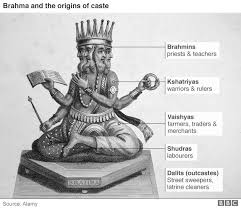
The Hindu scriptures mention the occupation of all varnas. According to Manu, the functions of the Brahmin, Kshatriya, Vaishya and the Shudra were definite. The functions of the Brahmin was to study, teach, guide and perform religious rituals, and to give and receive alms, that of the Kshatriya to study, perform religious rituals, give alms, punish the evil and go to war, that of the Vaishya to study, perform religious rituals, give alms, work in agriculture, trade and animal husbandry, that of the Shudra to do menial work for all the other varnas. In Hindu society even today in most cases, the son of a blacksmith pursues the occupation of his father, the son of a carpenter becomes a carpenter while the son of a shoemaker becomes a shoemaker,
Define caste and describe its characteristics.
Endogamous Group
The majority of persons marry only within their own castes Brahmin, Kshatriya, Shudra and Vaishya all marry within their respective castes. Westermarck has considered this to be a chief characteristics of the caste system. Hindu community does not sanctify inter-caste marriage even now.
Define caste and describe its characteristics.
Rules Concerning Status and Touchability
Hindu social organisation divides various castes into a hierarchy of ascent and descent, one above the other. In this hierarchy the Brahmins have the highest and the untouchables have the lowest position. The law of untouchability also conjoins with the sense of superiority among the Brahmins. This sense of superiority is much exaggerated and manifests in the South. Sometimes even the shadow of a member of the lower caste is enough to defile an individual of a high caste. In Kerala, a Nayar defiles a Namboodiri Brahmin by touching him, but if a member belongs to the Tiya caste, one must keep a distance of 36 feet to avoid defiling him. The stringent observation of the system of untouchability has led Hindu society to call some people untouchables and consequently forbid them from using places of worship, cremation grounds, educational institutions, public roads and hotels, etc., and disallow them from living in the cities.
Define caste and describe its characteristics.
Economic Disparity
The higher caste people were generally have high economic status. Lower caste people are very harsh worker but they have low socio-economic status according to caste system.
Define caste and describe its characteristics.
Segmental Division of Society
Under the caste system, people divide society into several small social groups. India has many different castes, and they follow their own set of norms and beliefs.
Define caste and describe its characteristics.
The above mentioned characteristics of the caste system do not take into account all the numerous variations presently taking place in the caste system. Actually, it is difficult to formulate a definite and permanent definition of caste since the caste system is undergoing considerable modification and transformation. It would not be surprising if society eventually reduced castes to merely a group, since people are increasing inter-caste marriages and breaking the restrictions on mutual behaviour, exchange of goodwill, and conduct. Some people are changing their caste on the strength of their monetary wealth. Members of any caste take to any profession that they desire. Much of their past glory and respect has been taken away from the Brahmins. Many people have even started excluding their caste name from the name they use. In this way caste is continually taking on the shape of class and casteism is growing in the form of classism
Here we will learn the topic Define caste and describe its characteristics in detail.