
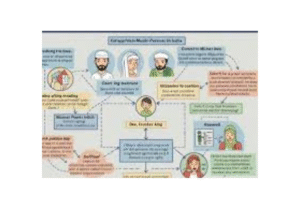
What does the term “will” mean in Muslim law? What are its fundamentals?
Here you will learn the topic What does the term “will” mean in Muslim Law?
A will is a legal document that specifies how a person wants their assets and properties to be distributed after they pass away. Muslim legal scholars have classified the question under
I. As defined by Tayabji, “will means a legal declaration of the intention of a Muslim with respect to his property,
“Will is a device for conferring a right of property in a specific thing, or in a profit or advantage, in a manner of a gratuity, postponed,” says Baillie.
Making a will is essential to preventing legal issues and guaranteeing a seamless transfer of assets. Will law in India is governed by the Indian Succession Act of 1925.
A person’s final wishes on the transfer of their assets after death are expressed in a will. If a person’s will is discovered to have been made in their favour after they pass away, the property listed in the will is awarded to that individual. Under Muslim inheritance law, the remaining property is then divided among his legitimate heirs in accordance with their respective parts. Even though he might not be the deceased’s legal heir, the legatee—the person in whose favour the will was made—gets the property. Therefore, it is effectively a “gift testamentary” in terms of the legal idea of will.
Here you will learn the topic What does the term “will” mean in Muslim Law? What is fundamentals
The fundamentals of a will
According to Muslim law, a valid will must meet the following requirements:
1. Both the legatee and the legator must be competent;
2. Free permission is required;
3. Formalities need to be finished;
4. The property ought to be transferable, and
5. The testamentary right must belong to the legator.
1A. The Legator’s Competency
The person who draft the will in Muslim Law is known as testator or legator. The legator must be able to make a will. A will can be made by any (i) Muslim who is (ii) of sound mind and (iii) has reached the age of majority.
Muslim
It should be mentioned that at the time the will was made, the legator had to be a Muslim. Therefore, the terms of the Indian Succession Act, 1925 apply to a Muslim’s will if he entered into a marriage under the Special Marriages Act, 1954. The Indian Succession Act of 1925 governs the terms of his executed will. According to Muslim law, a will made by a Muslim who stops being a Muslim at the time of his death is nonetheless enforceable. However, the testator must also be a Muslim at the time of his passing in accordance with Maliki law.
Soundness of Mind
The testator must be of sound mind at the moment a will is executed. An mad person’s will is null and void. The legator must be able to fully understand the legal ramifications of his actions both during and long after the declaration was made.
Age of Majority
At the time the will was executed, the testator had to have reached the age of majority. The Indian Majority Act, 1875, governs the age of majority for the purpose of creating a will. According to this law, a person becomes a majority at the age of eighteen (or twenty-one, if he is under the supervision of Courts of Wards). A minor’s will is null and void.
Legator’s Attempt at Suicide
According to Shia law, a will is null and worthless if it is executed after a suicide attempt. This criterion is based on the idea that a person who has tried suicide cannot be considered to be in a normal mental state. However, the will carried out in such a situation is entirely legitimate in Sunni law.
1B. Legate Competency:
Who May Accept Under Will?-
A legatee is the beneficiary of a will. A will must be able to be made by the legator. It should be remembered that property under a will devolves only after the testator passes away, not on the day the will was made. As a result, the legatee needs to be alive at the time of the testator’s passing.
Any individual, regardless of religion, age, sex, or mental state, may legitimately be named in a Muslim’s will. Therefore, a will that favours a non-Muslim, a Hindu woman, a minor, or someone who is mad is legitimate. A competent legatee is also a juristic person. An institution with a religious or benevolent purpose, for instance, may be a competent legatee and a bequest made in its favour is legitimate.
Child in Mother’s Womb
A fetus is regarded as a living, breathing human being. As a result, a fetus could be a capable legatee. However, there are two requirements that must be met for a will to be enforceable in favour of a fetus.
(i) At the time of the testator’s passing, the child had to be in the mother’s womb.
(ii) The unborn child must be born alive within six months after the testator’s passing.
Murderer of Legator
A person in whose favour a will has been formed is ineligible to receive any property under the will if he purposefully or inadvertently murders the legator or causes their death. Because a will only takes effect once a legator passes away, an avaricious and eager legatee may cause the legator’s death in order to obtain the properties right away. Shia law, however, states that if a legatee accidentally or negligently causes the legator’s death, he is not disqualified and the will in his favour is valid.
Joint Legatees
Two or more legatees may receive a bequest together. The property is distributed equally among all legatees when a will is made jointly to multiple legatees and no specific share of any of them is specified. When a will is made in favour of a particular group of people, that group is regarded as a single legatee, and each individual receives an equal share of the property.
Lapse of Legacy
The will is void if a legatee passes away before the legator. The entire property is awarded to the surviving legatees when a will is made to two or more legatees jointly without defining their shares and one of them passes away before the testator. However, if their shares are stated, the surviving legatee only receives his portion; the predeceased legatee’s share is returned to the testator’s heirs.
Here you will learn the topic What does the term “will” mean in Muslim Law? What is fundamentals
2A. The Legator’s Free Consent
A will is null and void if it can be demonstrated that the legator executed it under duress, fraud, or undue influence. It is generally assumed that a sane individual is capable of making a will, has done so voluntarily, and is fully aware of the nature of the transaction. When a Pardanash in lady executes a will, the legatee must demonstrate that there was no undue influence and that she performed the will voluntarily and independently.
2B. Legatee Consent
The legatee’s consent is also required. The legatee’s title to the property is incomplete if he does not consent to taking it. The property under the will immediately passes to the legatee’s heirs if the legatee outlive the legator but passes away without acknowledging or rejecting the legacy. However, the property does not automatically pass to the legatee’s heirs under Shia law if the legatee passes away without accepting or rejecting the will in Muslim Law .
The formalities must be fulfilled; Muslim law does not stipulate any particular requirements for a will to be deemed legitimate. The sole necessary condition is that the testator’s intention to transfer ownership to the legatee after his death must be expressed. The shape of the will is irrelevant once this intention has been established.
Any type of property, whether it be corporeal or incorporeal, moveable or immovable, must be bequeathed as subject matter of the will. Any property may be included in a testator’s will, provided that it is both transferable and possessed by the testator at the time of death.
Testamentary Right
According to Muslim law, there are two restrictions on the testamentary right, or the ability to transfer property through a will
I. The amount of property that can be bequeathed is limited. When someone passes away, their property is used to pay for their funeral costs and any outstanding debts. If the deceased has left a will, the property that is left over after burial costs and obligations are settled
is referred to as bequeathable property. Therefore, only one-third of the bequeathable property—that is, one-third of what is left over after debts and burial costs are paid—may be bequeathed by a Muslim testator.
Here you will learn the topic What does the term “will” mean in Muslim Law? What is fundamentals?
II. There are two categories that might examine a Muslim’s Testament rights in Muslim Law :
Bequest to stranger (non-heir)
A Muslim can leave a third of his entire estate to a stranger in his will. Muslim person has an unconditional testamentary right to up to one-third of his property in a will to a non-heir under both Sunni and Shia law. The testator’s legal heirs must give permission for a will that includes more than one-third of the property. A Muslim’s will is legitimate if he leaves all of his property to a stranger and his heirs approve. A Muslim may, however, leave any quantity of property to a stranger if he has no heirs at all.
Bequest to an heir
Even if the property given is one-third or less, the remaining legal heirs must give permission when one of the testator’s legal heirs is the legatee. This law is based on the fact that if a Muslim testator leaves a will favouring one of his heirs
, that heir will benefit twice from the testator’s assets. In addition to receiving the property specified in the will, he would also get some property as the testator’s legal
heir. A bequest to an heir and a bequest to a non-heir are same under Shia law. If the testator is a Shia Muslim, a bequest to one heir up to one-third is legitimate without the
permission of the other heirs. Only in cases where an heir’s bequest exceeds the permissible one-third does a will require the approval of other heirs.
The attorneys construe the entire will in two distinct sections where the heirs adhere to the terms of the aforementioned
bequests when some property is left to them and some to non-heirs under the same will.
Spent the weekend testing out the live sports section and it runs flawlessly on mobile. Deposits go through instantly and I love how transparent the bonus terms are. Definitely keeping this as my go to spot for evening entertainment. peatlanticcity