

What is Social System? Explain the meaning and features of Social System in detail
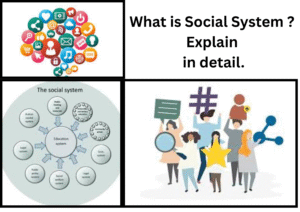
Introduction of Social System
The term ‘system’ implies an orderly arrangement, an interrelationship of parts. In
the arrangement, every part has a fixed place and definite role to play. The parts
are bound by interaction. Society may be viewed as a system of interrelated
mutually dependent parts which cooperate to preserve a recognizable whole and to
satisfy some purposes or goal. Social system may be described as an arrangement
of social interactions based on shared norms and values. Individuals constitute it
and each has place and function to perform within it.
Here we will learn the topic What is Social System? Explain the meaning and features of Social System in detail
Meaning of Social System
It is Talcott Parsons who has given the concept of ‘system’ in modern sociology.
Social system refers to’ an orderly arrangement, an inter relationships of parts. In
the arrangement, every part has a fixed place and definite role to play. The parts
are bound by interaction. System signifies, thus, patterned relationship among
constituent parts of a structure which is based on functional relations and which
makes these parts active and binds them into reality.
Definitions of Social System
1. Talcott Parsons
“A social system is a system of interaction between actors where relationships are guided by shared norms and values.”
2. Charles P. Loomis
“A social system is composed of interacting individuals whose relationships are guided by shared values and common goals.”
3. Kingsley Davis
“A social system may be defined as a set of interrelated roles and norms organized to fulfill important social functions.”
4. Harry M. Johnson
“A social system is an organized set of relationships among individuals and groups in society.”
5. MacIver and Page
“Society is a system of usages, procedures, authority, mutual aid, and many groupings which control human behavior.”
6. Emile Durkheim
Durkheim believed that society functions as a system of interrelated parts where each part contributes to the stability of the whole.
7. Herbert Spencer
Spencer compared society to a living organism in which different parts work together as a system to maintain life.
Features of Social System
-
Interdependence
Different parts of society such as family, education, religion, and economy depend on each other. -
Order and Stability
A social system maintains order and stability in society. -
Social Interaction
Continuous interaction among individuals forms the basis of a social system. -
Cultural Values and Norms
Social behavior is guided by shared values, traditions, and norms. -
Role and Status
Each individual performs certain roles according to their social status. -
Goal-Oriented
Social systems are organized to achieve certain social goals. -
Dynamic Nature
Social systems change over time according to social and cultural developments.
Aims of Social System
-
To maintain social order and harmony.
-
To organize social relationships among individuals.
-
To regulate behavior through norms and values.
-
To ensure cooperation among members of society.
-
To promote social integration and unity.
Objectives of Social System
-
Providing Structure to Society
It gives a structured framework for social interaction. -
Regulating Human Behavior
Social norms and institutions guide people’s behavior. -
Promoting Social Cooperation
Encourages cooperation among individuals and groups. -
Maintaining Social Control
Ensures discipline and order in society. -
Ensuring Social Continuity
Helps transmit culture, traditions, and values from one generation to another.
Importance of Social System
-
Maintains Social Stability
The social system keeps society stable and organized. -
Promotes Social Harmony
It helps reduce conflicts and promotes cooperation. -
Guides Human Behavior
Norms and values guide individuals in their daily life. -
Supports Social Institutions
Institutions like family, education, religion, and government function within the social system. -
Encourages Social Development
A well-organized social system helps society grow and develop.
Characteristics of Social System
1. System is connected with the plurality of Individual actors
2. Aim and Object
3. Order and Pattern amongst various Constituent Units
4. Functional Relationship is the Basis of Unity
5. Physical or Environmental Aspect of Social System
6. Linked with Cultural System
7. Expressed and implied Aims and Objects
8. Characteristics of Adjustment
9. Order, Pattern and Balance
Elements of Social System
1. Faiths and Knowledge
2. Sentiment
3. End Goal or object
4. Ideals and Norms
5. Status-Role
6. Power
7. Sanction
Functions of Social System
-
Adaptation,
-
Goal attainment,
-
Integration,
-
Latent Pattern-Maintenance.
-
Socialization
-
Social Control
-
Regulation of Social Relationships
-
Satisfaction of Basic Needs
-
Maintenance of Social Order
-
Cultural Transmission
-
Social Integration
-
Adaptation to Social Changes