

What is Economic Institution? Explain in Detail.
Introduction of Economic Institution
The economy of any country functions as a social institution that society organizes through the production, distribution, and consumption
of
goods and services. Economic activity deals with goods and services needed to satisfy human wants. It involves the land, capital, labour, and entrepreneurship. The period of Karl Marx, Max Weber, Emile Durkheim, and other sociologists of the 19th and early 20th centuries had
a long and deep interest in economic institutions, especially those that are related to non-economic aspects of social life
such as the family, education, and the state. They provide basic physical subsistence for society and meet needs for food, shelter, clothing, and other necessities of life. These institutions include the production of agriculture and industry and the distribution, exchange, and consumption of commodities, goods, and services
necessary for human survival. Secondary economic institutions are credit and banking systems, advertising, co-operatives, etc.
An economic institution establishes a system or structure within a society that governs the production, distribution, and consumption of goods
and services. An economic institution shapes how society organizes and conducts economic activities, influences how society creates and distributes wealth, and determines
how resources are allocated.
Meaning of Economic Institutions
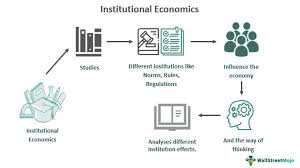
Economic institutions are the set of rules, norms, and organizations guiding economic behaviour in a society. These have been put in place to allow economic transactions and interactions while giving an outline of how economic activities take place. It covers almost all entities from governments, legal systems, markets, and cultural norms shaping the behaviour of an economy.
Here we understand the concept of Importance of Economic Institution
Importance of Economic Institutions
-
Economic Development : Well-functioning economic institutions are crucial for sustained economic growth and development.
-
Social Stability: They contribute to social stability by providing employment, regulating markets, and ensuring fair distribution of resources.
-
Innovation: Economic institutions support technological advancements and entrepreneurship by providing a conducive environment for innovation.
Key Components of Economic Institutions
-
Markets: Markets are venues (physical or virtual) where buyers and sellers engage in the exchange of goods, services, and financial instruments.
-
Property Rights: These are legal rights to own, use, and transfer assets, such as land, buildings, intellectual property, and other resources.
-
Financial Institutions: Financial institutions include banks, insurance companies, and other organizations that provide financial services, such as savings, loans, and investment opportunities.
-
Corporations and Firms: These are business entities that produce goods or services for profit.
-
Labour Unions: Labour unions are organizations formed by workers to protect their rights and interests, particularly in terms of wages, working conditions, and benefits.
Characteristics of Economic Institution
Understanding characteristic of an institution better calls for examining its most defining characteristics. Institutions are characterized by several defining traits that distinguish them from other social constructs:
-
Stability: Institutions are relatively stable over time and provide continuity in the pattern of economic interaction. While they can change to respond to new circumstances, basic principles and structures normally do not.
-
Normative Framework: Institutions define the rules of appropriate behaviour for economic agents in the framework.They establish norms about proper and improper behaviour and decide which behaviours to encourage and which to discourage.
-
Rules and Regulations: In this sense, formal rules and regulations apply to the behaviour of persons in economic institutions. A rule is legal if adopted by the government through enacting a law, whereas an informal rule is formed through customs and traditions.
-
Collective Action: Institutions may be a creation of collective action. Institutional structures result from the group’s ability to cooperate as well as coordinate their collective efforts toward overcoming common barriers and attaining common aims.
-
Path Dependence: The nature of the development of the institutions is path-dependent in that historical decisions and events determine their course of history. Past choices often go a long way in shaping the trajectory of the resultant outcomes to influence the present nature of the institutions.
-
Transaction Costs: Institutes reduce transaction costs with respect to economic transactions as they provide clear-cut rules and frameworks, hence bringing down the uncertainties and risks associated with transactions to lead to economic efficiency.
-
Cultural Context: Economic institutions are located in cultural contexts that reflect the prevailing values, beliefs, and practices of the societies they serve. This cultural dimension, in turn, influences how institutions work and how people use them
Features of Economic Institutions
-
It has an independent and legal entity.
-
It seeks to perform the function for which society founded it, because it has the capacity to carry out production.
-
It Should Have the ability to survive; it’s the continuation of the institution by obtaining adequate funding, adapting to political conditions, and interest in adequate employment; thereby contributing to its ability to adapt to volatile and changing circumstances.
-
Each institution defines its programs and methods of work, sets specific goals, and strives to achieve them.
-
It’s concerned with the provision of financial resources; for the continuation of its own operations, obtains these resources through financial revenues and loans, or combines all or some of these elements in accordance with the circumstances of the institution.
-
They adapt to their surroundings to perform their tasks in the best circumstances; if they don’t adapt to the environment,
obstacles may hinder their operations and objectives.
Functions of Economic Institutions
-
Resource Allocation: Economic institutions help allocate resources efficiently, deciding how land, labour, and capital are used to produce goods and services.
-
Distribution of Wealth: They influence how income and wealth are distributed within a society, affecting economic inequality and social mobility.
-
Regulation and Stability: Economic institutions establish rules and regulations that maintain economic stability, prevent fraud, and protect consumers and investors.
-
Innovation and Growth: By protecting property rights and providing capital, economic institutions encourage innovation, entrepreneurship, and economic growth.
-
: They play a role in ensuring social welfare by providing public goods, social security, and support for the unemployed or disadvantaged.
Role of Economic Institutions in Development
Economic institutions play an essential role in economic development. The efficiency and productivity of these institutions can result in the difference between one’s economy being a success story or a failure story. There are various ways by which economic institutions contribute to development:
-
Enhancing economic efficiency: A well-functioning set of economic institutions lowers the transaction cost, increases trade, and improves the reallocation of resources. They enhance market efficiency by having rules and regulations in place.
-
Fostering innovation: It promotes innovation by having an institution that supports research and development, intellectual property rights, and entrepreneurship. The environment here is fertile enough for the growth of new ideas to flourish and take the economy forward.
-
Investment Promotion: A strong economic institution will increase investor confidence by protecting property rights and enforcing contracts effectively. Such a situation will attract more domestic and foreign investment, which is an important source of economic growth.
-
Economic Institutions to Reduce Inequality: The economic institutions are expected to reduce income inequality by ensuring fair competition, education, and social protection. The more the inclusion of the marginalized groups by the institutions, the greater the possibility of equitable economic outcomes.
-
Stabilizing economy: Effective economic institutions help to stabilize the economy during any crisis. Through them, policymakers outline frameworks for both monetary and fiscal policies that allow government systems to easily respond to economic shocks and ensure long-run stability.
-
Sustainable development: Economic institutions are the backbone of any economy; they determine the behaviour of individuals and organizations while finally affecting the performance of an economy. Their characteristics—stability, normative framework, or rules—define how people ought to conduct economic activity. Thus, understanding economic institutions plays a critical role in discussing economic systems and their progress.
Types of Economic Institutions
Different types of economic systems define how economic institutions organize economic activities:
-
Capitalist Economy: It is an economic system which is based on private ownership of the means of production and distribution in which individuals are free to accumulate and invest capital. The state only plays a minor 93 role in the marketplace, mainly controlling monopoly and exploitation. E.g. The United States, and Germany.
-
Socialist Economy: Socialism is a political and economic ideology that advocates for collective or governmental ownership and control of the means of production, distribution, and exchange of goods and services. Socialism aims to achieve social equality, reduce economic disparities, and ensure that society distributes wealth and resources more equitably among the population. In socialism, people collectively own the natural resources and the means of producing goods and services. E.g. Cuba, and North Korea.
-
Mixed Economy: A mixed economy is an economic system that combines elements of both capitalism and socialism. It features a blend of private and public ownership, market-driven activities, and government intervention. This system allows for the coexistence of private businesses and state enterprises, aiming to balance the efficiency of free markets
-
with the social welfare objectives of government oversight. E.g.: Sweden, France.
-
Traditional Economy: A traditional economy is an economic system rooted in long-standing customs, traditions, and beliefs. “We typically find it in rural, agrarian societies where traditions passed down through generations guide economic activities. This type of economy often relies on subsistence farming, hunting, fishing, and gathering, with little emphasis on surplus production or