
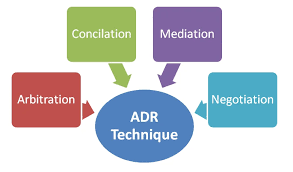

What is an Alternative Dispute Resolution?
Introduction of ADR
• Alternative Dispute Resolution (ADR) is a technique to resolve disputes and disagreements between the parties by arriving at an amenable settlement through negotiations and discussions.
• The ADR mechanism offers to facilitate the resolution of matters of business issues and the others where it has not been possible to initiate any process of negotiation or arrive at a mutually agreeable solution.
• In India, ADR is established on the basis of Article 14 (Equality before law) and Article 21 (Right to life and personal liberty) under the Constitution of India.
• The Directive Principles of State Policy (DPSP) of Equal justice and free legal aid as engraved in Article 39-A of the Indian Constitution can also be achieved by the ADR.
Characteristics of ADR
-
Voluntary Process – In most ADR methods (like negotiation, mediation), parties choose to participate freely and can withdraw if they are unsatisfied.
-
Neutral Third Party – A neutral mediator, conciliator, or arbitrator helps guide or decide the matter without favouring either side.
-
Flexibility & Informality – ADR has fewer rigid procedures than courts; the process can be adapted to suit the needs of the parties.
-
Confidentiality – Proceedings and outcomes are usually private, protecting sensitive business or personal information.
-
Cost-Effective & Time-Saving – ADR avoids lengthy litigation, reducing legal fees and resolving disputes faster.
-
Mutual Agreement & Control – In methods like mediation, parties retain control over the outcome, leading to more satisfactory settlements.
-
Preservation of Relationships – ADR encourages dialogue and compromise, helping maintain business, workplace, or personal relationships.
-
Enforceability (in some forms) – Arbitration awards, for example, are legally binding and enforceable by courts.
-
Expertise – Parties can select mediators or arbitrators with specialized knowledge relevant to the dispute.
-
Less Adversarial – Focuses on cooperation and problem-solving rather than winning or losing.
Importance of ADR in Indian law
-
Reduces Court Burden – Indian courts are heavily backlogged; ADR helps settle many disputes outside, easing judicial workload.
-
Faster Resolution – ADR procedures (arbitration, mediation, conciliation, Lok Adalat’s) resolve matters more quickly than lengthy litigation.
-
Cost-Effective – Parties save substantial court and lawyer fees, making justice accessible, especially for small disputes.
-
Promotes Access to Justice – ADR (especially Lok Adalat’s under the Legal Services Authorities Act, 1987) provides affordable and approachable forums for weaker sections.
-
Confidential & Flexible – Business and family disputes benefit from privacy and flexible procedures.
-
Encourages Settlements & Harmony – Focus on consensus, preserving business, family, and community relationships.
-
Legal Recognition –
-
Section 89 of the Code of Civil Procedure, 1908 empowers courts to refer disputes to ADR.
-
Arbitration & Conciliation Act, 1996 gives statutory backing to arbitration and conciliation.
-
Legal Services Authorities Act, 1987 institutionalizes Lok Adalat’s.
-
-
Supports Economic Growth – Quick resolution of commercial disputes builds investor confidence and improves the “ease of doing business.”
-
Reduces Litigation Costs for Government – Government departments increasingly adopt ADR to avoid prolonged litigation.
-
Global Alignment – Strengthens India’s compliance with international arbitration standards, boosting cross-border trade and investment.
Objectives of Alternative Dispute Resolution (ADR)
-
Speedy Justice – Resolve disputes faster than traditional court litigation.
-
Reduce Court Backlog – Divert suitable cases from crowded courts, easing the judiciary’s load.
-
Cost-Effective Resolution – Minimize legal fees and procedural costs for parties.
-
Accessible & Inclusive – Provide simple, user-friendly forums so that even weaker sections can seek justice.
-
Promote Amicable Settlements – Encourage cooperation, compromise, and preservation of business or personal relationships.
-
Confidentiality – Keep sensitive commercial or family matters private.
-
Flexibility of Procedure – Allow parties to design procedures that suit their needs.
-
Specialized Expertise – Permit appointment of mediators or arbitrators with technical knowledge.
-
Strengthen Public Confidence – Offer fair, impartial, and reliable alternatives to litigation.
-
Support Economic Growth – Quick resolution of commercial disputes improves investor and business confidence.
Advantages of ADR
• It is more viable, economic, and efficient because the procedural flexibility saves valuable time and money and there is no stress of a conventional trial.
• Helping maintain confidentiality as the resolution of disputes takes place usually in private.
• The possibility of ensuring that specialized expertise is available on the tribunal in the person of the arbitrator, mediator, conciliator, or neutral adviser.
• The result is often creative solutions, sustainable outcomes, greater satisfaction, and improved relationships.
• Further, it offers greater direct control over the outcome. Personal relationships may also suffer less.
Disadvantages of ADR
While ADR has various advantages, there are also some possible disadvantages to take into account. Some of the disadvantages that may occur when applying ADR mechanisms for conflict resolution are discussed below.
1. Absence of Legal Precedent
Unlike the decisions of courts, ADR does not form legal precedents. This implies that parties wishing to create a legal principle cannot do so through ADR. Courts have a significant role in developing the law, but ADR is concerned only with the resolution of the immediate dispute. Therefore, ADR might not be appropriate for cases that need legal clarification or the creation of new legal principles.
2. Limited Remedies
ADR can also lack the legal remedies of typical litigation. At times, the settlement that occurs through ADR is not enforceable by law. For example, mediation contracts are hard to enforce if the party chooses to ignore the agreement. Although arbitration can be binding, the available remedies in ADR tend to be limited when compared to the remedies that are available in court.
3. Risk of Unbalanced Power
ADR processes at times can favour the stronger party, particularly during negotiations. If one party possesses greater resources or bargaining leverage, they can bully the weaker party into accepting an unjust settlement. This can negate the process’s fairness. Even though mediators are taught how to manage these situations, the risk of unequal power is always present.
4. No Automatic Resolution
ADR is not automatic. Although most ADR proceedings are successful, there are some cases in which the parties will not reach a resolution. Mediation, for example, is voluntary, and if the parties are unable to agree, the case will remain unresolved. If the proceeding does not work, the parties may end up litigating after all, which negates the use of ADR to begin with.
5. Absence of Legal Representation
In ADR processes, such as mediation, for example, representation by legal counsel is frequently absent. This is disproportionality starkly so for those who do not have prior opportunity to get acquainted with the legal issues involved in the matter. The existence of such disparity can lead to unequal settlements or decisions.
6. Not For All Disputes
ADR is not appropriate for all disputes. Formal legal processes are often required in certain cases, such as criminal accusations or intricate issues of law. ADR may be inappropriate in issues that entail public accountability or issues of momentous legal doctrine. In those situations, litigations based on traditional litigation are usually preferred.
Types of Alternate Dispute Resolution mechanisms
1. Arbitration
Under this form of Alternative Dispute Resolution mechanism, both the parties involved in the dispute, choose the person to hear and determine their dispute through a consensus. The objective of arbitration is to arrive at a fair resolution through an unbiased tribunal speedily and in a cost-effective manner.
2. Conciliation
Under the process of conciliation, the intention is to facilitate the settlement between the parties. However, conciliation does not oblige or bind the parties, and they may continue negotiations until they arrive at a mutually pleasing settlement. An impartial individual termed the conciliator handles the process. He actively participates in conciliation by discussing the issues, negotiating, and bringing about an amicable settlement
3. Mediation
A mediator assists the parties in dispute to reach an agreement. The parties in dispute themselves set the conditions of the settlement. The third-party does not impose any decisions on the parties but merely acts as a facilitator involved in improving the dialogue between the parties.
4. Lok Adalat’s
The Legal Services Authorities Act 1987 established the Lok Adalat system of dispute settlement to expedite dispute resolution. Lok Adalat’s amicably settle disputes even at the pre-litigation stage.