
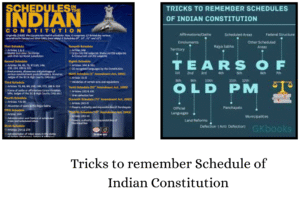
Tricks to Remember 12 Schedules of the Indian Constitution
Schedules in Indian Constitution
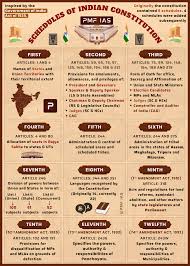
Schedule – 1 -: Name of Indian State and Territories
14 States – 28 States
6 Union Territories – 8 Union Territories
2nd Schedule -: Enrolments and Salary of different officials.
-
President
-
Vice – President
-
Governor
-
Council of Minister
-
Comptroller & Auditor General Salary
-
Attorney General
3rd Schedule -: Affirmation & Oath
4th Schedule -: Allocation of Rajya Sabha
5th Schedule -: Special Provision for SC & ST
6th Schedule-: Special Provisions for 4 States
-
Assam
-
Tripura
-
Meghalaya
-
Mizoram
7th Schedule -: Federal List of Constitution
-
Union List
-
State List
-
Concurrent List
8th Schedule -: Official Language of Indian it currently recognizes 22 languages.
-
21st CAA,1967 -: Sindhi
-
71st CAA, 1992 -: NMK — Nepali , Manipuri and Konkari (Goa)
-
92nd CAA, 2003 -: BDMS — Bade(Nagaland), Dongri(Jammu & Kashmir), Maithli(Bihar) and Santhali( Jharkhand)
9th Schedule -: Laws of Land Reforms .
1st CAA 1951
Schedule – 10 -: Anti Defection Law
52nd CAA, 1985
The 52nd Amendment Act of 1985 introduced the “Anti-Defection Law” to the Indian Constitution, adding the Tenth Schedule to curb political defections. It aimed to prevent instability caused by legislators switching parties for power, stipulating that members voluntarily leaving their party or defying party whips can be disqualified.
11th Schedule -: Panchayati Raaj
73rd CAA, 1992
The 73rd Constitutional Amendment Act of 1992 granted constitutional status to Panchayati Raj Institutions (PRIs) in India, establishing a mandatory three-tier structure (village, intermediate, district) and strengthening grassroots democracy. It added Part IX (“The Panchayats”) and the Eleventh Schedule (29 subjects) to the Constitution.
12th Schedule -: Muncipalities