Discuss the concept of Non-alignment of India. What are the reasons for which India had adopted a policy of non-alignment ? Describe the chronicles of the launching of the Non-alignment Movement in brief.
Discuss the concept of Non-alignment of India. What are the reasons for which India had adopted a policy of non-alignment ? Describe the chronicles of the launching of the Non-alignment Movement in brief.
Discuss the concept of Non-alignment
The concept of non-alignment of India is its contribution to international relations.
Discuss the concept of Non-alignment
Jawaharlal Nehru announced the policy soon after taking over charge as interim Prime Minister, and he developed it into the concept of non-alignment.
Discuss the concept of Non-alignment
People say it is directly related to the Cold War, which commenced as soon as the Second World War ended.
Discuss the concept of Non-alignment
The term Cold War described the acute tension that developed between two erstwhile allies, the United States of America and the Soviet Union.
Discuss the concept of Non-alignment
The Second World War ended in 1945 and immediately thereafter a conflict, that was simmering within the Allied camp, came out in the open. The Allies (Britain, France, the United States, the Soviet Union and others) won a decisive war against Germany, Italy and Japan. But, the victors could not permanently forget their ideological differences, and the Cold War was the outcome. It was a strange war, a war fought without weapons and armed forces, a war of nerves, a war diplomatically fought between two hostile camps. The two camps, or blocs
Discuss the concept of Non-alignment
(i) The United States led the capitalist, Western, or democratic bloc.
(ii) The Soviet Union led the socialist, Eastern, or Soviet bloc.
Discuss the concept of Non-alignment
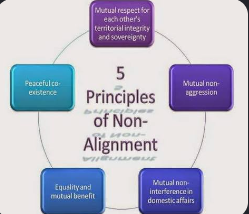
The policy of non-alignment was to keep away from bloc politics, maintain friendship with both, and military alliance with none, and evolve an independent foreign policy.
Nehru had made it clear on September 7, 1946 that, “We shall make history of our choice.”
He had added: “We propose, as far as possible to keep away from the power politics of groups, aligned against one another, which have led in the past two’ world wars and which may again lead to disasters on an even vaster scale.”
Discuss the concept of Non-alignment
Later, in 1947, he said that India did not belong to any of the power blocs. India’s policy of non-alignment is a positive, or dynamic, neutralism, in which a country acts independently, and decides its positions on each international issue on the merit of the case. Non-alignment, according to Professor Mahendra Kumar, is one of those phenomena of international politics which appeared on the international scene after the Second World War and which represents an important force in shaping the nature of international relations.
Explaining the Indian view, Professor M.S. Rajan writes: “non- alignment essentially consists in the retention of a substantial measure of freedom of policy and action in international affairs… especially in relation to the policies and postures of the two Super Powers…” He says that, “additionally non-alignment stands for abstention from power politics, for peaceful co-existence and force active international cooperation among all states-aligned and non-alignment.” The emphasis here is on enjoyment of freedom of policy and action by a non-alignment country. It Promotes international peace, security and cooperation.
Thus KP. Misra says, “dissociation from bloc politics or military alliances became the focal point of non-alignment.”
India adopted non-alignment (and later other countries adopted it) as an instrument, or means, of foreign policy in order to ensure fuller meaning and content to our newly achieved political independence. Freedom from the colonial role was important, but not enough achievement. Promotion of India’s national interest depended largely on “accelerated socio-economic development.” of the country. As K.P. Misra states that they considered international peace essential to achieving this objective. They opposed the Cold War, bloc politics, and power politics because they viewed them as harmful to international peace.Thus, decision-makers established non-alignment as a well thought out and well planned policy. Its ultimate objective was promotion of national interest, which included not only protection of India’s sovereignty and territorial integrity, but also socio-economic development of the Third World in general and India in particular, and international peace and security.
According to Professor V.P. Dutt, “Non-alignment became the logical framework of India’s foreign policy. An independent foreign policy responded to the conscious and sub-conscious urges of the people, imported a sense of pride and belonging and helped cement the unity of the country….” Such was the value of non-alignment that a large number of countries who became independent and desired, like India, to maintain their political freedom and accelerate their economic development readily adopted the policy of non-alignment.
India’s Policy of Non-alignment
India, under the leadership of Jawaharlal Nehru was the first country to have adopted the policy of non-alignment.
India’s policy is positive or dynamic neutralism in which a country acts independently and decides its policy on each issue on its merit. Nehru had declared in the US. Congress in 1948, “Where freedom is menaced, or justice is threatened, or where aggression takes place, we can not be and shall not be neutral our policy is not neutralist but one of active endeavour to preserve and, if possible, establish peace on firm foundations.”
Commenting on India’s foreign policy, K. M. Panikkar had said, “She has been able to build up a position of independence and, in association with other states similarly placed, has been able to exercise considerable influence in the cause of international goodwill.” In a way, this policy promotes Gandhiji’s belief in non-violence. The critics in carly days had said that India’s policy was to remain “neutral on the side of democracy.” Speaking in the Constituent Assembly (Legislative) on December 4, 1947, Nehru had sought to remove the impression that India’s non-alignment also meant neutrality. He had said:
“We have proclaimed during this past year that we will not attach ourselves to any particular group. This has nothing to do with neutrality or passivity or anything else. If there is a big war, there is no particular reason why we should jump into it.
We are not going to join a war if we can help it,
and we are going to join the side
which is to our interest when the time comes to make the choice.”
India wanted to prevent the third world war.
Nehru said: “If and when disaster comes it will
affect the world as a whole Our first effort should be to prevent that disaster from happening.”
Reiterating India’s resolve to keep away from power blocs,
he said in 1949, “If by any chance we align
ourselves definitely with one power group, we may perhaps from one point of view do some good, but
I have not the shadow of doubt that from a larger
point of view, not only of India but of world peace, it will do harm.
Because then we lose that tremendous vantage
ground that we have of using such influence as we possess… in the cause of world peace.”
India’s foreign policy has always prioritised the
country’s economic development, independence
in foreign affairs, protection of its sovereignty and territorial integrity, and the maintenance of world peace.
India firmly believes that it can achieve
these objectives only by staying away from power blocs and retaining the freedom to make independent foreign policy decisions.
Nehru supported the Western concepts of liberalism and democracy.
But, he did not approve of the military alliances
like NATO and SEATO initiated by the United States to contain communism.
He opposed western alliances on the ground that
they encouraged new form of colonialism and also
because these were likely to promote countermoves and race for armaments between the two camps.
Nehru was impressed by socialism and strongly advocated the idea of democratic socialism. But, he totally rejected the communist state as “monolithic” and described Marxism as an outmoded theory. Nehru was c combination of a socialist and a liberal democrat. He was opposed to the very idea of power blocs in international relations.
India’s policy of non-alignment, therefore, was not to promote a third bloc, but to ensure freedom of
decision-making of the recently decolonised states. Non-alignment was promoted by India as a policy of peace, as against the policy of confrontation.
India’s policy of non-alignment was against the status quo situation in international relation.
That meant opposition of colonialism, imperialism, racial discrimination and now of neo-colonialism. India wants a world free from these evils. Secondly, non-alignment rejects the concept of superiority of Super Powers. It advocates sovereign equality of all states. Thirdly, non-alignment encourages friendly relations among countrics.
it is opposed to the alliances that divide the world into groups of states, or powers blocs. Non-alignment advocates peaceful settlement of international disputes and rejects the use of force. It favour complete destruction of nuclear weapons and pleads for comprehensive disarmament. It supports all efforts to strengthen the United Nations. India’s policy of non-alignment emphasises the social and economic problem of mankind. India has been fully
supporting the demand for a new international economic order so that the
unjust and unbalanced existing economic order may be changed into a new and just economic order.
Reasons for adopting Non-Alignment Policy by India
Discuss the concept of Non-alignment
India has adopted the policy of non-alignment as it did not
Discuss the concept of Non-alignment
want to lose it freedom of decision-making, and because india’s primary concern soon after independence was economic development. The policy has been sustained for five decades. Professor M.S. Rajan had mentioned seven reasons for adopting this policy initially.
Discuss the concept of Non-alignment
Firstly , it was felt that India’s alignment with either the US or the
USSR bloc would aggravate international tension, rather than
Discuss the concept of Non-alignment
that in view of size, geopolitical importance and contribution to civilisation.
India had “a positive role
Discuss the concept of Non-alignment
to play in reducing international tension, promoting peace and serving as a bridge between the two camps.”
Discuss the concept of Non-alignment
Secondly , India was neither a great power, nor could she
Discuss the concept of Non-alignment
allow herself to be treated as a nation of no consequence. India was, however, potentially a great power. Non-alignment suited India’s “present needs to keep our national identity” and on the other hand not to compromise “our future role of an acknowledged Great Power.”
Discuss the concept of Non-alignment
Thirdly, India could not join either of the power blocs because of emotional and ideological reasons. We could not join the Western (American) Bloc because many of its members countries were colonial powers or ex-colonial powers, and some still practised racial discrimination. We could not join the Eastern (Soviet) Bloc because communism, as an ideology, was completely alien to Indian thinking and way of life.
Discuss the concept of Non-alignment
Fourthly , like any sovereign country, India, who had just become sovereign wanted to retain and exercise independence of judgement and not to “be tied to the apron-strings of another country.” It meant that India wanted freedom to decide every issue on its merit.
Discuss the concept of Non-alignment
Fifthly, according to Professor Rajan, once India launched economic development plans, we need foreign economic aid “it was both desirable politically not to depend upon aid from one bloc only, and profitable to be able to get it from more thavn one source.”
Discuss the concept of Non-alignment
Sixthly , non-alignment is in accordance with India’s traditional belief that “truth, right and goodness” are not the monopoly of any one religion or philosophy. India believes in tolerance. Therefore, the world situation called for tolerance and peaceful co-existence of both the systems, with India not aligning with any of the blocs, nor being hostile to them.
Discuss the concept of Non-alignment
Lastly , the domestic political situation was also responsible for the adoption of the policy of non-alignment. According to Professor Rajan “By aligning India with either of the Blocs, the Indian Government would have sown seeds of political controversy and instability in the country….”
Discuss the concept of Non-alignment
Whatever the actual reasons that may have promoted Nehru and his Government to adopt the policy of non-alignment, it is obvious that the people of India by and a large supported the policy. Many other countries found it in their national interest to adopt this policy which led to the establishment of the Non-Aligned Movement.
Discuss the concept of Non-alignment
India was largely responsible for launching the Non-aligned Movement (NAM) in 1961. It was initiated by Nehru, Yugoslav President Tito and Egyptian President Nassr. Twenty five countries attended the First NAM Conference held at Belgrade and presided over by Tito. Invitations were sent out by Nehru, Nasser and Tito after careful scrutiny of foreign policies of proposed participants of the first NAM Summit. The five criteria for joining NAM were:
Discuss the concept of Non-alignment (i) the country followed independent foreign policy based on non-alignment and peaceful co-existence.
(ii) the country was opposed to colonialism and imperialism;
Discuss the concept of Non-alignment
(iii) it should not have been a member of a Cold War related military bloc;
Discuss the concept of Non-alignment
(iv) it should not have had a bilateral treaty with any of the Super Powers; and
Discuss the concept of Non-alignment
(v) NAM should not have allowed any foreign military base on its territory.
The Non-Aligned Movement (NAM) has expanded both quantitatively and qualitatively. By 1996, it had 113 member countries. NAM holds periodic summits where member states discuss international political issues and attempt to develop a common approach to various matters.
Discuss the concept of Non-alignment
However, the large number of members often makes it difficult to adopt a common approach that all countries can follow.
Discuss the concept of Non-alignment
Between 1961 and 1995, NAM held eleven summits. The last two summits, held in Jakarta (1992) and Cartagena (1995), took place after the end of the Cold War, the disintegration of the former Soviet Union, the completion of decolonisation with Namibia’s independence, and the end of apartheid in South Africa.
Discuss the concept of Non-alignment
NAM gradually lost some of its enthusiasm and influence after the end of the Cold War, although various leaders continue to emphasise its relevance.